Airbus delivers first aircraft from 2nd A320 assembly line in Tianjin to China Eastern Airlines
Delivery capability inseparable from support of China's resilient supply chain: executive
By and Chen Zishuai in Tianjin Published: Sep 16, 2026 09:42 AM

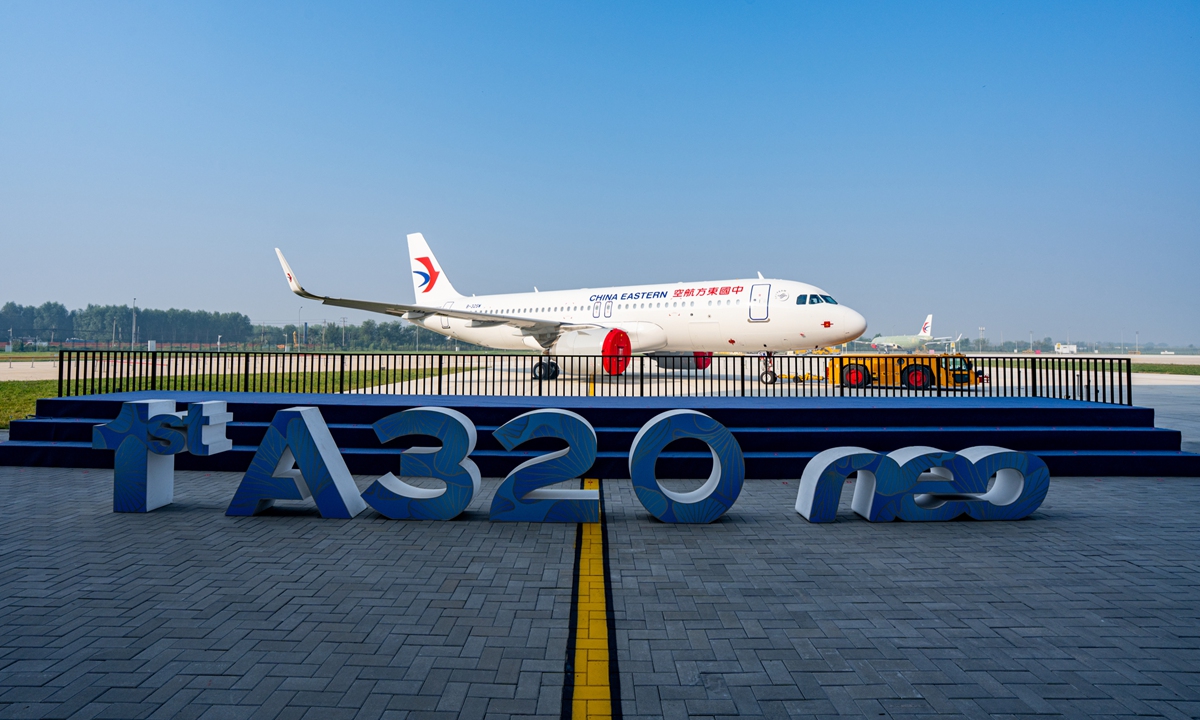
Airbus has delivered the first A320 Family aircraft assembled at its second Final Assembly Line (FAL) located in Tianjin, North China, an A320neo plane to China Eastern Airlines on September 16, 2026. Photo: Courtesy of Airbus China
Airbus delivered the first aircraft assembled at its new Final Assembly Line (FAL) for A320 family aircraft in North China's Tianjin Municipality on Wednesday, a milestone in Airbus' industrial footprint expansion in China and across its global industrial system, the company said.
Erik Buschmann, chief operating officer of Airbus China, highlighted the importance of China's supply chain, and said that Airbus' delivery capability is inseparable from the support of China's resilient supply chain and its close cooperation with excellent partners.
He also said that China is Airbus' largest single-country market globally, and he noted that the Chinese market has strong competitiveness and a forward-looking innovation environment, so Airbus chooses to continue investing in China to better serve the Chinese market and meet its growing and robust demand.
China Eastern Airlines took delivery of the A320neo aircraft. To celebrate the event, Airbus China arranged a lion dance performance with Chinese characteristics, and many guests emphasized the importance of the Chinese market in their speeches and described the delivery as an "important milestone" in Airbus' development in China, the Global Times observed.
"Today's delivery also represents a vital leap forward in Airbus' global industrial footprint. As we drive toward a global production rate of 75 aircraft per month, this second line in Tianjin is far more than just one of our 10 final assembly lines worldwide - it is an indispensable pillar of Airbus' global delivery network, backed by a resilient ecosystem of around 200 local suppliers," Philippe Mhun, executive vice president for programs and services of the commercial aircraft business at Airbus, said in video speech made at the ceremony.
From major component manufacturing to this new assembly line, and onward to our Aircraft Lifecycle Services Centre in Chengdu, Airbus has established a complete, end-to-end industrial layout in China covering the entire industrial chain, Mhun added.
He Xiaoqun, vice president of China Eastern Airlines, said that the two companies have cooperated for more than four decades, with their partnership expanding from aircraft acquisition to fields such as operational support, maintenance engineering, and technical services.
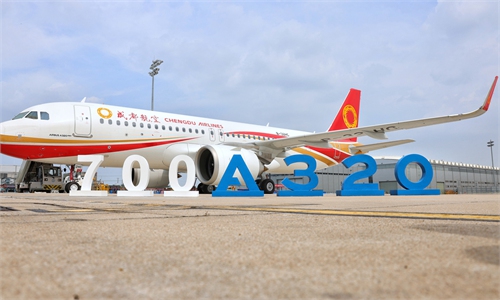
Since the inauguration of the first FAL in Tianjin in 2008, Airbus' first commercial aircraft assembly line outside Europe, the facility has assembled and delivered more than 800 A320 Family planes.
The second assembly line, inaugurated in October 2025, will enable Airbus to significantly increase production to the benefit of customers in China and beyond, the company said.
The second line also complements the global Airbus production network of 10 Final Assembly Lines - four in Hamburg (Germany), two in Toulouse (France), two in Mobile (US), and two in Tianjin (China).
The global aviation industry faces challenges such as supply chain fluctuations and delivery pressure, while international aviation giants represented by Airbus are placing increasing emphasis on, and growing their trust in and reliance on, the resilience of China's supply chain.
Buschmann said that looking back over the past 10 to 15 years, China initially accounted for a relatively small share of Airbus' supply chain, but today, China's share of the supply chain has become very large, and this proportion is still rising.
Now that Airbus has put forward a production increase plan, we hope that China's supply chain can also take another big step forward. We are constantly looking for new Chinese suppliers and hope they can join in to enhance the resilience and reliability of the aviation industry's supply chain, he said on Wednesday.
The potential and demand of China's aviation market also provide broad development opportunities for aircraft manufacturers.
According to Airbus' latest Global Market Forecast released earlier this month, the Chinese market will need 8,830 new passenger aircraft over the next two decades. This massive figure accounts for more than 20 percent of the total global demand for 42,060 new passenger planes for the same period.
Guo Jia, a veteran industry analyst, told the Global Times that second assembly line will significantly accelerate the delivery of Airbus' mainstream aircraft models in China and the broader Asia-Pacific region, and promote further in-depth cooperation between China and the EU in the aviation sector.
China's civil aviation industry is rising rapidly, and the mass production and delivery capabilities of domestically produced large aircraft are steadily improving.
When asked how Airbus views its competitive and cooperative relationship with China's aviation industry, Buschmann said that China's large civil aircraft is "a very valuable and strong competitor" in the aviation industry. He believes that healthy competition is conducive to the common growth of the entire industry.
"Airbus grew up in a competitive environment. We welcome competition, as it drives us to keep developing and improving."
RELATED ARTICLES