Airbus delivers 800th Chinese-built A320 Family aircraft, demonstrating pledge to deepen strategic partnerships in China: company
By Published: Dec 17, 2025 05:26 PM

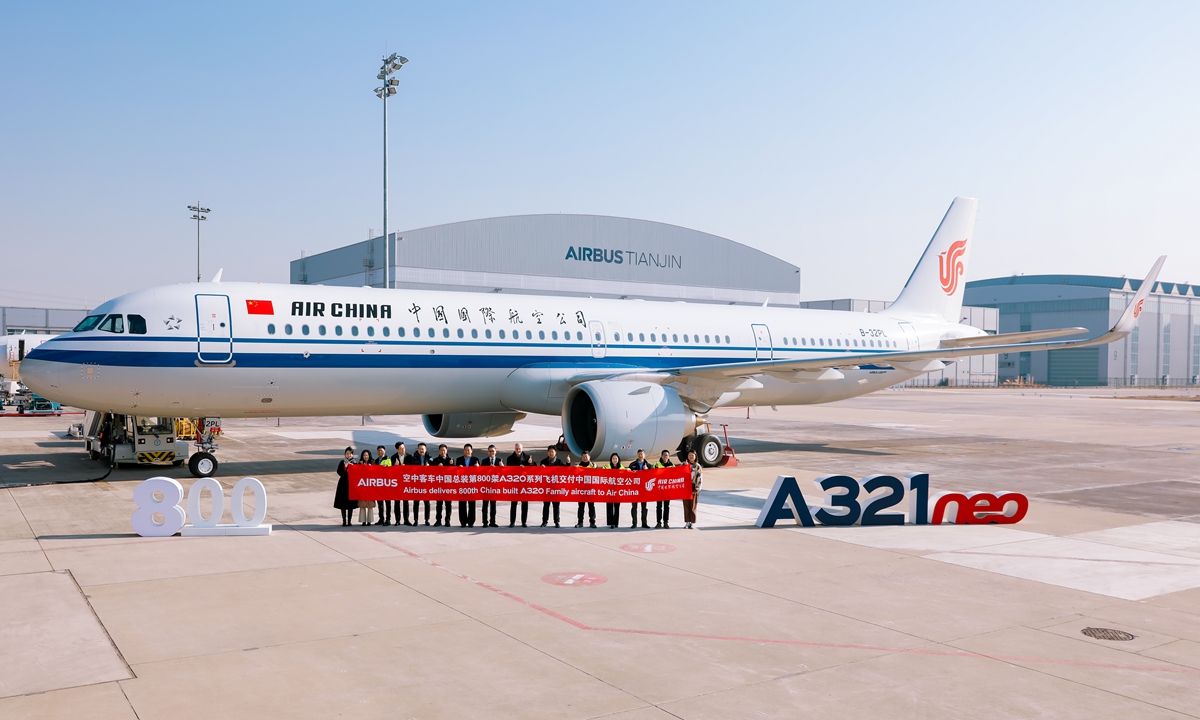
A delivery ceremony of 800th China built A320 Family aircraft held in Airbus Tianjin plant in North China's Tianjin Municipality on December 17, 2025 Photo: Courtesy of Airbus China
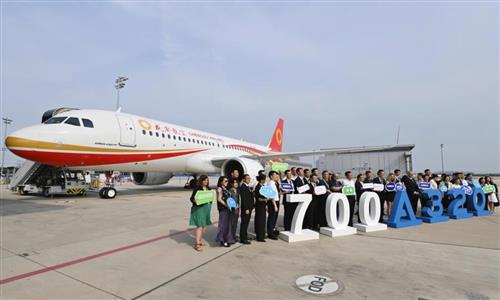
Airbus said on Wednesday that it has delivered its 800th A320 Family aircraft assembled at its Final Assembly Line (FAL) in North China's Tianjin Municipality, further exemplifying the EU plane manufacturer's deepening integration with the Chinese aviation supply chain.
The aircraft, an A321neo, was handed over to Air China.
The 800th A320 Family aircraft assembled in Tianjin is a milestone that demonstrates Airbus' ongoing pledge to deepen strategic partnerships in China, reinforcing our 40 years of commitment to the country, George Xu, Airbus executive vice-president and Airbus China CEO, was quoted as saying in a press release sent to the Global Times on Wednesday.
Airbus teams in China remain dedicated to supporting the global A320 Family ramped-up plan of assembling 75 aircraft per month in 2027, he added.
The 800 aircraft assembled in the Chinese factory highlight the resilience of the supply chain of China's aviation industry, Qi Qi, a veteran market watcher, told the Global Times on Wednesday.
Qi noted that the global aviation supply chain had long been more developed in Europe and America, owing to the earlier maturation of the manufacturing industry in those markets. For years, major civil aircraft producers like Boeing and Airbus depended heavily on suppliers from those regions.
Yet since Airbus established its FAL in China, a growing share of aircraft components assembled locally have been sourced from within the country. Airbus' systematic cooperation with China's aviation sector continues to widen and deepen, increasingly integrating China's aviation supply chain into global aircraft manufacturing, according to the expert.
"China is not merely a market," Qi added. "It is an indispensable part of Airbus' supply chain and a vital component of the global aviation supply network."
The delivery aligns with Airbus' broader expansion strategy within the Chinese market.
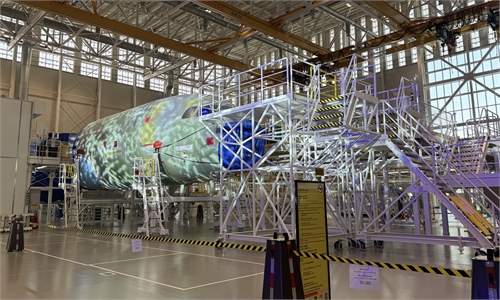
Inaugurated in 2008, the FAL in Tianjin was the first Airbus production line for commercial aircraft outside Europe. It has been successfully operating for more than 17 years, making the facility a symbol of successful Sino-European cooperation.
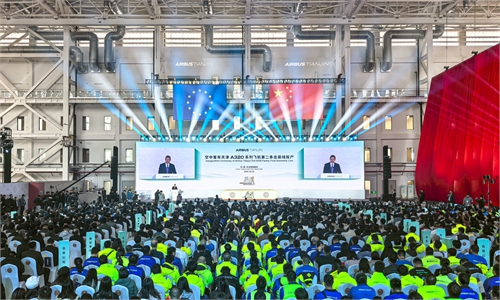
In October 2025, Airbus opened its second FAL for the A320 Family aircraft in Tianjin. It complements the global Airbus production network of 10 FALs - four in Hamburg, Germany, two in Toulouse, France, two in the US and two in Tianjin.
Last year, 25 percent of the aircraft that were assembled in Tianjin were delivered outside of China, including to Europe, Asia and the Middle East, according to information Airbus provided to the Global Times.
However, it is a fact that today's aviation industry supply chain has failed to keep pace with the accelerated demands of industrial progress.
On December 9, the International Air Transport Association (IATA) updated its analysis of aerospace supply chain bottlenecks, noting that aircraft availability remains one of the most significant constraints on industry growth.
While deliveries of new aircraft began to pick up in late 2025 and production is expected to accelerate in 2026, demand is forecast to outstrip the availability of aircraft and engines. The normalization of the structural mismatch between airline requirements and production capacity is unlikely before 2031-2034 due to irreversible losses on deliveries over the past five years and a record-high order backlog, the IATA said.
Xu from Airbus China said in June in an interview with the Global Times that even in 2025, Airbus' delivery levels still had not returned to the peak achieved in 2019, largely attributable to supply chain constraints.
The supply chain must be strengthened and gaps must be filled to make it more robust, Xu said, adding that in this process, it is undeniable that China's traditional suppliers, such as Aviation Industry Corp of China, as well as numerous private enterprises, have demonstrated strong competitiveness.
Building on this competitiveness, we must deepen cooperation with these suppliers, aiming for mutually beneficial outcomes with China's supply chain. I am confident that China's supply chain will play a vital role in reinforcing and strengthening the global aviation supply chain, he said.
RELATED ARTICLES