China’s sea-launched rocket sets new record, sending 9 satellites into orbit in a single mission
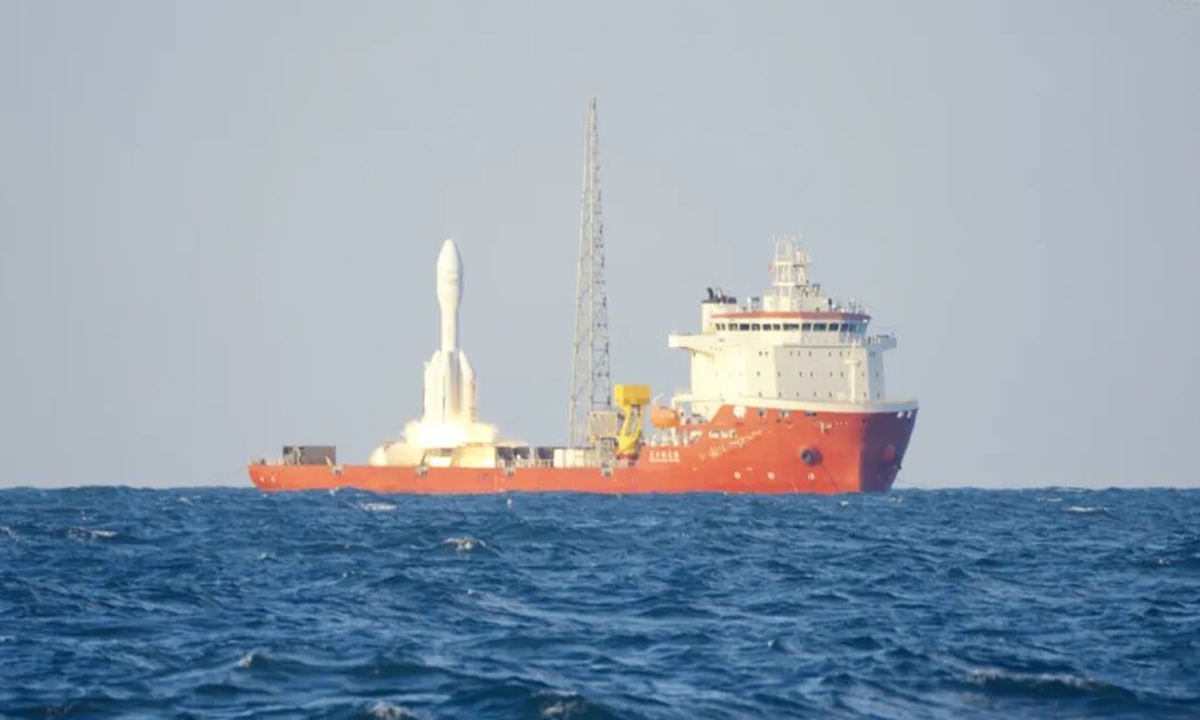
Photo: Science and Technology Daily
China launched nine satellites into pre-set orbits on Wednesday from waters off the coast of Shanghai in east China, setting new records for both the heaviest payload and the highest orbital altitude achieved in a single maritime launch, the Science and Technology Daily reported on Wednesday.
The Gravity-1 Y3 carrier rocket, developed by Orienspace, placed eight Qianfan Constellation satellites and one EUHT technology test satellite into their planned orbits with a complete success. The mission marks the world's first sea-based mobile launch of a low-Earth-orbit broadband internet constellation networking mission, said the report.
The flight set new Chinese records for both the heaviest payload and the highest orbital altitude achieved in a single maritime launch. The net payload mass exceeded 3 tons and the insertion altitude reached 800 kilometers, demonstrating that the sea-launch mode is fully capable of handling medium-to-large satellite payloads.
This was Orienspace's first launch dedicated to a mega low-Earth-orbit satellite internet constellation. The payload configuration consisted of a stacked-satellite assembly and a flat-panel satellite assembly, placing higher demands on multi-stage separation control technology, according to the report.
Gravity-1 is a solid-propellant rocket developed by the company with a maximum low-Earth-orbit capacity of 6.5 tons. This was the rocket's second far-sea mobile and far-sea launch, coming only 56 days after the previous mission. It once again fully verified the vehicle's ability to operate in high-temperature, high-humidity and high-salt-fog maritime environments, further confirming its reliability.
The development of its reusable large liquid-propellant rocket, Gravity-2, is accelerating and the vehicle will soon make its debut. It is expected to deliver a low-Earth-orbit capacity of 21.5 tons, said the report.
Global Times
RELATED ARTICLES