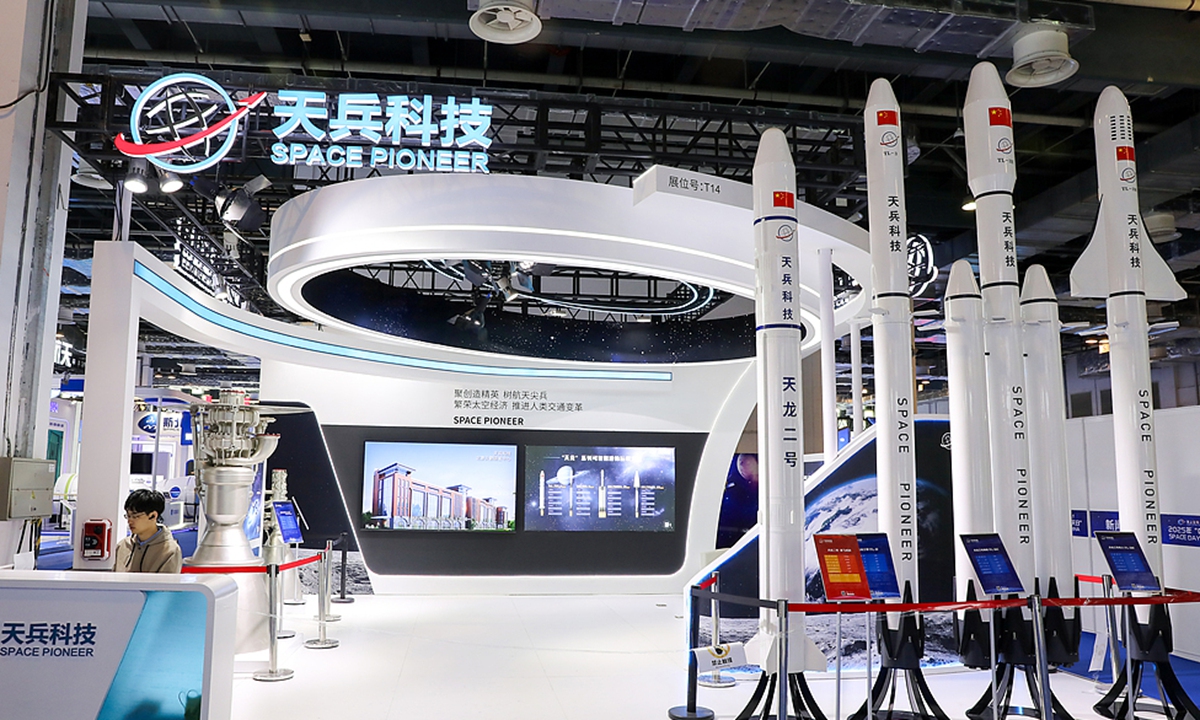
Space Pioneer's exhibit at an aerospace exhibition in Shanghai on April 28, 2025 Photo: VCG
Chinese commercial aerospace firm Space Pioneer's testing facility for its "36 satellites in one launch" technology has passed delivery and acceptance inspection, and it will be used to support future launch missions of its reusable Tianlong-3 rocket, the company told the Global Times on Wednesday.
After the facility is put into operation, it is expected to double single-rocket launch efficiency, reduce constellation deployment costs by more than 30 percent, and support a high-frequency launch capacity of more than 60 missions per year, comprehensively advancing the construction of China's low-Earth orbit satellite constellations and contributing to the high-quality development of the country's commercial space sector, said the company.
The facility is a key ground infrastructure component of Space Pioneer's dedicated launch site at the Jiuquan Satellite Launch Center in Northwest China's Gansu Province. With a total floor area exceeding 3,000 square meters, it integrates full-process functions including satellite final assembly, multi-satellite testing, satellite-rocket docking, and environmental simulation.
The facility is equipped with multiple high-precision testing rooms and a clean testing area. It is designed to adapt to Jiuquan's complex environment, which is characterized by frequent sandstorms and extreme temperature differences, ensuring all-weather, high-precision satellite testing requirements. Space Pioneer said that it is China's first large-scale satellite technology facility in the commercial aerospace sector.
The Jiuquan facility will coordinate with Space Pioneer's intelligent manufacturing base in Zhangjiagang, East China's Jiangsu Province. The Zhangjiagang base is responsible for the mass production of up to 50 Tianlong-3 rockets per year, while the Jiuquan facility will handle batch satellite testing and launch preparation, fully supporting the maiden flight and subsequent commercial launches of Tianlong-3, said the company.
The Shanghai Securities Times reported on January 28, 2026, that the Tianlong-3 Yao-2 rocket was undergoing final assembly. The rocket stands 72 meters tall with a diameter of 3.8 meters and uses liquid oxygen-kerosene rocket engines, and its fairing can accommodate 36 internet satellites. The separation test for 36 satellites of the Tianlong-3 rocket was successfully completed in October 2025.
The report also noted that the maiden launch vehicle of the Tianlong-3 carrier rocket had completed pre-launch preparations at Jiuquan and entered launch-ready status. It is expected to become the third reusable rocket to conduct a maiden flight test, following the Zhuque-3 and the Long March-12A Y1.
RELATED ARTICLES