US AI ‘slow down vs no moratorium’ is not real conflict: shared push to contain China, driven by anxiety as China closes AI gap, experts
Debate shows anxiety, attempt to preserve tech hegemony as China closes the gap

Conceptual diagram of AI Photo: VCG
As debate intensifies in the US over whether to "slow down" or "not stop" artificial intelligence (AI) development, Chinese experts said that the two ostensibly opposing positions share a common underlying logic: containing China's AI development and preserving US technological hegemony, motivated by anxiety over competition with China.
The experts warned that this zero-sum mindset risks splitting the global AI supply chain, and that major economies must pursue greater coordination and open, inclusive governance.
The remarks come as the US debate over AI safety and regulation widens, with policymakers and tech leaders increasingly putting competition with China at the center of their AI policies.
US House Speaker Mike Johnson said on Tuesday that there cannot be a moratorium on AI development without losing the competitive edge to China, and that AI companies can regulate themselves, Reuters reported.
Treasury Secretary Scott Bessent said that AI labs should be held accountable for their creations, but that it was important to stay ahead of China in the AI development race, according to another Reuters report.
These remarks by US officials came after Anthropic CEO Dario Amodei called on AI companies to slow the rate of advancement to ensure AI safety — sentiments echoed by OpenAI CEO Sam Altman and Elon Musk.
While on the surface it is a plea for industry-wide safety coordination, Amodei's lengthy letter is geared toward safeguarding the US lead in AI relative to China, and a call for tighter controls on China's AI development.
Amodei urged the US to strengthen controls on chip exports on China and crack down on alleged model distillation by Chinese AI labs. He then told CBS News on Sunday that the "toughest dilemma" over his proposal to slow AI advancement was if China and other adversarial nations chose not to do the same, Reuters said.
Experts pointed out that despite apparent contradictions between tech firms and government officials, protectionism lies beneath the surface. The "slow down thesis" advanced by tech giants and the "no moratorium" stance held by US officials both stem, at their core, from protectionist instincts.
Ma Jihua, a telecom industry expert, told the Global Times that US officials obviously aim to uphold US technological hegemony, while the "slow down" talk from tech firms is a way to pressure China in an attempt to prevent competitors from narrowing the technological divide.
Ma noted that the debate reflects widespread anxiety across industry and official circles.
"When you are ahead and it gets harder to stay ahead, you want everyone else to slow down. From a broader competitive perspective, US AI firms have watched Chinese AI models improve fast. That has made US companies nervous and prompted them to call for deceleration," Ma said.
"But the slow down narrative is unlikely to be real policy. No company will actually slow down. They all want others to slow down while they keep running," Ma added.
Li Yong, a senior research fellow at the China Association of International Trade, told the Global Times on Wednesday that whether they are tech giants or politicians, their underlying consensus is to treat AI competition as the key to whether US global hegemony can continue.
Tech giants call for a slow down, citing runaway AI risks, but in reality it is a packaged narrative for capital to protect its own interests — a face-saving excuse for AI companies whose huge investments have not yet given them an overwhelming edge, Li said.
That anxiety is not unfounded. The 2026 Stanford AI Index Report shows the overall performance gap between top US and Chinese frontier models has narrowed to just 2.7 percent. Since early 2025, leading models from both countries have traded places atop various benchmark rankings.
JPMorgan's analysis put it plainly: "A run of open-weight releases this summer, such as Moonshot AI's Kimi K3 and Z.ai's GLM-5.3, landed close to the US capability frontier while remaining free to download and much cheaper to run. The US still leads in capability, but China is competing aggressively on cost, openness and distribution."
Zhou Mi, a senior research fellow at the Chinese Academy of International Trade and Economic Cooperation, told the Global Times that the debate reflects a classic American mindset: zero-sum thinking. "The US always assumes that other countries will do to them what they would do to others," he said. "If someone else gets ahead, they think that country will push them down.
"But this thinking has real costs. It splits the global AI supply chain. No single country can handle AI's challenges alone. We need coordination, especially among major economies," Zhou said.
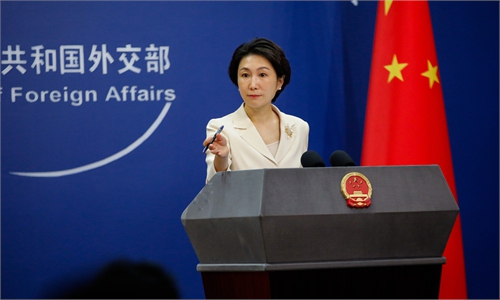
AI is a consequential technology for the well-being of all humanity. All parties should jointly promote the open and inclusive development of AI for good and for all. Fear-mongering, confrontation and vicious competition will only hamper efforts toward sound global AI governance, and such competition serves no one's interests, Chinese Foreign Ministry spokesperson Guo Jiakun told a press conference on Monday in response to the AI "slow down" narrative.
RELATED ARTICLES