From the world’s key buyer of services to an emerging seller: 'China services' meet the world at CIFTIS 2026
Services fair highlights nation’s AI solutions benefiting the world

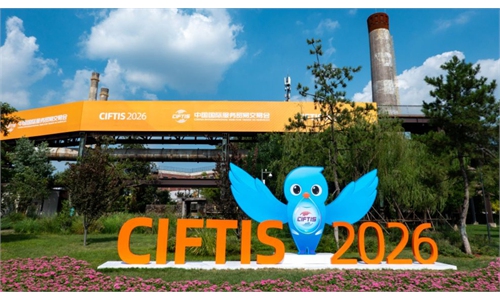
The 2026 China International Fair for Trade in Services (CIFTIS) opened September 9, 2026 in Beijing's Shougang Park, which has drawn participants from 90 countries, regions and international organizations, with over 1,800 companies exhibiting on-site. Photo: Li Hao/GT
Walk into the ICT-themed exhibition hall at Beijing's Shougang Park during this year's China International Fair for Trade in Services (CIFTIS), and the first things to catch the eye are artificial intelligence (AI) models. A trillion-parameter open-source AI large model - the first of its kind fully trained and run on a domestic 10,000-GPU cards computing cluster - is making its public debut. Nearby, a "logistics super brain" AI model paired with robots for global supply-chain solutions is showcased.
This is the first CIFTIS of China's 15th Five-Year Plan period (2026-30). For the first time, the main exhibition features a dedicated "China Services" case zone, bringing together over 140 innovative cases across all 12 services trade categories. Nearly 40 percent of them are centered on AI, large models and intelligent agents. Beyond telecoms, the zone features BeiDou satellite navigation services, quantum computing cloud platforms, and even reusable rocket launch services.
The very establishment of this zone signals that Chinese companies are also increasingly exporting algorithms, digital intelligence and productivity solutions that are already reshaping industries worldwide, participants said.
The shift underway
Knowledge-intensive services have been increasingly driving China's service exports. In the first half of 2026, the country's total services imports and exports reached 3.8 trillion yuan (about $566.2 billion), up 8.3 percent year-on-year, according to the Ministry of Commerce (MOFCOM). Notably, service exports grew by 17.6 percent, becoming a key driver of foreign trade growth.
While China is becoming a seller, the shift goes deeper: China is not just selling services; it is providing integrated technologies, solutions and full-cycle services that make other countries' industries more competitive, more efficient, and more sustainable.
At the ICT-themed exhibition hall of CIFTIS, China's three major telecom operators showcased their "token going global" capabilities - exporting AI computing power and intelligent applications, moving from "laying cables" to "exporting tokens."
Their AI agents - China Telecom's TeleAgent, China Mobile's MobileClaw and China Unicom's UniClaw - made their debuts, alongside 10 service packages covering multimodal token services, computing-power empowerment for manufacturing, AI quality inspection, and secure cross-border data circulation, the Global Times learned from the companies.
These are not demo products. Chinese AI solutions are already deployed in real-world operations across the globe.
For example, at a plant of Sinar Mas Group, one of the largest private conglomerates in Indonesia, local managers used to struggle with equipment training videos in the Chinese language. Manual translation took three full days. Using a dedicated AI platform powered by China Mobile's Jiutian large model, the videos now auto-generate Indonesian subtitles or voiceovers. Staffers understand instructions instantly, sharply raising efficiency, according to media reports.
According to a recent PwC study report released in June, China ranks among the global leaders in applying AI effectively across the real economy. Liu Yaxiao, PwC China's head of its new AI Innovation Center in Shanghai, noted that more overseas clients are now adopting China's open-source AI ecosystem into their digital upgrades.
"AI is now permeating all services sectors, with notable improvements in efficiency, distribution and timing," Bruno Masier, President of the World Trade Point Federation, who has attended every edition of CIFTIS, told the Global Times on Wednesday.
He praised China's leadership in opening up its services market and supporting free trade, noting that China now often serves as a model for other countries to follow.
An even more symbolic case occurred just before the fair opened. Huawei signed a multi-year global patent cross-licensing agreement with US company HP, under which HP will pay to use certain Huawei Wi-Fi patents in its personal computers.
The agreement "is a strong testament to Huawei's persistent independent innovation in cutting-edge fields in information and communications technology" and allows the company to "share its innovations with the industry," Huawei's Chief IP Officer Alan Fan said in a statement sent to the Global Times.
A Chinese company that was once placed on the US' Entity List is now licensing patents to a major American computer maker. The story itself is a clear illustration of China's transition from buying technology to selling it, Xiang Ligang, a veteran telecom and tech policy observer, told the Global Times.
Data supports the trend. In the first half of 2026, knowledge-intensive services accounted for 53.5 percent of China's total services exports, up 3 percentage points from the end of 2025, according to the MOFCOM.
Creating opportunities
While the rapid expansion of knowledge-intensive exports signals China's growing competitiveness in higher-value services, the country's continued demand for imported services reflects greater market openness, analysts said.
China has made services sector opening a strategic priority in its 15th Five-Year Plan (2026-30). In April, the State Council released the Opinions on Promoting Expansion and Quality Improvement of the Service Sector, which explicitly called for further expanding pilot openings in value-added telecommunications, biotechnology and wholly foreign-owned hospitals, while improving the negative-list management system for cross-border services trade.
Recent foreign investment cases in China's services sector reflect growing confidence in the country's market opening.
For example, in mid-May, SK Hynix signed a memorandum of cooperation with local companies to advance its international hospital project in Wuxi, East China's Jiangsu Province.
AstraZeneca announced early this year that it plans to invest more than 100 billion yuan in the Chinese market by 2030, further expanding its drug production and R&D footprint. At the China Development Forum 2026 held in March, Louis Dreyfus Company confirmed plans to establish a second R&D center in China.
As China continues to open its services sector, global providers are seeing fresh opportunities - driven by growing two way trade, digitalization, and the overseas expansion of Chinese firms, all of which boost demand for cross border logistics and other professional services, analysts said.
"China is already the world's largest importer of travel services," Luz Maria de la Mora, director of UNCTAD's Division on International Trade and Commodities, told the Global Times on Wednesday at CIFTIS. She added that China accounts for about 5 percent of global services exports and about 7 percent of global services imports, underscoring its role as a key player in the global services trade.
A vote of confidence
This year's fair has drawn participants from about 90 countries, regions and international organizations, with more than 1,800 companies exhibiting on site, including 456 Fortune Global 500 firms and industry leaders. Walmart China, EY, KPMG and other major names are prominently featured. New exhibitors account for over 40 percent of the total, the internationalization rate exceeds 30 percent, and Fortune 500 and industry-leading companies make up 50 percent.
This year's CIFTIS provides a key platform for expanding and upgrading the services sector, Jack Chan, Chairman of EY China, said in a statement sent to the Global Times.
"It brings together legal, accounting and other outbound service providers offering one-stop solutions, enabling companies worldwide to benefit from global services and mutual gains," Chan said.
"I have seen CIFTIS grow stronger every year, becoming one of the most important global trading fairs for services," Masier said. He emphasized that the fair offers foreign participants a wealth of business opportunities and a platform to exchange best practices that can be adapted to their local contexts.
CIFTIS is where the world gathers to learn about China's policy progress and business sector development, de la Mora said.
She added that China can be a strong partner for developing countries, not only as an importer of services but also as an investor, to expand the global services economy and create better jobs.
RELATED ARTICLES