BUSINESS / CHINA NEOMAKE
Landmark waterway Pinglu Canal opens, strengthening China-ASEAN connectivity and industrial integration: expert
By Yin Yeping and Published: Sep 16, 2026 11:52 PM

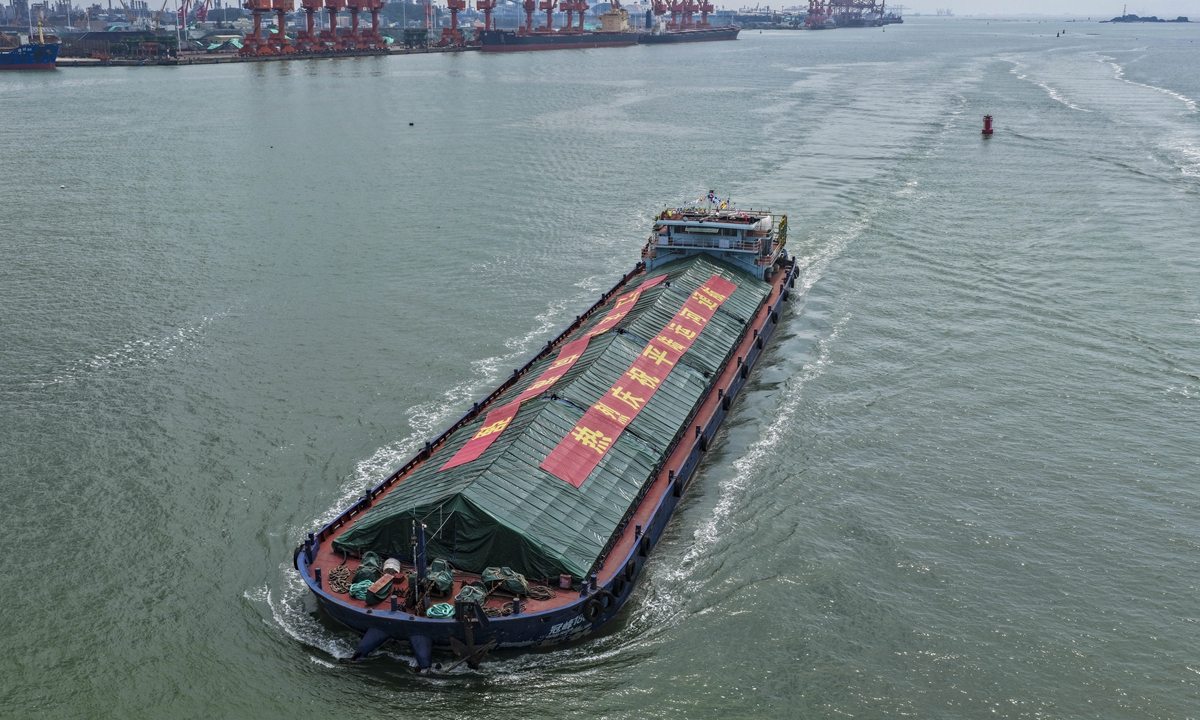
A cargo ship departs from Qinzhou Port in Qinzhou City, before being transported via the inland waterway of the Pinglu Canal to Nanning Port, and is finally shipped to the Xiangzhou Operation Area in Baise, South China's Guangxi Zhuang Autonomous Region on September 16, 2026. Photo: VCG
After four years of construction, the Pinglu Canal, a landmark project strengthening regional land-sea connectivity, officially opened to navigation in South China's Guangxi Zhuang Autonomous Region on Wednesday.
As China's first nationally planned and coordinated canal project since 1949 linking inland waterways with the sea, the canal creates a direct river-sea route from the Xijiang River to the Beibu Gulf, providing Southwest China with its shortest, most economical and convenient route to the sea.
As a backbone project of the New International Land-Sea Trade Corridor, the Pinglu Canal not only reshapes traditional waterborne logistics routes in Southwest China, but also brings China's southwestern hinterland closer to those in the Association of Southeast Asian Nations (ASEAN), the country's largest trading partner, industry representatives and experts said.
With the new river-sea corridor now in operation, logistics, trade and industrial ties between the two sides will deepen further, injecting fresh momentum into China-ASEAN economic and trade cooperation, they said.
Major milestone
Built at a cost of 72.7 billion yuan ($10.83 billion), the 134.2-kilometer canal runs from Nanning, capital city of Guangxi, to the Beibu Gulf, the closest maritime outlet for much of southwest China, according to the Xinhua News Agency.
The project has set four world records among comparable canals: the highest navigation capacity, the fastest ship-lock transit speed, the highest lift for a water-saving ship lock, and the largest water-saving ship lock on an inland waterway.
The canal stretches along the New International Land-Sea Trade Corridor, a strategic trade route connecting China's inland regions with ASEAN and other global markets. It is the first river-to-sea canal project planned and coordinated at the national level since the founding of the People's Republic of China in 1949, Xinhua said.
Designed for vessels of up to 5,000 tons, the canal shortens the inland waterway journey for goods from southwest China to the sea by more than 560 kilometers compared with traditional routes through ports in Guangdong Province.
It is expected to reduce overall logistics costs by 18 to 30 percent and save more than 5 billion yuan in transportation costs each year.
Behind these breakthroughs lie the enormous challenges posed by a complex terrain. The water level drops by 65 meters from the starting point to the end of the Pinglu Canal. To overcome the difference and ensure smooth navigation, locks were built along the canal. At some locks, the maximum water level difference between the upstream and downstream sides reaches 29.6 meters, roughly the height of a 10-story building, the People's Daily reported.
"The opening of the canal means cargo from Guangxi can, for the first time in hundreds of years, flow southward instead of eastward," Hu Binsheng, deputy general manager of the Qinshi Group's Guangxi branch, a shipyard for modern vessels based in the Liujing Industrial Park near Hengzhou, told the Global Times on Wednesday.
"The industrial heartland of Guangxi now has a direct access to the sea and we see the canal not only as a waterway but an industrial highway," Hu said.
Hu's company unveiled on Wednesday three types of new vessels specifically designed for the canal, including the 200‑TEU/5,000‑ton green standard ships. "In the long run, we aim to build a 10‑million‑deadweight‑tonne fleet within five years," the industry insider said.
What extends from the canal is therefore not only a new waterway, but potentially a new industrial layout. Hu Qimu, a professor at the Maritime Silk Road Institute of Huaqiao University, told the Global Times on Wednesday that as transport costs fall and river-sea intermodal efficiency rises, ports, logistics, shipbuilding, and port-related industries along the canal will see new opportunities for growth.
Stronger connectivity with ASEAN
The changes brought by the Pinglu Canal go well beyond that. It further opens up logistics links between China's southwestern hinterland and ASEAN markets.
"The Pinglu Canal is not merely a water project. In the era of China-ASEAN FTA 3.0, it is a key link in moving connectivity from point-to-point ties toward network-to-network coordination," Huang Dongri, a research fellow at the Center for Area Studies of Guangxi Minzu Normal University, told the Global Times. Like the China-Laos Railway and the Jakarta-Bandung High-Speed Railway, the canal will play an important role in the China-ASEAN connectivity map, he said.
The China-Laos Railway focuses on inland connectivity and all-weather express freight, mainly serving Laos, Thailand, Myanmar and some other Southeast Asian countries, while the Pinglu Canal is designed for high-volume, low-cost and low-energy river-sea transport over long distances, Huang said. "It is well suited for bulk commodities, industrial intermediates, agricultural products and large equipment, with its core reach extending to coastal markets such as Vietnam, Thailand, Malaysia," the expert said.
The Pinglu Canal is well poised to become another transport artery servicing the robust trade between ASEAN and China, Ong Tee Keat, president of the Belt and Road Initiative Caucus for Asia-Pacific and former deputy speaker of the lower house of the Malaysian Parliament, told the Global Times in an interview on Wednesday.
The Pinglu Canal will be known for cutting logistics time and cost, rendering the New International Land-Sea Trade Corridor a more competitive seaborne transport route between the Southwestern region of China and ASEAN member states, the former Malaysian official said. "The conventional focus of China-ASEAN trade along the wealthy and more established southeast coastal seaboard looks set to diversify to the emerging hinterland market in the mid-West which is catalyzed by the New International Land-Sea Trade Corridor," Ong said.
The latest trade figures also underscored the strong connectivity between China and Southeast Asian countries. In the first eight months, China-ASEAN trade reached $862.75 billion, up 25.6 percent year-on-year, data from China's General Administration of Customs showed. Both imports and exports posted double-digit growth.
For China and ASEAN, the significance of the Pinglu Canal goes beyond adding another trade route, said Hu, noting that it will more closely connect China's southwestern hinterland with the Beibu Gulf and ASEAN markets, facilitating the flow of agricultural products, raw materials, machinery and equipment, manufacturing intermediates and other goods.
More importantly, better connectivity will further intertwine China and ASEAN's markets, industrial chains and supply chains, Hu said.
"This will deepen industrial cooperation and regional integration, while providing greater certainty in regional cooperation to counter uncertainties facing industrial and supply chains amid rising global protectionism," the expert noted.
RELATED ARTICLES