China-EU trade talks signal need to manage differences, concrete action needed to meet China halfway: expert
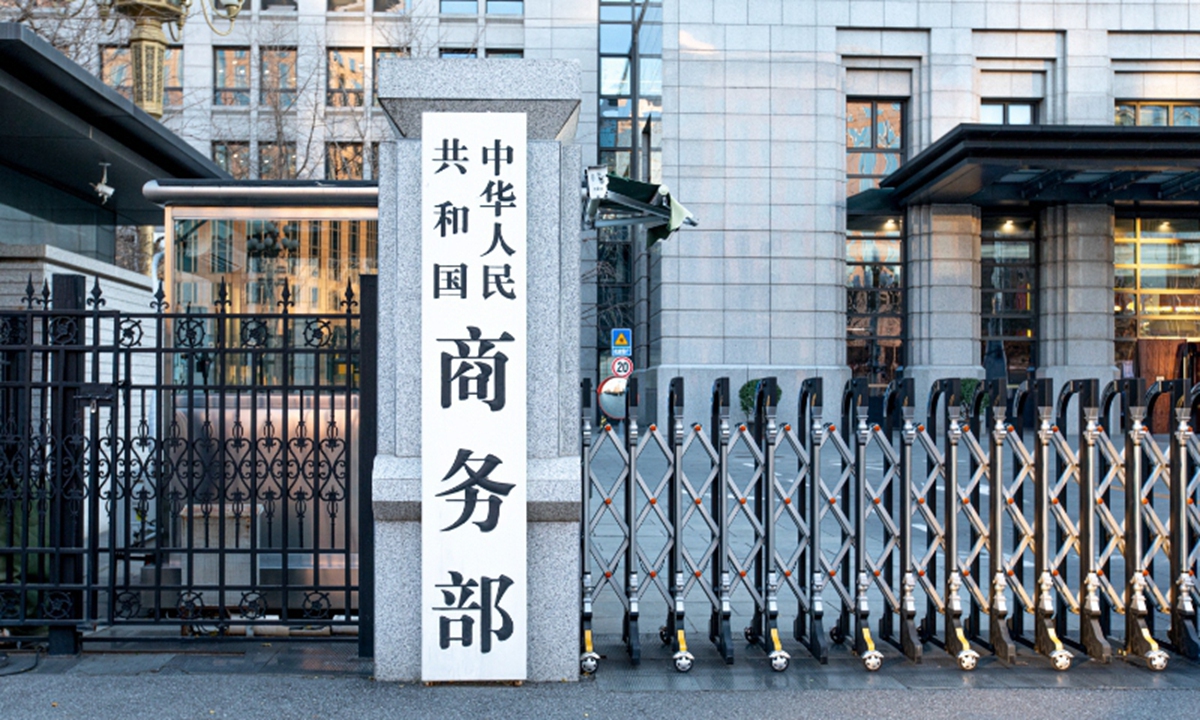
The Ministry of Commerce of China File photo: VCG
Chinese Commerce Minister Wang Wentao held a video call on Thursday with European Commissioner for Trade and Economic Security Maros Šefčovič at the latter's request to discuss China-EU economic and trade issues, according to China's Ministry of Commerce (MOFCOM).
The ministerial talks came amid lingering challenges in China-EU economic and trade relations, with recent EU restrictions raising concerns over trade ties and supply chains. Against this backdrop, the EU's move to seek talks with China is particularly noteworthy.
The move shows that the EU recognizes the deep economic interdependence between the two sides and the need to manage differences through dialogue, a Chinese expert said.
More importantly, the EU should translate this willingness into concrete policies by reducing discriminatory restrictions, ensuring a fair, transparent and non-discriminatory business environment for Chinese companies, and meeting China halfway, the expert said.
On Wednesday, European Commission (EC) President Ursula von der Leyen claimed that the EU will use every possible means to reduce its "unsustainable" trade deficit with China, Reuters reported.
Von der Leyen claimed that the imbalance, with a goods trade deficit of 1 billion euros ($1.15 billion) a day last year, had reached a tipping point and that Europe was already suffering from the second "China shock" through deindustrialization, according to the media report.
The remarks received immediate and firm responses from the Chinese authorities and the business community in the bloc.
The China Chamber of Commerce to the EU (CCCEU) said in an article regarding Von der Leyen's remarks on Wednesday that the EC president believes that a second "China shock" has already occurred and links it to deindustrialization in Europe's industrial heartlands, a perception that is not only mistaken but also completely overlooks the fundamental problems behind the declining resilience of EU industry.
The CCCEU also said, in response to the so-called trade imbalance, that the EU, itself a trade-surplus economy, criticizes China for its trade surplus with the bloc, which also highlights a "double standard."
He Yadong, a spokesperson of the MOFCOM, said on Thursday that China does not engage in "microphone diplomacy" or a war of words, refuting von der Leyen's recent claims about a so-called "China Shock 2.0."
The EC recently unveiled a legislative proposal allowing EU public authorities to favor European companies in public procurement for key public services such as energy, water, railways, ports, airports and postal services, the Euro News reported, noting that it was "a move that clearly targets Chinese companies."
Responding to a media inquiry regarding the EC's recently unveiled Public Procurement Act, the MOFCOM spokesperson said at Thursday's press conference that the proposed legislation includes a "European preference" provision and also requires non-market factors such as security to be incorporated into bid evaluation criteria, excluding or restricting third-country companies that do not meet the relevant requirements. China is highly concerned about this, He said.
Since the beginning of this year, the EU has successively introduced revisions to the Cybersecurity Act, the Industrial Accelerator Act and the Public Procurement Act. Under the pretexts of cybersecurity and industrial development, the bloc is pursuing protectionism by repeatedly introducing discriminatory provisions and continuously tightening market access conditions, He said.
China urges the EU to abide by World Trade Organization rules, keep its market open, revise the discriminatory provisions in the proposed legislation, and create a fair, transparent and non-discriminatory business environment for companies investing and operating in the EU.
Europe stresses fair competition and balanced trade, yet keeps tightening market access in procurement, cybersecurity and industrial policy, while blaming its own high costs and weaker competitiveness on outside rivals, Huo Jianguo, former head of the Chinese Academy of International Trade and Economic Cooperation under the MOFCOM, told the Global Times on Thursday, noting that "such moves will not fix Europe's structural problems and may only raise costs and sap market vitality."
However, Huo also noted that as China-EU trade faces new uncertainties, Thursday's ministerial talks send a positive signal that both sides still use dialogue to manage differences.
"The priority, however, is turning talks into action on specific issues through existing consultation mechanisms," Huo said.
Given the EU's recent tougher signals on economic and trade ties with China and a series of restrictions, its move to seek ministerial-level talks suggests that it recognizes the high degree of China-EU economic interdependence, Jian Junbo, director of the Center for China-Europe Relations at Fudan University's Institute of International Studies, told the Global Times on Thursday.
As the EU pushes for so-called trade "rebalancing," the EU's request for the talks also reflects a practical need to maintain dialogue, manage differences and prevent further escalation, Jian said.
Despite frictions, China-EU trade has continued to grow, underscoring the strong complementarity between the two economies. According to China's General Administration of Customs, China-EU trade reached $608.09 billion in the first eight months of this year, up 12.4 percent year-on-year, with both imports and exports recording growth.
The bilateral trade structure itself also shows industrial integration.
The Chinese and European economies are highly complementary, with deeply integrated industrial and supply chains, Jian said, urging the EU to translate its willingness to engage in dialogue into concrete policies by reducing discriminatory restrictions and providing Chinese companies with a fair, transparent and non-discriminatory business environment.
RELATED ARTICLES