Five-year plan for intelligent connected NEVs signals major shift in devt, opens new prospects
Beyond scale
By Zhang Yiyi, , Yang Shasha and Wang Dong Published: Sep 20, 2026 08:31 PM

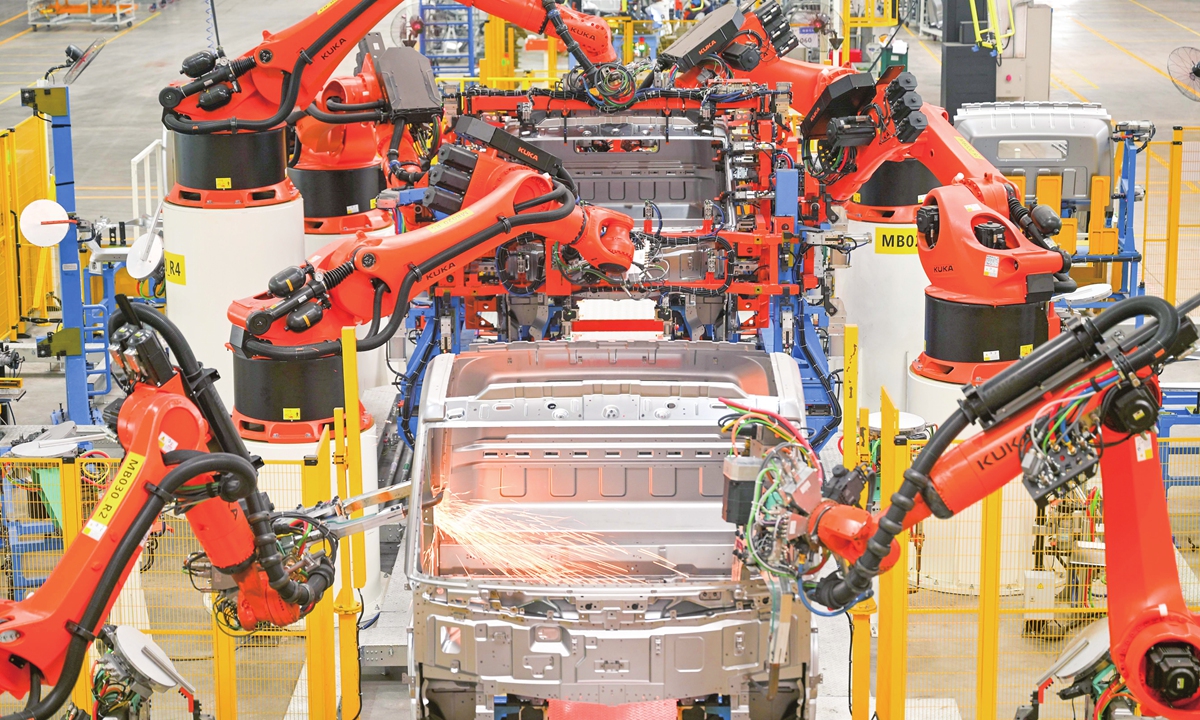
Industrial robots work on a smart assembly line at an automobile company in Guiyang, Southwest China's Guizhou Province, on July 27, 2026. Photo: VCG
At Xiaomi's auto factory in Beijing E-town, more than 700 robots work across the production line, with a new vehicle rolling off roughly every 76 seconds. Overseas, BYD is building a vehicle production base in Szeged, Hungary, while Chery is working with Spain's Ebro to make use of existing local manufacturing capacity.
These developments highlight not only the speed and scale of China's rapidly evolving new-energy vehicle (NEV) industry, but also its overseas expansion, as competition increasingly extends beyond electrification to software, artificial intelligence (AI) and intelligent driving.
The next stage of that transformation is now taking shape in national policy. China has unveiled its 15th Five-Year Plan for intelligent connected NEVs, setting 2030 targets to further strengthen the sector's full industrial-chain advantages, raise NEV penetration to 70 percent for passenger cars and 40 percent for commercial vehicles, and achieve large-scale deployment of vehicles with autonomous-driving functions.
Notably, after years of rapid NEV adoption, China's policy focus is shifting toward core technologies, intelligent capabilities, supply-chain resilience and global operations, experts said.
The shift comes as the global auto industry undergoes a broader restructuring. European automakers are pressing ahead with electrification while grappling with cost, profitability and competitive pressures, while US carmakers are recalibrating EV investment and domestic manufacturing strategies. Japanese automakers are also stepping up efforts in software-defined vehicles and cost efficiency as autonomous driving moves closer to commercial-scale deployment, according to media reports.
Industry experts told the Global Times that as China strengthens its capabilities in NEVs, intelligent driving, software and supply chains, its role is shifting from largely adapting to global rules toward deeply participating in setting technical standards, data governance rules and safety norms. At the same time, industry ties are becoming more two-way, with Chinese automakers localizing production, R&D and supply chains overseas, while global carmakers deepen investment in China's technology and innovation ecosystem.
New phase of globalization
The global rise of China's auto industry is on vivid display at Xiaomi's plant in Beijing.
Ma Lan, an executive at Xiaomi's Beijing plant, told the Global Times that visiting foreign officials and auto executives often ask about Xiaomi's supplier network, development cycle and how it built an integrated business covering design, R&D, manufacturing and sales in a relatively short period.
Ma added that Xiaomi plans to enter overseas markets in 2027, with some foreign companies already expressing interest in distribution and cooperation.
In addition to overseas production bases of Chinese firms like Xiaomi, BYD and Chery, Chinese autonomous-driving companies are also entering overseas markets through technology and services. On September 10, WeRide, Uber and AVOMO announced that they had secured an L4 autonomous passenger-vehicle operating permit from Spain's Directorate-General for Traffic under the ES-AV framework, allowing vehicles to be deployed on public roads.
Chinese intelligent-driving companies are entering a new phase of globalization, a representative from SEEWAY.AI, a Chinese intelligent-driving technology company, told the Global Times.
While the earlier stage focused largely on exporting vehicles and components, the next phase will require companies to build overseas capabilities in data management, compliance, technical services and local partnerships. As large AI models and end-to-end autonomous-driving technologies advance, competition will also expand beyond algorithms to the ability to acquire, manage, train and use data in compliance with local rules, making localized data compliance and technical support increasingly important for overseas expansion.
Zheng Yun, global senior partner at Roland Berger, vice president for Greater China and head of its automotive practice in Asia, told the Global Times that Chinese auto suppliers need to shift from opportunity-driven exports toward long-term globalization and from supplying individual components to providing integrated solutions.
This will require deeper localization in R&D, manufacturing, supply chains, talent, compliance and after-sales services, as well as greater participation in global standards. Companies must not only "go global," but also become embedded in local industrial ecosystems rather than simply selling products and moving on, he said.
New prospects for co-op
The 15th Five-Year Plan for intelligent connected NEVs sets out five key tasks: strengthening technological innovation, upgrading the industrial system, promoting cross-sector integration, building a more effective industry governance framework, and opening up new prospects for global industrial cooperation.
China has continued to open its manufacturing sector, including auto production, to foreign investment. The 2024 negative list removed all remaining foreign-investment restrictions in manufacturing. In 2025, a revised catalogue added automotive chips, domain controllers, in-vehicle operating systems and hardware for L3-L5 autonomous driving to sectors where foreign investment is encouraged. The 2026 Government Work Report further pledged to ensure national treatment for foreign-funded enterprises and support for reinvestment and expanded localized production in China.
Volkswagen has established its largest R&D center outside Germany in China, giving its local operations greater capabilities in vehicle development, component R&D, procurement and full-vehicle validation. The company says the China operation also enables faster decision-making and deeper integration into the local innovation ecosystem.
Volkswagen's CEA electronic and electrical architecture, jointly developed with XPeng, is one example of the shift. The company told the Global Times that cooperation among Volkswagen Group China Technology Company, CARIAD China and XPeng has helped shorten development cycles by about 30 percent and reduce development costs by roughly 40 percent.
Volkswagen has also expanded cooperation with Chinese technology companies, including Horizon Robotics and ThunderSoft, in intelligent driving and smart cockpits, with partnerships moving beyond traditional component sourcing toward joint development, software and system integration.
Ma Jihua, a veteran telecom industry analyst, told the Global Times that a more open investment environment is giving foreign automakers greater room to combine their strengths in technology, branding and global operations with China's rapidly evolving auto market.
China's attraction, he said, lies not only in the size of its NEV market but also in its complete supply chain and ability to move technologies quickly from R&D and testing to mass production and commercial application. This can help foreign automakers shorten development cycles, lower commercialization costs and respond faster to changing consumer demand.
Foreign automakers can also use China's strengths in electrification, intelligent driving and manufacturing to accelerate their own transformation and develop products that could eventually serve markets beyond China, Ma said.
Becoming a standard-setter
The 15th Five-Year Plan for intelligent connected NEVs aims to strengthen Chinese brands' overseas operations and role in international standard-setting.
Ma told the Global Times that China's huge NEV market and complete automotive supply chain give it a unique advantage in turning new technologies into large-scale applications.
"China has a large enough market to test new technologies across diverse scenarios, while its complete industrial chain allows innovations to move quickly from R&D and testing to mass production and commercial use," Ma said. "This combination not only shortens development cycles and lowers commercialization costs, but also gives China more practical experience that can contribute to the development of global technical standards and industry rules."
The representative from SEEWAY.AI told the Global Times that the new plan sends a fresh signal to the sector and could reshape many parts of the industry.
The company expects competition to shift from technological capability alone toward data supply and operations. AI and embodied intelligence are changing R&D priorities, with more investment flowing into data collection, labeling, synthesis and compliance. At the same time, infrastructure such as high-definition maps, chips and sensors is increasingly being treated as part of the data-production system, which could in turn reshape how companies plan capacity and investment.
Zheng told the Global Times that the next round of competition in intelligent vehicles will no longer be about simply expanding capacity or adding more driving-assistance functions. Instead, companies will need stronger capabilities in fundamental R&D, safety validation, software-hardware integration and closed-loop data systems.
"The future will not be defined by how much production capacity a company has, but by whether that capacity can support the deployment of a new generation of intelligent connected vehicle systems," Zheng said.
RELATED ARTICLES