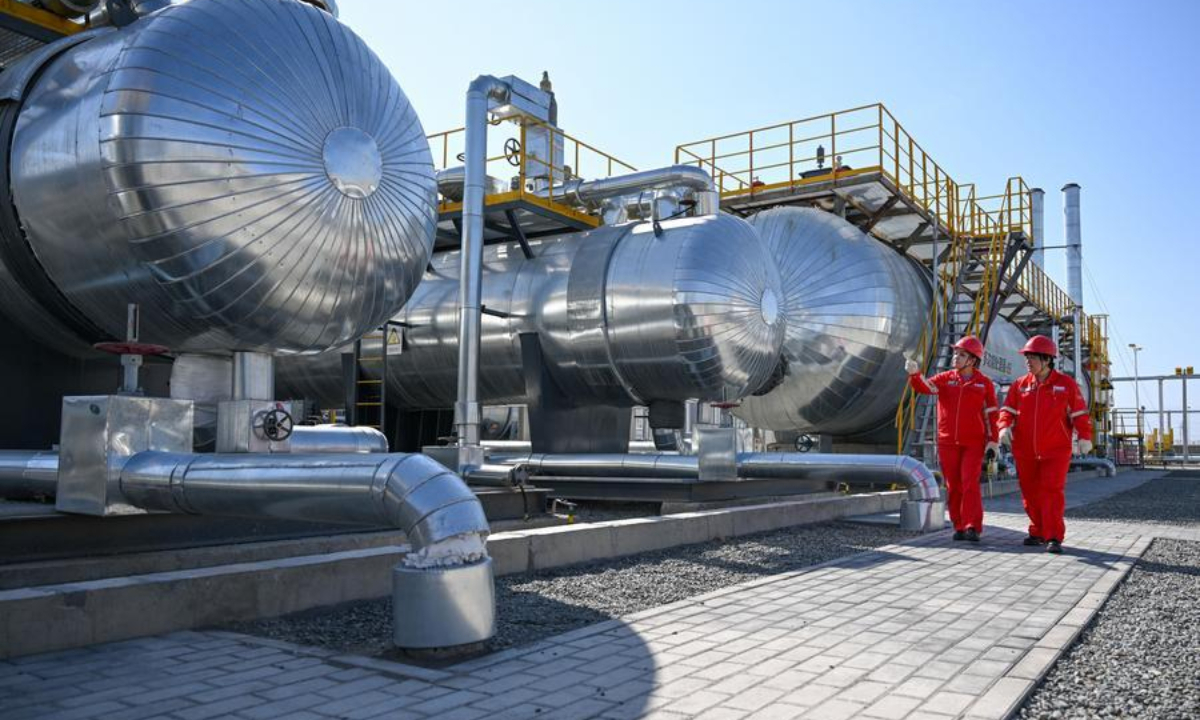
Staff members do patrol checking at a shale oil joint station of Jiqing Oilfield operation area of Xinjiang Oilfield Company of China National Petroleum Corporation (CNPC) in Jimsar, northwest China's Xinjiang Uygur Autonomous Region, Aug. 30, 2026. (Xinhua/Ding Lei)
With the global oil market in turmoil, China's oil imports have drawn wide attention in recent days. While acknowledging that the country's lower oil imports have helped prevent global oil prices from surging even higher, some Western media outlets have framed China's ability to adjust oil imports within the narrative of geopolitics, going so far as to call its oil reserves "leverage" or a "weapon" in the global energy landscape.
Such interpretations are clearly clouded by bias that blurs the boundary between a country's energy security and geopolitical games, while completely ignoring a fundamental truth: A more flexible and resilient Chinese oil market is a major positive for global energy security and the world's economic performance.
As the world's major crude oil importer and consumer, China has spent years building up its strategic petroleum reserves, diversifying its oil import sources, refining its domestic refining capacity, and strengthening guidance of market expectations.
The core purpose of this maturing regulation capability is to bolster China's ability to withstand sudden shocks to the global energy market. When Middle East tensions escalate or key shipping lanes are disrupted, drawing on reserves and adjusting import volumes are aimed first and foremost at safeguarding domestic energy security.
Portraying a country's routine energy-security measures as a "geopolitical weapon" is itself a geopolitical mindset. For a major economy to keep its energy supply running smoothly is the most basic and important contribution to the global oil market, buffering the transmission of external shocks for other economies that are deeply dependent on energy imports.
Turbulence in the energy market triggered by the latest geopolitical conflicts in the Middle East is a case in point. With supply corridors under strain and the market hit by panic buying, China has slowed its import pace, breaking the vicious cycle of "panic buying driving prices higher and higher prices spurring even more hoarding" that often happens in oil crises.
Chinese crude oil imports fell 20 percent year-on-year in April, 29 percent in May, and 41 percent in June, according to customs data. This has created a natural buffer for global oil prices and prevented price spikes from spilling over into widespread global inflation.
This is the tangible, real-world contribution China's energy resilience has made to the global economy. It offers a revealing lens on China's broader economic role: Far from generating the "China Shock" - a narrative that frames China's industrial might as pressure on competitors - the Chinese economy has shown itself ready and able to serve the world as a shock absorber.
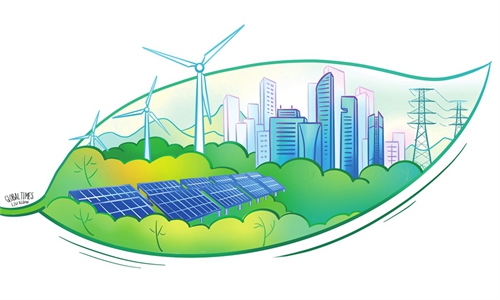
What underpins China's oil adjustment capabilities is far more than just oil reserves - it is an integrated, sophisticated comprehensive energy mix system. In addition to the pursuit of diversified fossil fuel supplies, the widespread adoption of electric vehicles, the large-scale deployment of solar and wind power, and continuous breakthroughs in alternative energy technologies have steadily reduced Chinese economy's dependence on fossil fuels, granting China far greater flexibility to adjust demand as market conditions shift.
These clean energy technologies are not resources limited to the domestic market. As more of these technologies and types of equipment are exported, China is helping more countries advance their energy transition, building their own energy buffers.
The shocks from the recent Middle East situation have made it clear that every economy, regardless of size or strength, needs to enhance its energy security. China's experience in building reserves, diversifying imports, refining demand-side management and pursuing new-energy substitution shows that energy security does not depend solely on resource competition.
This experience could offer valuable references for countries striving to improve their energy security. Far from posing a threat to the global energy landscape, the steady growth of China's energy resilience represents a pivotal positive force for sustaining global energy stability and robust world economic development.
RELATED ARTICLES