How China's aircraft maintenance is meeting global standards
By Ding Yazhi and Published: Sep 21, 2026 10:28 PM

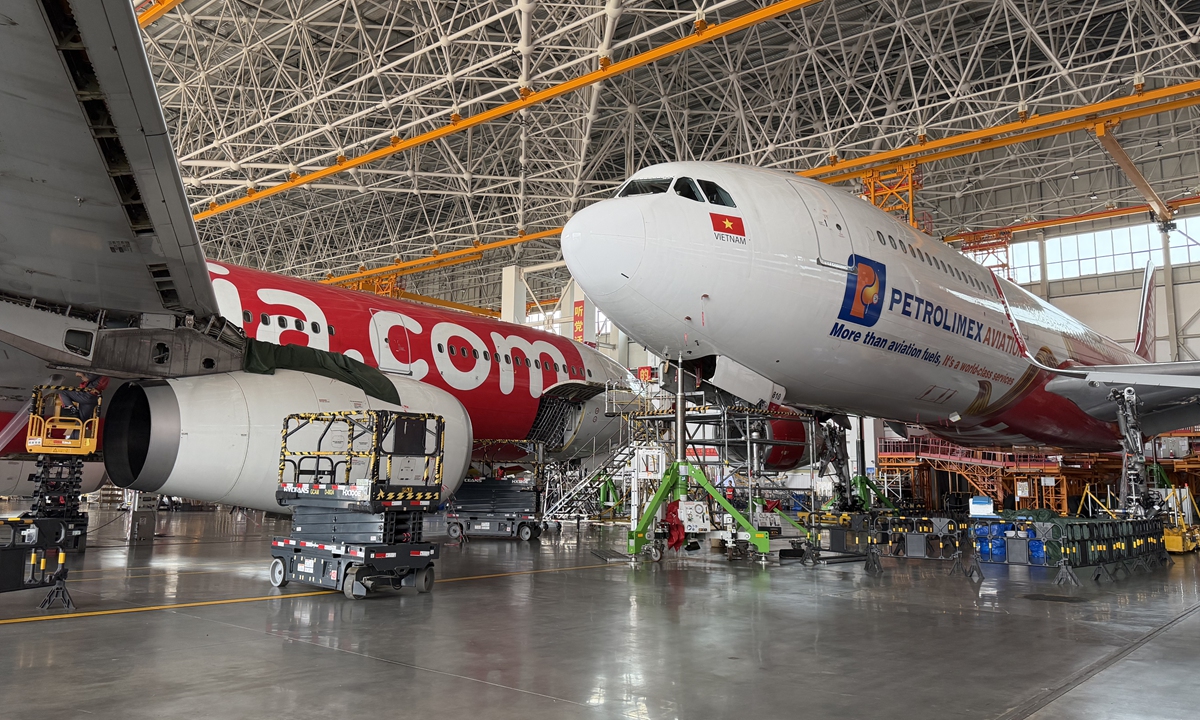
A corner of the one-stop aircraft maintenance industrial base in Haikou, South China's Hainan Province, on September 1, 2026 Photo: Ding Yazhi/GT
A Boeing aircraft landed in South China's Hainan Province and was towed into the line-maintenance hangar at the Hainan Free Trade Port one-stop aircraft maintenance base, where engineers began checking its avionics, power systems, fuselage, wings and cabin.
More than 30 years ago, Chinese engineer Su Maogen relied on a dictionary when working on foreign aircraft, as imported aircraft maintenance standards and experience were almost entirely learned by following foreign countries. Today, Chinese engineers are able to independently complete maintenance engineering analysis for large civil aircraft and participate in the formulation and revision of international maintenance standards.
Aircraft maintenance may look like simple "upkeep," but it is in fact a highly specialized engineering service. The technological, engineering and supply chain capabilities that China's manufacturing industry has built up over decades are now going global through such services.
Su, who once served as chairman of the China Maintenance Program Industry Group (CMPIG) and member of the International Maintenance Program Industry Group, still remembers that when he first entered the field of civil aviation maintenance, Chinese engineers were facing a massive system of "foreign standards."
In the 1980s, Airbus, Boeing and other foreign aircraft entered China one after another. For China's newly emerging civil aviation maintenance industry, mature foreign systems offered guidance on how to repair aircraft, where to inspect, and when to replace components.
But the problem was that, first of all, they had to be able to understand them. In his early years, Su participated in major line maintenance checks for aircraft models such as the McDonnell Douglas MD-82.
"At that time, there were no ready-made work cards in China," he told the Global Times. Maintenance materials came from abroad, and some were even in German. "We could only hold a dictionary and translate word by word, groping our way forward little by little to complete the maintenance."
For a long period of time, the maintenance standards, plans, and programs of domestic airlines mainly followed the original manufacturer manuals and the rules set by airworthiness authorities such as the US' Federal Aviation Administration and European Union Aviation Safety Agency.
The more aircraft they maintained, the more they accumulated. Decades of continuous maintenance of European and American aircraft exposed Chinese engineers to a massive number of real operating cases. They gradually mastered the repair of components such as engines and auxiliary power units, and began studing failure mechanisms, degradation patterns, and maintenance economics.
Su gave an example: once, a tiny crack appeared in an engine component. According to the foreign original manufacturer's approach, the entire unit needed to be replaced, at a cost of millions of dollars.
Chinese engineers studied the crack propagation rate, material properties, and actual operational risks, and found that the risk could be controlled and that immediate replacement of the entire unit was not necessary.
Drawing on their own engineering analyses, they entered technical negotiations with the manufacturer, which recognized the Chinese engineers' judgment.
"You can't ask the manufacturers about everything, otherwise you lose your own competitiveness," Su said. Behind this statement is a change in the value of maintenance services.
If they were only strictly executing the original manufacturer's manual, Chinese companies would mainly be providing maintenance labor hours; when engineers begin to be able to judge failure mechanisms, assess operational risks, and propose alternative solutions, maintenance services are no longer selling only "labor hours," but the engineers' judgment.
This judgment was later brought to the aircraft design.
In 2010, Su participated in the development of home-made large aircraft and led maintenance engineering analysis work at COMAC. This time, what he faced was no longer a foreign aircraft already in operation, but a domestic commercial aircraft still under development.
They referred to international general standards, combined aircraft design and future operating conditions, and established their own maintenance engineering analysis system to provide an engineering basis for maintenance manuals, troubleshooting manuals, and maintenance plans.
"For domestically produced commercial aircraft currently in operation, the vast majority of failures and defects can be addressed with corresponding contingency plans in the existing manuals. For new problems that arise during operation, we will also continuously update and iterate the maintenance technical publications," Su said.
Under the promotion of the Civil Aviation Administration of China, domestic original equipment manufacturers also formed the CMPIG to benchmark against international practice, with Su serving as its first chairman.
China completed the Chinese translation and engineering interpretation of the MSG-3 standard, and this Chinese version received official recognition from the Airlines for America, becoming the only officially recognized language version besides the original English version. Chinese engineers also participated in international maintenance review work and put forward revision suggestions, some of which were adopted into international rules.
But recognition in standards is not the end point. What truly tests China's service capability in aircraft maintenance is the market.
At the Hainan Free Trade Port one-stop aircraft maintenance industrial base, aircraft from airlines in Southeast Asia, South Korea, the Middle East, and Europe successively enter the hangar.
Gu Zhilin, director of the Grand China Aviation Maintenance Co, a subsidiary of HNA Technic, stood in the hangar and pointed to the factory building not far away.
"Next door is the paint hangar, ahead is HNA Technic's component maintenance department, and beside the one-stop maintenance base there is also the factory of Haikou Meilan Airport Gineers Aero-Engine Maintenance Engineering Co. After an overseas aircraft completes a line check here, if it needs painting or engine and component maintenance, it can all be done within this park."
For airlines, where to send an aircraft for maintenance is essentially an economic calculation. One-stop service is especially attractive to overseas airlines.
What they value is, first, the policies of the Hainan Free Trade Port. Policies such as exemption from deposit for inbound maintenance and bonded maintenance aviation materials, plus fast customs clearance, can further reduce the capital occupied during maintenance and overall costs for airlines. According to our estimates, the overall cost of some maintenance businesses can be reduced by about 10 percent to 15 percent, Gu said.
Second, convenience. Line maintenance, whole-aircraft painting, component maintenance, and engine maintenance can all be completed in one stop here, without the need to ferry aircraft between multiple locations. In the aviation industry, every day an aircraft sits on the ground means lost revenue. We always put safety first, so that overseas clients can have their aircraft maintained in Hainan with less worry, less time, and less money," Gu said.
During an online interview with the Global Times, Su was in Laos participating in the maintenance of an Airbus A320 aircraft.
According to the one-stop aircraft maintenance industrial base in Haikou, overseas business has continued to grow since 2022, and in the first half of this year, overseas business volume increased by more than 50 percent year on year compared with the first half of last year. From Southeast Asia to South Korea, the Middle East, and South Asia, the base's overseas business continues to expand.
RELATED ARTICLES