ARTS / CULTURE & LEISURE
Exhibition in Beijing offers first overseas public showing of Notre Dame restoration
China-France cultural salon held in Beijing

Photo: Wu Jie/GT
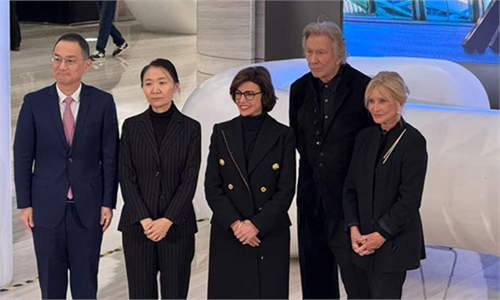
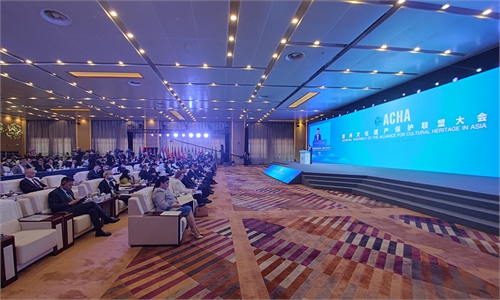
Representatives from French cultural institutions hailed China's support in the restoration of the Notre Dame Cathedral and shared their insights on the in-depth cooperation between France and China in the field of cultural heritage preservation during a salon held in Beijing on Monday.Additionally, a themed photo exhibition opened at the former site of the Sino-French University in Beijing on Sunday. The exhibition features photographs and documentary footage taken during the restoration of the Notre Dame Cathedral in Paris, marking the first time this collection of visual materials has been publicly exhibited outside France.
At the Sino-France Salon for Dialogue on Cultural Heritage in Beijing on Monday, Michel Picaud, president of Friends of Notre Dame de Paris, told the Global Times that he was impressed with the exhibition and offered a brief overview of Notre Dame Cathedral's journey from emergency rescue efforts following the fire to its full restoration.
Notre Dame has long attracted millions of visitors each year, including many from China, Picaud said, expressing appreciation for their support.
A huge fire broke out at the historic cathedral, located in the heart of Paris, destroying the spire of the building on April 15, 2019.
Following the catastrophic fire, China was the first country to sign an intergovernmental agreement with France for the restoration of the cathedral, enabling Chinese experts to contribute to the restoration project.
While acknowledging the global support for the cathedral's restoration, Picaud said China made a notable contribution and helped facilitate systematic reconstruction over the following five to six years.
In February 2024, Emperor Qinshihuang's Mausoleum Site Museum in Northwest China's Shaanxi Province sent specialists to Paris to assist with the conservation and restoration of Notre Dame. China and France have jointly initiated scientific research on the preservation of wooden relics and earthen sites from both Notre Dame and the Mausoleum of Emperor Qinshihuang.
The cathedral officially reopened in December 2024. Picaud noted that important work still lies ahead. "We have embarked on a five-year campaign to restore the cathedral's exterior."
Meanwhile at the Sino-France cultural salon, other French and Chinese representatives also shared their experiences in the in-depth cooperation in cultural heritage between the two sides.
Riding into Reflection, an ongoing exhibition on equine culture of China and France held at the Prince Kung's Palace Museum in Beijing, is the fruit of the cooperation between the two countries, Feng Naien, director of Prince Kung's Palace Museum, said at the salon.
There have been many exhibitions featuring horses held across China especially during the Year of the Horse in 2026, Feng noted.
"What sets our exhibition apart is that we bring together tangible representations of horses and horse-related equipment with intangible cultural heritage, including traditional craftsmanship for making horse tack and customs related to raising and using horses," said Feng.
"To this end, we have brought in many horse-culture-themed artifacts from the Chateau de Chantilly in France, alongside horse-related collections from the Prince Kung's Palace Museum and other museums across China. Together, these exhibits show how China and France have viewed and appreciated horses, while using the horse as a lens to showcase the two countries' respective aesthetic pursuits, customs and ways of life," Feng said, adding that the exhibition is set to run until November 29.
When talking about the cultural heritage conservation practices of Beijing and Paris, Guo Jingning, director of the Capital Museum, said at the salon that the two cities share similarities when it comes to their respective UNESCO World Heritage sites, the Beijing Central Axis and the Banks of the Seine in Paris.
Both sites demonstrate historical continuity and encompass a diverse range of heritage types and values. They include prestigious royal architecture and other heritage sites, as well as residential areas closely connected to the everyday lives of ordinary people, Guo noted.
These sites are not isolated or removed from the public. Along Beijing's Central Axis, for example, areas such as Tianqiao and Qianmen are closely tied to residents' daily lives and intangible cultural heritage. The Seine likewise remains an active part of city life, with activities such as water sports taking place along the river, Guo said.
Benedicte Alliot, director of the International City of Arts in Paris, said at the salon that since the institution established its first cooperation program with a Chinese partner in 1984, the number of Chinese institutions it has partnered with has grown to 13, including the China Artists Association and the Central Academy of Fine Arts.
"Through these partnerships, more than 2,000 Chinese artists have undertaken residencies at the institution. We warmly welcome Chinese artists to Paris and are also very willing to come to China to further strengthen cultural cooperation between France and China," said Alliot.
RELATED ARTICLES