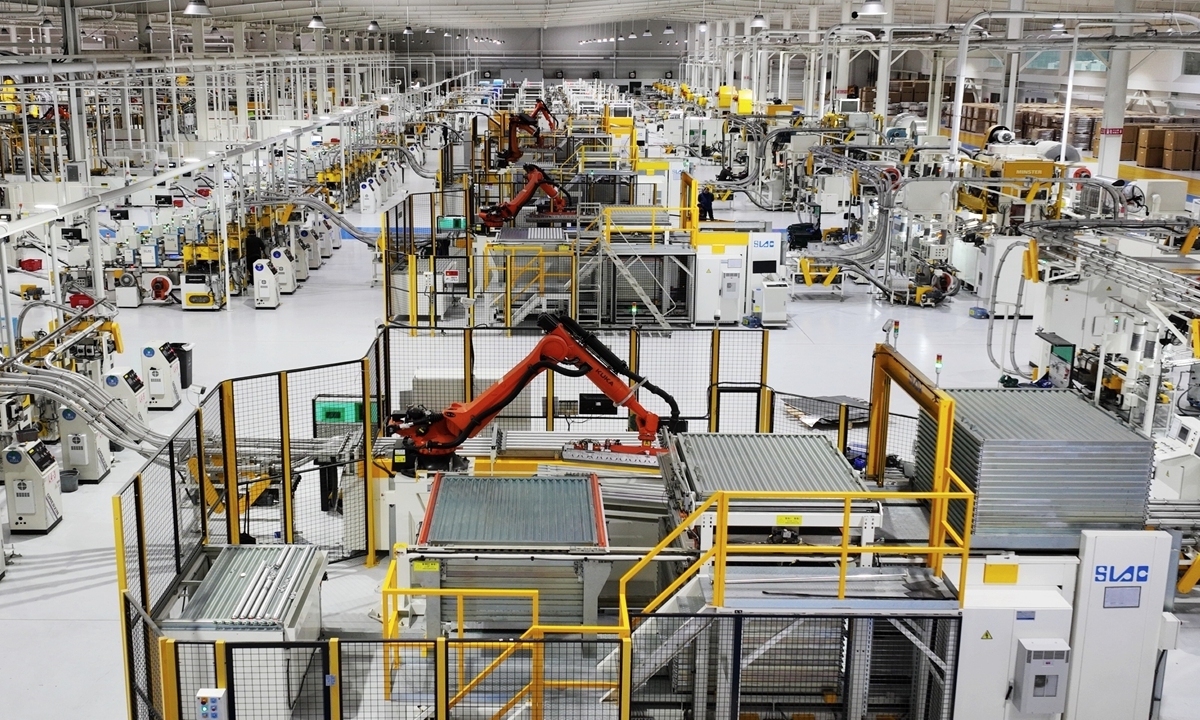
Industrial robots are operating on an intelligent production line in a smart manufacturing enterprise in Yangzhou, East China's Jiangsu Province. Photo: VCG
The latest rankings of China's 500 largest private enterprises were announced on Tuesday, with leading tech giants including Alibaba (China) Co Ltd, Huawei, and BYD retaining top positions on the list. The list shows that amid complex economic conditions, China's private sector is leveraging innovation-driven strategies to demonstrate resilience and vitality, achieving steady growth.The list, compiled by the All-China Federation of Industry and Commerce, showed that 6,350 enterprises with operating revenue exceeding 1 billion yuan ($149.34 million) each in 2025 participated in this year's survey. The top 500 were ranked by operating revenue.
According to the survey, the total operating revenue of China's top 500 private enterprises reached 44.93 trillion yuan, up 4.35 percent year-on-year. Their total net profit rose by 1.31 percent to 1.83 trillion yuan.
Compared with last year's list, the most notable change is the continued optimization of the industrial structure, with the growing weight of enterprises in the real economy, high-end manufacturing, and artificial intelligence (AI)-related sectors, Tian Yun, a Beijing-based economist, told the Global Times on Tuesday.
The list shows that high-end manufacturers continue to expand in scale, with companies such as BYD and CATL remaining among the top ranks. AI is now expanding into the real economy, with a growing number of related firms making the list, Tian said.
Among the top 500 private companies, manufacturing enterprises reported combined operating revenue of 32.22 trillion yuan, up 8.73 percent year-on-year, accounting for 71.72 percent of the total.
These companies are actively expanding into strategic emerging industries and industries of the future. A total of 311 companies have invested in 679 projects in strategic emerging industries, spanning sectors including new materials, new energy, and next-generation information technology. Meanwhile, 82 companies have launched 112 projects in industries of the future, covering areas including embodied intelligence, hydrogen energy and nuclear fusion energy, and biomanufacturing, according to the survey.
"In addition, the list shows that not only have many Chinese private enterprises continued to expand in scale, but some have also broken into the Global 500, underscoring the resilience and international competitiveness of China's private economy," the expert said.
The survey showed that the top 500 enterprises reported combined overseas operating revenue of 3.70 trillion yuan, up 11.23 percent year-on-year, and 209 made overseas investments, up 3.98 percent year-on-year.
"Another distinct feature is the continuous rise in research and development (R&D) intensity among private enterprises, which are increasingly demonstrating their crucial role in cultivating and strengthening new quality productive forces," Wan Zhe, a professor at Beijing Normal University, told the Global Times on Tuesday.
The survey showed that 60.6 percent of these enterprises have formulated strategic plans for digital transformation, while 83.4 percent are advancing green and low-carbon transition initiatives. Additionally, the top 500 reported combined R&D spending of 1.26 trillion yuan.
Private enterprises offer a micro-level window into China's macroeconomy, while these new trends showcase the transition toward an economy driven by manufacturing upgrading and tech innovation, Wan said.
"In the arena of innovation, private enterprises across the country are showing vitality, injecting powerful momentum into the economy," she said.
In the first nine months of this year, Chinese private enterprises have been pressing ahead with continuous breakthroughs. For example, Huawei recently launched the Mate XT 2 tri-fold smartphone powered by the new Kirin 9050 Pro chip, the first high-performance processor to use logic folding technology.
Separately, a humanoid robot shattered the human half-marathon record in April, and the Kimi K3 open-source large-language model unlocked new frontiers of cognitive computing.
In recent years, China has rolled out comprehensive measures to improve the business environment and shore up the confidence of private businesses. In May 2025, China's new Private Sector Promotion Law came into effect, offering legal safeguards to protect the rights and interests of private enterprises. In November 2025, China introduced measures to promote the development of private investment, which drew positive responses from private enterprises.
A meeting of the Political Bureau of the Communist Party of China (CPC) Central Committee held on July 30 further stressed the need to "improve the development environment for the private economy."
Pragmatic measures are aimed at fostering a fairer, more orderly, transparent and stable market competition environment for enterprises, thereby consolidating the foundations for the high-quality development of the private economy, experts said.
RELATED ARTICLES