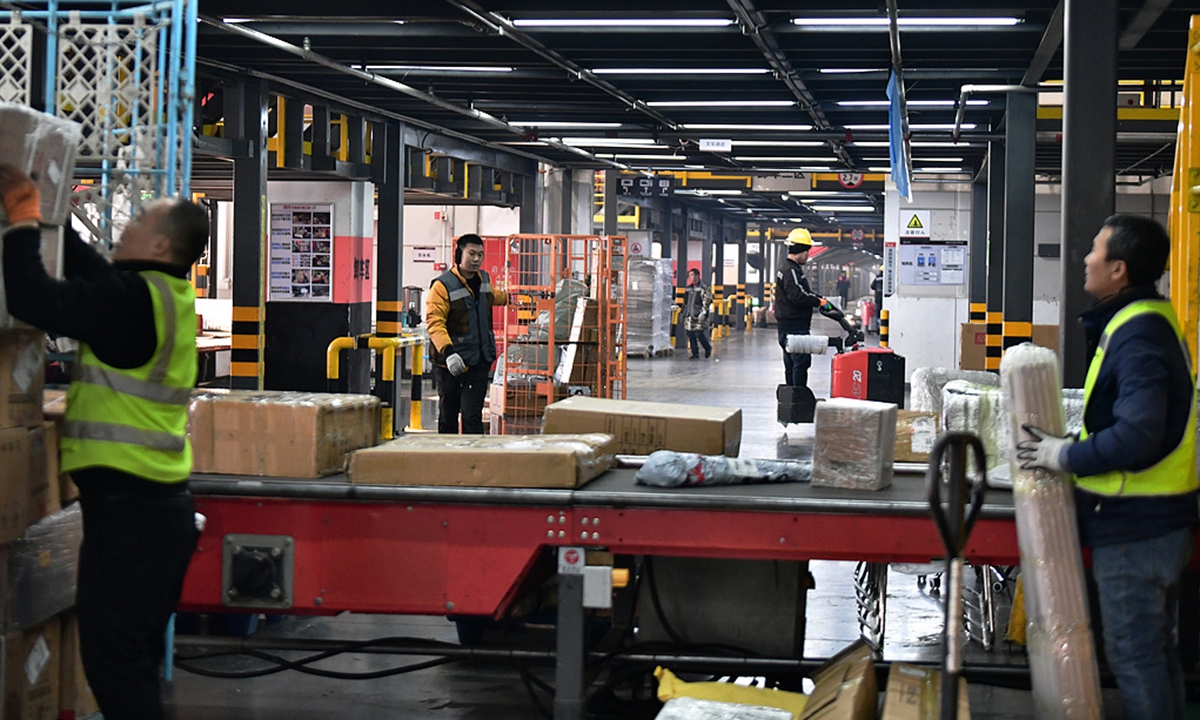
Workers are on duty at an express delivery sorting and transfer center in the development zone of Langfang, North China's Hebei Province, on December 17, 2025. The city's annual express delivery volume last year has recently surpassed 2 billion parcels for the first time, with more than 6 million packages dispatched on average each day to destinations across China and overseas. Photo: VCG
China's postal and express delivery sector handled more than 200 billion parcels in 2025, setting a historic high that indicates the sustained vitality of the country's consumption market, according to data released by the State Post Bureau on Wednesday.
The sector supported more than 14 trillion yuan ($2.0 trillion) in online retail sales of physical goods over the year, the report said, reflecting the deep integration between e-commerce and logistics.
Industry insiders said the milestone was underpinned not only by China's highly developed logistics network, but also by strong household consumption willingness driven by sustained economic vitality.
The report attributed the milestone to the nation's postal and express delivery sector better adapting to emerging consumption models such as livestreaming sales and social e-commerce, while supporting the expanded trade-in program for consumer goods.
Data also showed that in 2025, China's postal and express industry generated 1.8 trillion yuan in business revenue, up 6.4 percent year on year. Parcel volumes reached 216.5 billion pieces, marking an annual increase of 11.5 percent.
The delivery network has since continued to expand and upgrade, with major logistics hub clusters taking shape in the Yangtze River Delta, the Guangdong-Hong Kong-Macao Greater Bay Area, and the Chengdu-Chongqing region in Southwest China.
The record-breaking parcel figures offer a snapshot of China's economic resilience, reflecting not only robust consumer activity but also tangible progress in regional coordination and structural upgrading across the economy, according to industrial analysts.
Since the start of the 14th Five-Year Plan period (2021-25), China has built the world's largest and most widely used delivery network, said CMG's report.
During the Period, industry revenue has grown at an average annual rate of around 10 percent, while per-capita parcel usage has doubled.
Data from the State Post Bureau further showed that annual industry revenue rose from 1.1 trillion yuan at the beginning of the plan period to 1.8 trillion yuan, with growth outpacing most modern service sectors. Annual parcel volumes jumped from just over 80 billion to nearly 200 billion, and per-capita usage climbed from 59 to 141 parcels, the State Post Bureau said, per CMG.
Over the past year, the nation has rolled out substantial policy-backed funding to stimulate the consumer market.
In 2025, sales of goods eligible for trade-in programs exceeded 2.6 trillion yuan in value, benefiting more than 360 million consumers, data from the nation's Ministry of Commerce showed.
Since the policy was fully implemented in September 2024, more than 480 million consumer-targeted subsidies have been issued cumulatively, accelerating the uptake of a wide range of green, low-carbon, and smart products in everyday life, said the ministry.
As the policy dividends feed through an increasingly efficient logistics network, consumption demand is reaching households more quickly and at lower cost.
The rapid growth of China's postal and express delivery sector and retail industry has been central to advancing the building of a unified national market, Tian Yun, an economist based in Beijing, told the Global Times on Wednesday.
Previously, China's market was fragmented across regions and between urban and rural areas, but a modern logistics system supported by highways, railways and aviation has significantly narrowed the gaps, he noted.
Even shipments spanning several thousand kilometers are often delivered within less than a week — a rare feat for a country with more than one billion people and nearly 10 million square kilometers of territory, Tian said.
With continued policy support for major national strategies and projects, as well as large-scale equipment upgrades and consumer goods trade-in programs, Tian said the express delivery sector's rapid expansion will have lasting effects on coordinated regional development and economic restructuring. "A unified market enables more efficient allocation of production capacity and factors of production, allowing regional comparative advantages to be better utilized, boosting overall efficiency and shared prosperity."
Global Times
RELATED ARTICLES

