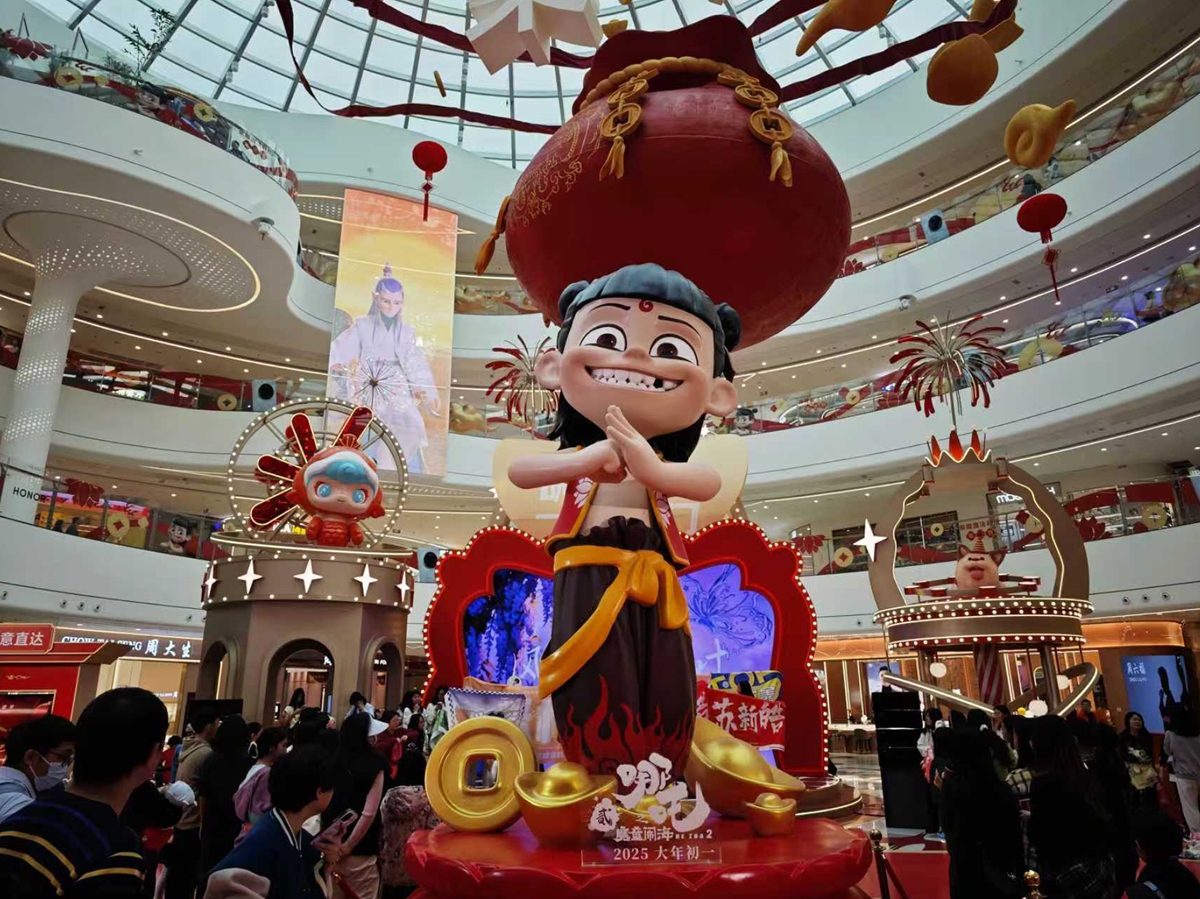
A Wanda Plaza in Zhuhai, South China's Guangdong Province, displays promotional materials for the animated film Ne Zha 2 on January 25, 2025, released during the Spring Festival holidays. Photo: Screenshot from website
January
Ne Zha 2 tops the box office; Chinese, US netizens engage in 'fact check' contest
January 2025 may go down in history as film Ne Zha 2 made a landmark debut in this month. Released on January 29, the long-awaited return of Ne Zha - five years after its first episode - astonished Chinese audiences, proving that a Chinese domestically produced animated film could achieve 15.446 billion yuan at the box office, ranking 5th in global film history and first in animation history.
This is just the beginning. By the end of the year, Zootopia 2 had earned over 4 billion yuan in China, closing in on the Hollywood box office leader in the country, Avengers: Endgame. When combined with Nobody, a film telling the story of a little pig monster who gathers three other nameless little demons to form a grassroots pilgrimage group, which took nearly 1.8 billion yuan during the summer box, these three animated films collectively raked in almost 21.2 billion yuan - nearly 40 percent of China's total annual box office.
Nine days before the release of Ne Zha 2, US President Donald Trump officially began his second term, drawing widespread attention even before his inauguration. Could the Russia-Ukraine conflict be resolved in 24 hours? Will the US launch a new round of trade conflict with China? Will the US become a country less welcoming to immigrants? The year of 2025 gave its answer.
Ten days earlier, among the unresolved matters left to Trump by the Biden administration was the looming January 19 deadline for TikTok to be sold or banned in the US. Looking back from December 31, Americans can breathe a sigh of relief that TikTok survived. At the time, however, widespread concern over losing the platform led countless US netizens and content creators to jokingly call themselves "TikTok refugees," flocking to the Chinese social media app RedNote. Sharing tips on paying the "cat tax," exploring Chinese cuisine and debating fashion trends, netizens from both countries broke through information bubbles, exchanging their daily lives and cultural habits. Some US netizens gained a better understanding and even appreciation of the real China, with some even meeting Chinese families in Shanghai in person. It became clear that despite differences between the two countries, peoples' desire for a better life is universal.

Rongrong's family from China and Brecken's family from the US take selfies at the hotel in Shanghai on March 23, 2025. Photo: Li Yawei/GT
February
DeepSeek makes a spectacular debut; 'tech powerhouse' becomes China's new label
February 2025 began with a shake-up in the tech world. In Silicon Valley, across the US, and throughout Western media, discussions went viral over a Chinese generative AI model called DeepSeek. Initially, some questioned whether Chinese AI was just a passing phenomenon, but by the end of the year, more and more Chinese traveling overseas realized that "tech powerhouse" had long become the newest and most dazzling label for China's pursuit of new quality productive forces.
While most Chinese audiences watched robots dressed in floral padded jackets performing traditional Yangge dances at the Year of the Snake Spring Festival Gala, stumbling slightly in their steps, few could have imagined that by the end of this year, robots from the same company, Unitree, could execute fully powered front flips at a Wang Leehom concert, earning praise even from Elon Musk.
Today, for foreigners who visit China, if they don't see the country's advancement in robots, do they feel that their trip is in vain?
February also brought global attention to Harbin. When the Asian Winter Games flame was lit in the "Ice and Snow City," Chinese enthusiasm for winter sports surged alongside the "China speed" displayed on the tracks. What was once considered a high-barrier sport has now become an accessible, spontaneous experience. Winter sports are increasingly embraced by ordinary families, and the ice-and-snow economy has grown into a tangible and vibrant sector of China's economy.
On February 20, as Chinese charter flights landed at Nanjing Lukou International Airport, the first group of 200 Chinese nationals involved in fraud in Myanmar's Myawaddy region was repatriated from Thailand under the law enforcement cooperation mechanism. About a month earlier, the public had witnessed with shock the disappearance of actor Wang Xing, highlighting the lawlessness of cross-border telecom fraud in northern Myanmar. By October, the four major crime syndicates in Myanmar's Kokang region were fully brought under judicial process. Within two months, Chinese official media reported that, through the coordinated efforts of China, Myanmar and Thailand, more than 7,600 Chinese nationals involved in online gambling and telecom fraud in Myawaddy had been repatriated. Furthermore, 494 buildings in KK Park involved in gambling and fraud have been demolished, and the gambling and fraud zones in Yatai New City have been completely cleared. The decisive action by the country became one of the most satisfying moments in 2025.

Photos: Screenshot from videos
March
Reading a 'certain China' through national 'two sessions'; a 'Thank You' moment in Washington goes viral
As winter fades and early spring arrives, China's annual national "two sessions" convene as scheduled. Viewed through this window, a picture of a "certain China" comes into focus - one defined by clear direction, steady progress and a growing sense of public confidence. In Chinese modernization, people's well-being remains central. This year's Government Work Report once again addresses public concerns head-on, responding directly to livelihood-related demands. The happiness and well-being of the people are the ultimate goals of promoting high-quality development. A closer look at the report reveals a policy "checklist" marked by both innovation and warmth, outlining tangible measures that shape everyday life and offering a future that feels within reach.
Attention then turns to the international stage, where diplomatic signals from Washington in March - captured in what became known online as the "thank you" moment - highlighted the volatility of today's geopolitical landscape. On March 1, Beijing time, Ukrainian President Volodymyr Zelensky visited the White House and met with US President Donald Trump and Vice President JD Vance. In a rare scene played out openly before the media, the three engaged in a heated exchange that quickly escalated. Vance accused Zelensky of ingratitude, pointedly asking, "Have you said 'thank you' once?" A reporter went further, bluntly questioning why Zelensky was not wearing a suit. More than five months later, when Zelensky returned to the White House, he abandoned his familiar military-style attire and began the meeting by repeatedly expressing thanks. Yet during his August and October visits, he was unable to speak inside the White House at all, delivering remarks instead from Lafayette Square across the street, before meeting Trump at the latter's Mar-a-Lago resort in December.
Throughout this year, as peace negotiations between Russia and Ukraine unfolded, the US, Europe, and other parties engaged in intense strategic maneuvering. Twists, setbacks, and calculations abounded, yet the dawn of peace flickered intermittently—appearing and vanishing—but never truly arrived.
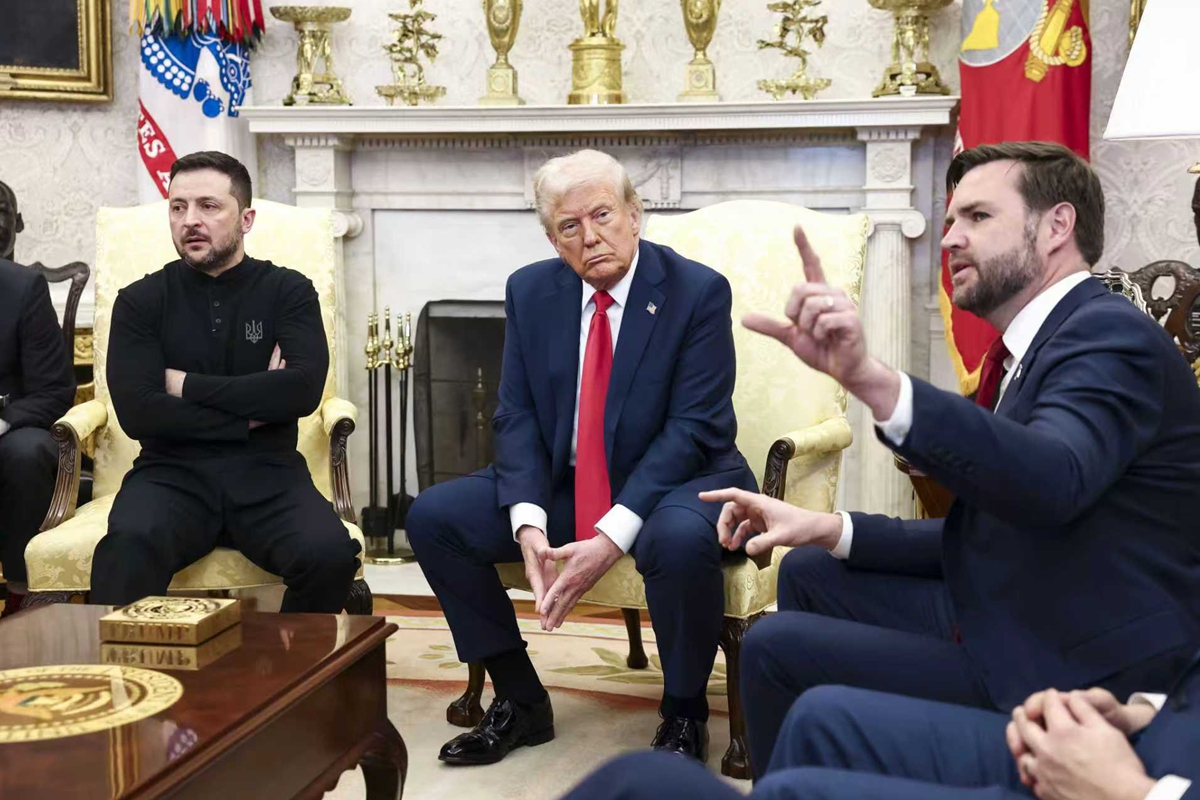
Ukrainian President Volodymyr Zelensky meets with US President Donald Trump and Vice President JD Vance at the White House on March 1, Beijing time. Photo: VCG
April
The US recklessly wields 'tariff stick'; China ready to fight till end
From April 14 to 18, Chinese President Xi Jinping paid state visits to Vietnam, Malaysia and Cambodia at the invitation of the three countries. The visits marked his first trips abroad this year and also his first to neighboring countries following the central conference on work related to neighboring countries.
Over the course of five days and four nights, President Xi attended nearly 30 events, during which he elaborated on the principles of amity, sincerity, mutual benefit and inclusiveness to guide China's diplomacy with neighboring countries, and called for building a community with a shared future among neighboring countries. After the visit, more than 100 cooperation have signed, opening a new chapter in building a community with a shared future among neighboring countries. The three countries extended the highest-level courtesy and the most grand and warm welcome to President Xi. This not only reflected genuine friendship but also sent a clear signal of the high priority they place on relations with China. As Chinese Foreign Minister Wang Yi said when briefing the media on the visit, China views its neighborhood with a broad perspective and long-term vision, demonstrating a true sense of strategic vision and responsibility. As globalization enters an "Asian moment," the world's center of gravity is shifting toward Asia, with China serving as a key driving force.
As the calendar turned to April 1, the PLA Eastern Theater Command announced joint military drills around Taiwan island. A series of cartoon images titled "Shell" quickly went viral, delivering a striking visual message: six major PLA "strike capabilities" crossed the sea and tightly encircled the island. The three cartoons, titled "Parasite poisoning Taiwan Island," "Parasite hollowing Island out," and "Parasite courting ultimate destruction," illustrate how "Taiwan independence" separatists exploit the old "Republic of China" framework as an empty shell to poison, harm, and ultimately destroy Taiwan. The message was unmistakable: the drills were a response to Lai Ching-te's repeated provocations against the one-China principle, to his relentless incitement of "anti-China resistance," and to his escalating campaign of creating "green terror."
Almost simultaneously, on the other side of the Pacific, the US began swinging its "tariff stick" with increasing frequency, leaving even the world's most remote corners unable to escape its reach. Faced with the US' reckless and arbitrary tariff policies, as well as its tactics of "coercion and inducement," countries reacted differently. US allies in Europe and Japan moved quickly to fall in line, while frustration surged across the Global South. In the East, however, one country chose to confront the pressure head-on: China.
"We will fight, if fight we must. Our doors are open, if the US wants to talk." This became China's unequivocal stance on tariff and trade wars. From Geneva in May, to London in June, Stockholm in August, Madrid in September, and Kuala Lumpur in October, the world watched closely as China-US economic and trade talks unfolded in successive rounds. When the outcomes of the Kuala Lumpur consultations were made public in October, the word that resonated most internationally was "pause" - a pause through which the world sensed China's strategic composure and its much-discussed sense of certainty.
April also brought a moment of embarrassment for US Vice President JD Vance who sparked outrage after referring to Chinese people as "peasants" in a media interview, a comment that stunned international audiences. Some media outlets in the US criticized the comment as an attack for which "Americans felt totally embarrassed," while the Chinese Foreign Ministry responded that "to hear words that lack knowledge and respect like those uttered by this Vice President is both surprising and kind of lamentable." The United Nations also condemned the remarks as "inflammatory." As for how China should be viewed, some suggested Vance might learn from an unlikely source: the internet personality known as "IShowSpeed."
As "China Travel" emerged as a global buzzword, international social media influencers - including IShowSpeed - began traveling to China. From his late-March visit to China to later arrivals by other online content creators, these influencers shared what they saw and experienced, offering global audiences an unfiltered glimpse of the real China. Even after returning home, IShowSpeed continued to mention China during livestreams, an endearing reminder that firsthand experience often speaks louder than rhetoric.
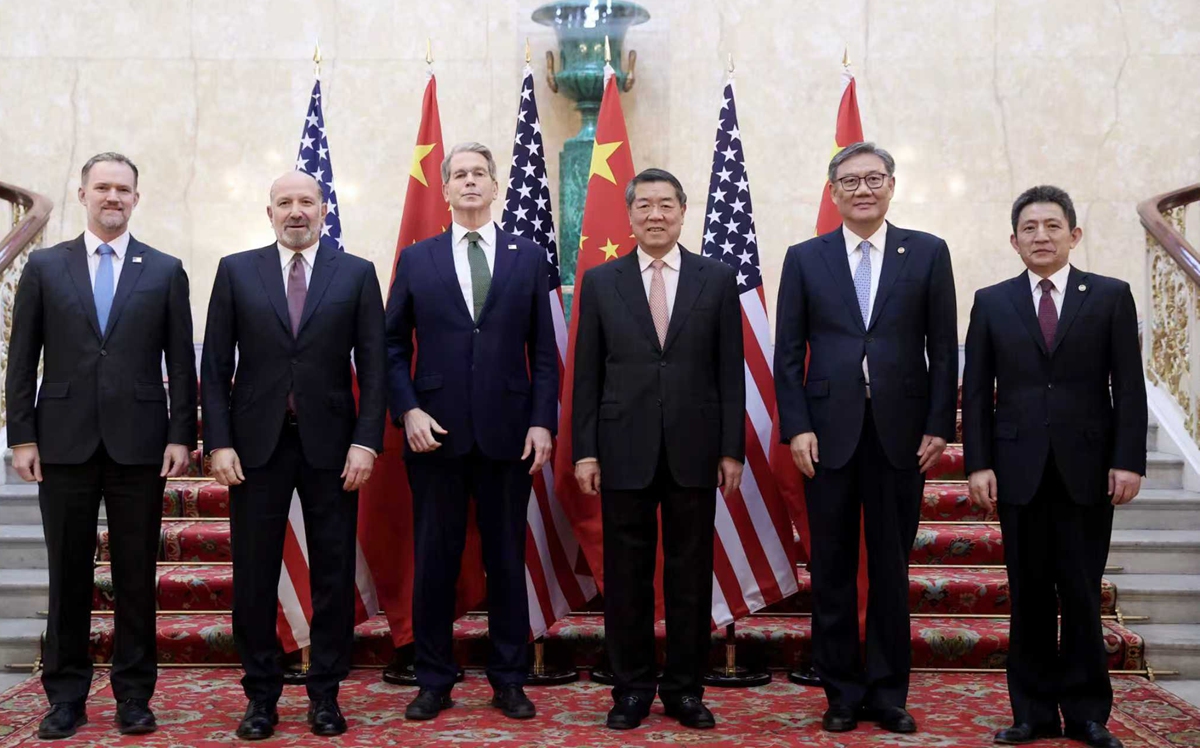
Delegations of China and the US pose for a group photo prior to the first meeting of the China-US economic and trade consultation mechanism in London, the UK, on June 9, 2025. Chinese Vice Premier He Lifeng, also a member of the Political Bureau of the Communist Party of China Central Committee, attended the meeting with US representatives.
May
The China-Russia joint statement stands out; China's J-10 shoots to fame in a fight
This year marked the 80th anniversary of the Victory of the Chinese People's War of Resistance Against Japanese Aggression and the World Anti-Fascist War, as well as the 80th anniversary of the founding of the United Nations. These historical milestones coincided, and the echoes of history resonated powerfully. From May 7 to 10, President Xi was invited to Russia and attended the celebrations marking the 80th anniversary of the Victory in the Great Patriotic War. President Xi once noted, "The best inheritance of history is to create a new history." On May 8, President Xi and President Vladimir Putin signed the Joint Statement Between the People's Republic of China and the Russian Federation on Further Deepening the China-Russia Comprehensive Strategic Partnership of Coordination for the New Era on the Occasion of the 80th Anniversary of the Victory of the Chinese People's War of Resistance Against Japanese Aggression, the Soviet Union's Great Patriotic War and the Founding of the United Nations. The title of the joint statement speaks for itself.
Almost simultaneously, hostilities broke out on the South Asian subcontinent. On May 7, India launched Operation Sindhur against Pakistan in the name of counter-terrorism. Pakistan flatly rejected India's accusations and responded with a military operation codenamed "Operation Bunyan Marsoos." The fighting between the two sides lasted for several days, and they agreed to a ceasefire on May 10 - with negotiations wrapping up as quickly as ice melting under the scorching sun.
The India-Pakistan air combat, however, catapulted China's J-10 fighter jet to instant fame. Pakistan announced that it had shot down multiple Indian fighter jets including the Rafale. The Indian government firmly denied this and even accused the Global Times, which had reposted the news, of publishing fake news - only to be contradicted by reports carried by a number of Western media outlets. On May 17, China Central Television (CCTV) stated in its news program: The J-10CE, an independently developed and exported aircraft of the Aviation Industry Corporation of China (AVIC), achieved its first-ever combat success overseas, shooting down multiple fighter jets in a real overseas battlefield without suffering any losses itself. Discussions have emerged among foreign military experts and enthusiasts: if the J-10 has delivered such combat results, then what about China's sixth-generation fighter jet?
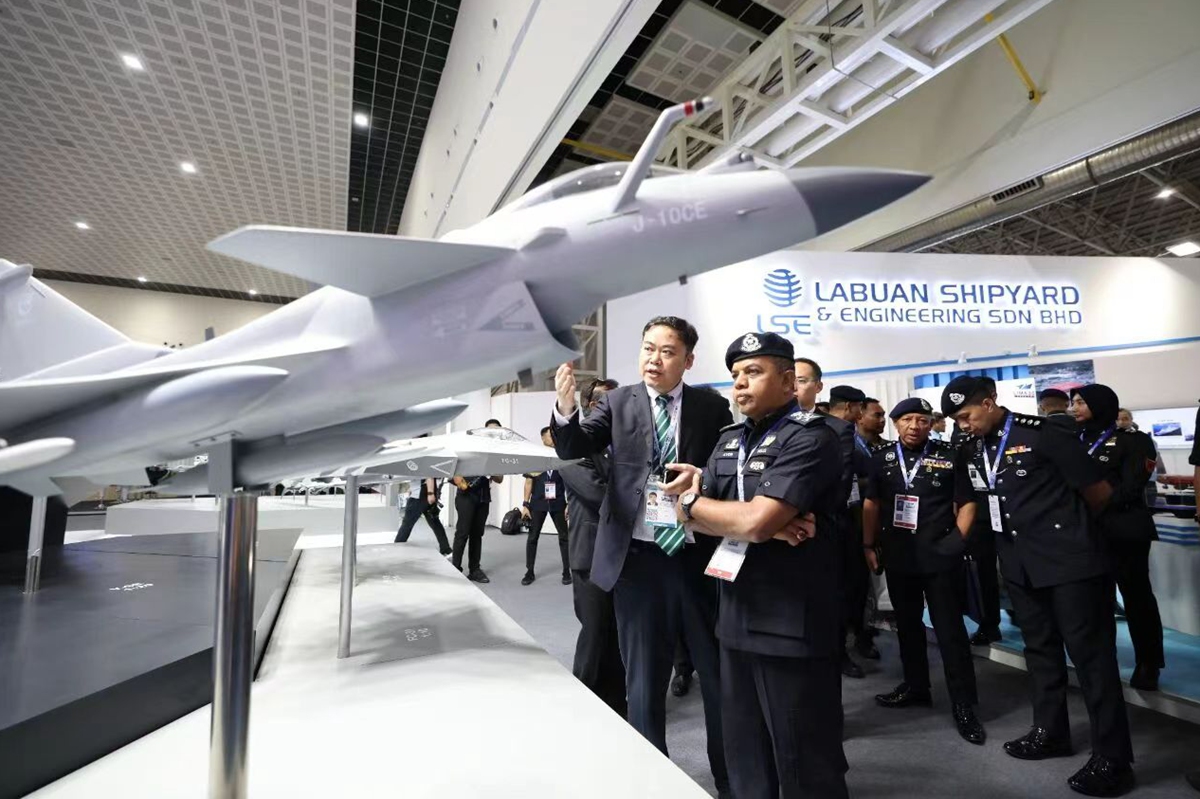
The J-10CE fighter jet model and related technology displays once again take center stage at the 2025 Langkawi International Maritime and Aerospace Exhibition in Kedah, Malaysia, on May 20, 2025. Photo: VCG
June
'Suchao' goes viral online; US intervenes in Israel-Iran conflict
Whether you follow football or not, chances are that you have come across mentions of the "Su Super League," popularly known as "Suchao," this June. Thirteen teams locked horns with each other in succession, as an unprecedented football frenzy swept across the land of "Sanzhuang Jiangsu" - a playful reference to the fierce competition among the 13 participating cities. The battle for the title "Big Brother in the South" reached a fever pitch, and the online meme "Competition First, Friendship 14th" went viral. "Nanjing Release" - the official WeChat account of local government gained massive popularity, prompting cultural and tourism authorities across the province to jump on the bandwagon with their own witty responses: Xuzhou and Suqian staged a modern-day "Chu-Han Contention"; Nanjing and Wuxi launched a playful rivalry themed "salted duck vs juicy peaches"; Suzhou rallied under the slogan "Defend Taihu Lake"; and Changzhou joked about "protecting the number of strokes in the name of the city." In no time, the sports event collided with the regional culture, sparking fascinating outcomes.
Meanwhile, the international arena has witnessed the fickleness of human relationships. After six months of political turmoil, South Korea welcomed its new president, Lee Jae-myung. Upon taking office, Lee lost no time in advancing a pragmatic foreign policy, opposing anti-China demonstrations at home. He appointed Roh Jae-heon - the son of former president Roh Tae-woo - as South Korea's ambassador to China and was laying the groundwork for a visit to China in January 2026. His gestures underscoring the importance of China-South Korea relations stand in stark contrast to those of his predecessor Yoon Suk-yeol.
Across the Pacific, the once "perfectly harmonious" relationship between Elon Musk and Donald Trump has fallen apart. Although the global audience has since seen the two appear together again, "they can never be as close as before." The quiet demise of the Department of Government Efficiency - an initiative spearheaded by Musk - and his post-crisis remark that "it's better for me to stay out of politics" have both become new footnotes to Washington politics.
In the early hours of June 13, Israel launched a sustained large-scale air campaign against Iran, which retaliated with ballistic missiles and drones. The US soon entered the fray: Trump announced that US bombers had "successfully" struck three nuclear sites in Fordow, Natanz, and Isfahan. Subsequently, Iran launched missile attacks on the US-run Al Udeid Air Base in Qatar, further complicating the situation. The 12-day Israel-Iran conflict once again laid bare the bias and double standards of some Western countries, including the US.

Lee Jae-myung, confirmed as South Korea's 21st president-elect, raises both hands to greet citizens on June 4 in Seoul, South Korea. Photo: VCG
July
The US withdraws from intl organizations again; Cambodia, Thailand clash again
The US has done it again - another exit from an international organization.
On July 22, US State Department Spokesperson Tammy Bruce announced that the US would withdraw from the United Nations Educational, Scientific and Cultural Organization (UNESCO). This marked the third time the US had declared its withdrawal from the organization. It took away the weight of its contribution checks, leaving only the fading warmth of its seat at the table of cultural multilateralism. Inevitably, it also left behind a chorus of criticisms and ridicule triggered by such typical US-style recklessness.
Back in Asia, tensions flared again along the Thailand-Cambodia border. Following a clash in May, fresh fighting broke out between the two countries on July 24, with both sides accusing each other of firing the first shot. The UN Security Council convened an emergency closed-door meeting, while Malaysia and other parties stepped in to mediate. After several days of hostilities, news emerged that Thailand and Cambodia had agreed to a ceasefire starting from 12:00 pm on July 28. The flames of war died down temporarily, yet the lull lasted a mere four months - another intense conflict erupted between the two sides in December 2025. China once again launched mediation efforts promptly.
On December 27, Cambodia and Thailand signed a joint ceasefire statement at a Special General Border Committee (GBC) Meeting between Thailand and Cambodia. Later that day, China's Foreign Ministry issued a statement, stating: China welcomes the joint statement between Cambodia and Thailand agreeing to a ceasefire; Member of the Political Bureau of the CPC Central Committee and Minister of Foreign Affairs Wang Yi met with Deputy Prime Minister and Foreign Minister of Cambodia Prak Sokhonn and Minister of Foreign Affairs of Thailand Sihasak Phuangketkeow in Yunnan from December 28 to 29, and representatives of the militaries of the three countries also took part; China will play a constructive role in its own way for Cambodia and Thailand to consolidate the ceasefire, resume exchanges, rebuild political trust, achieve turnaround in bilateral relations and uphold regional peace.
On July 25, the film Dead to Rights was released nationwide in China, sparking a surge of moviegoing enthusiasm. As this year marked the 80th anniversary of the Victory of the Chinese People's War of Resistance Against Japanese Aggression and the World Anti-Fascist War, a number of wartime films - including 731 and Dongji Rescue - have hit Chinese theaters. At the same time, several films that whitewash Japan's role in World War II, distort historical facts, and portray Japan as a so-called "victim" have been released in Japan. A cinematic "battle of narratives" has thus unfolded between China and Japan. Maybe film critics at the time could have never imagined that just months later, a woman named Sanae Takaichi would bring this clash out of the realm into reality.
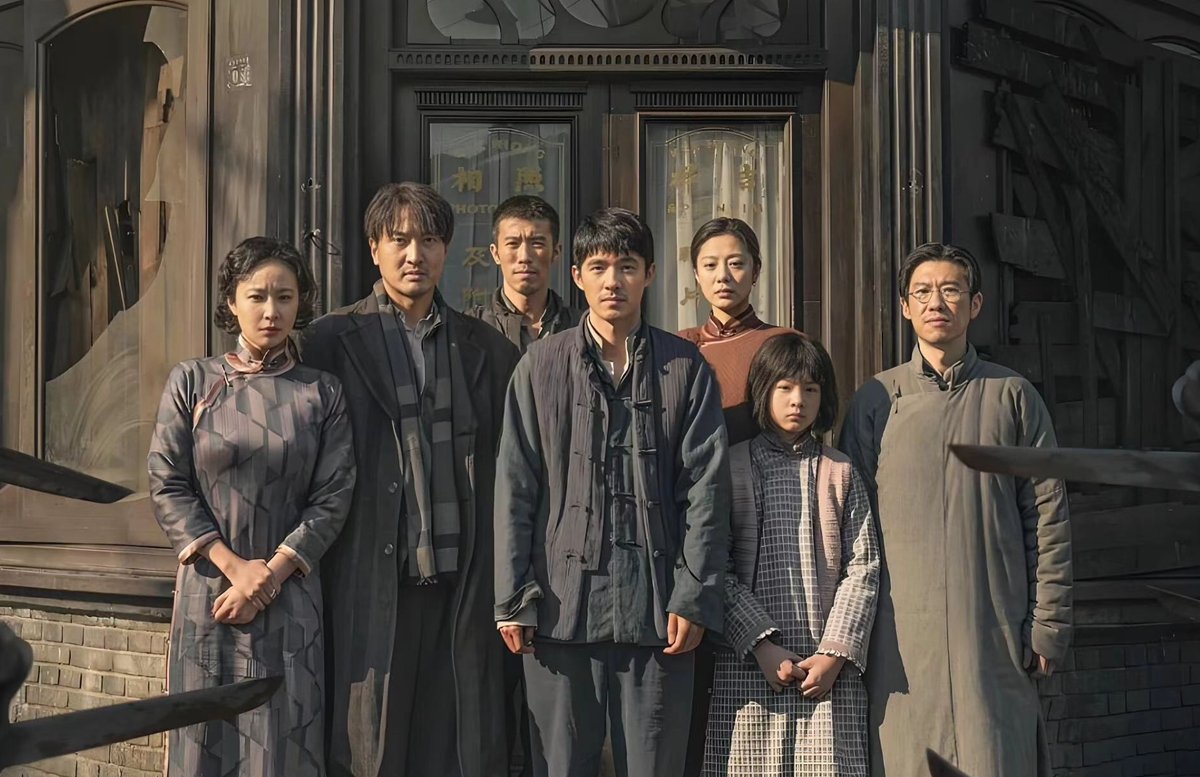
Dead to Rights still. Photo: Screenshot from website
August
Trump meets Putin in Alaska; 'Real steel' comes to life in Beijing
DeepSeek attempted to capture the moment in these words: "Sea fog from the Bering Strait drifted past the windows of an Alaska conference hall, as the 'eagle and the bear' left fresh footprints on the permafrost." Russian President Vladimir Putin on August 15 set foot on Alaskan soil, holding a nearly three-hour meeting with US President Donald Trump, who had been waiting for him. Media attention quickly shifted to the minutiae of the encounter - why fighter jets appeared behind and above them, why the two leaders rode in the same vehicle, and even why Russian Foreign Minister Sergey Lavrov wore clothing bearing the Soviet-era "CCCP" emblem. Yet amid all the twists and turns, Europe was clearly the most uneasy. "If Trump and Putin are getting along so well, what will become of Ukraine?" some asked anxiously.
On August 21, suspended Thai Prime Minister Paetongtarn Shinawatra appeared in court on her birthday to answer questions over a leaked phone call with Cambodian Senate President Hun Sen - an episode that had rattled Thailand's domestic politics and foreign relations. In the conversation, Paetongtarn addressed Hun Sen as "uncle," sought his help in resolving border issues, and criticized remarks made by a Thai military figure. Later that month, Thailand's Constitutional Court ruled that her conduct violated constitutional provisions and removed her from office. Some media outlets described her dismissal as a heavy blow to the Shinawatra family.
From August 14 to 17, Beijing hosted the inaugural World Humanoid Robot Games, drawing 280 top robot teams from 16 countries and regions to compete in 26 events across 487 matches. A week earlier, on the morning of August 8, the 2025 World Robot Conference opened in Beijing's Yizhuang area. In the sweltering summer heat, spectators watched robots play football, compete in track events, and perform cleaning services - and even witnessed real-life versions of the cinematic "Real Steel" robot battles. Such scenes, unfolding in China, felt strikingly in step with the spirit of the times.
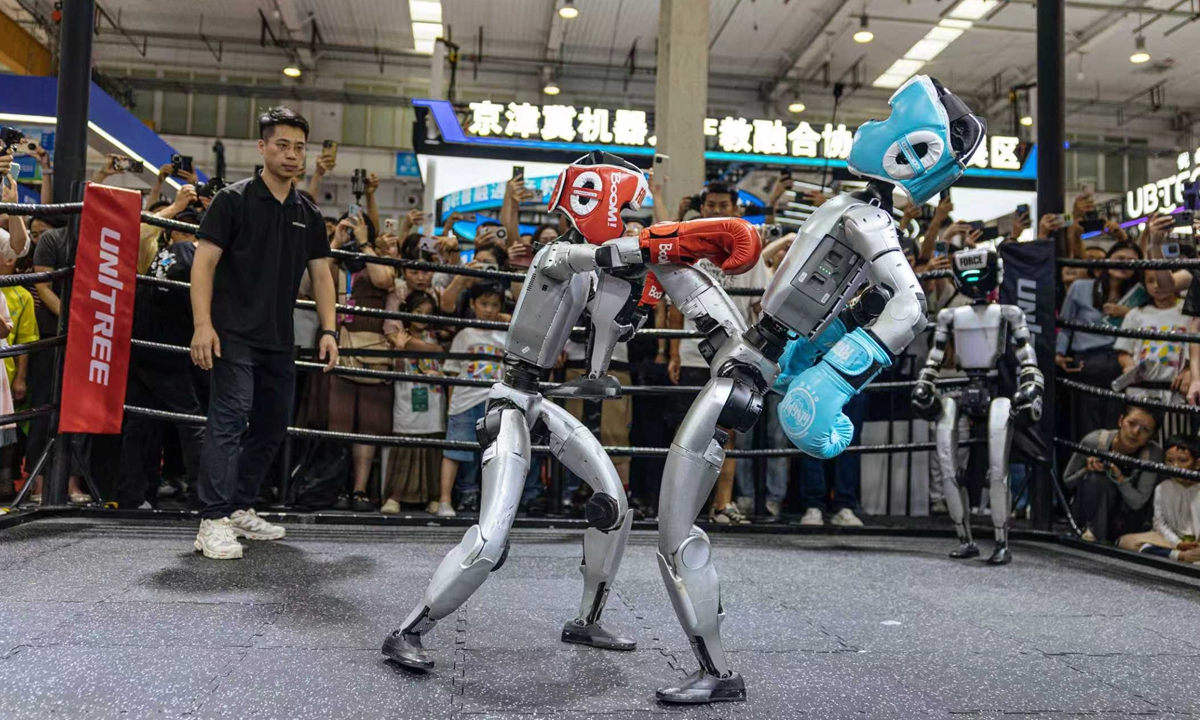
2025 World Robot Conference Photo: Li Hao/GT
September
Military parade on Sep 3 stuns the world; GGI resonates internationally
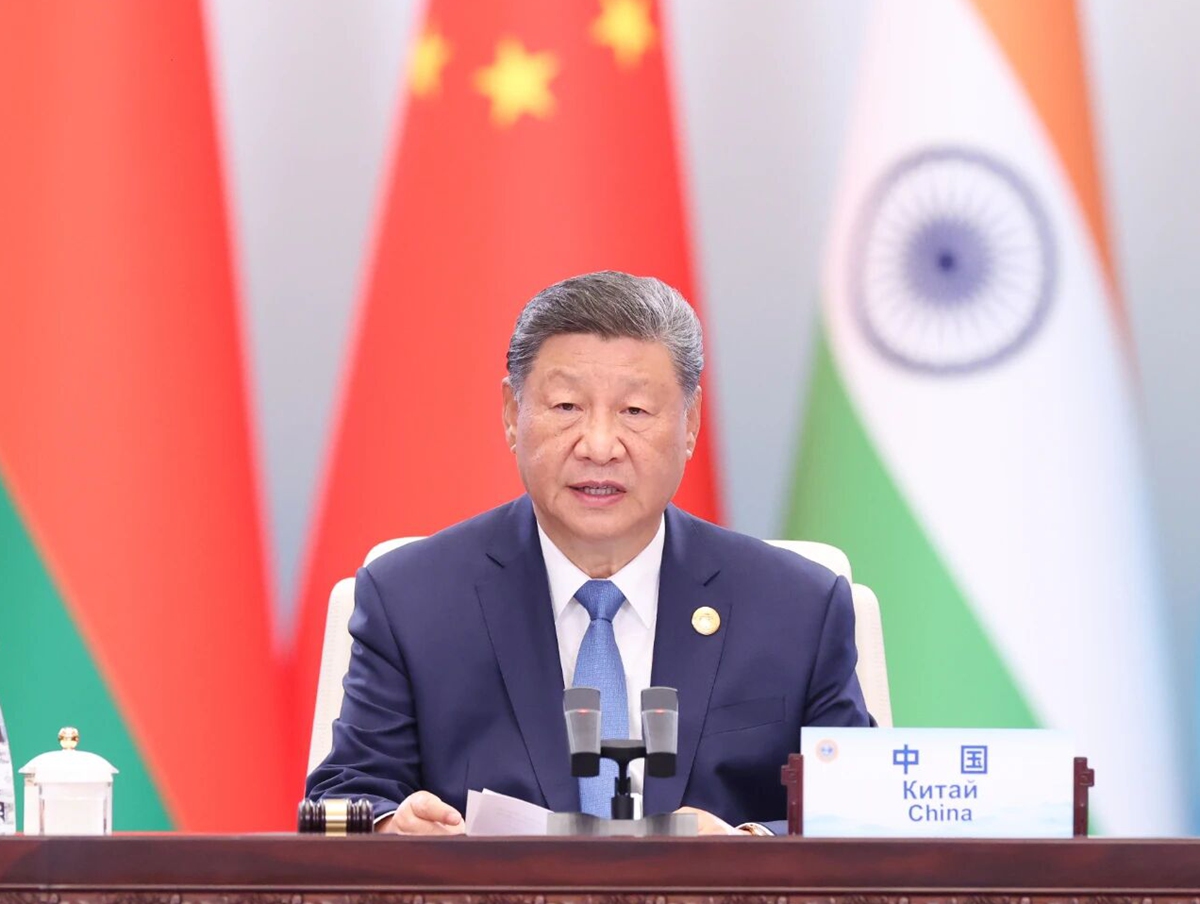
Chinese President Xi Jinping chairs the "Shanghai Cooperation Organization (SCO) Plus" Meeting and delivers a speech titled "Pooling the Strength of the Shanghai Cooperation Organization To Improve Global Governance" in Tianjin, north China, Sept. 1, 2025. Photo: Xinhua
"To this end, I wish to propose the Global Governance Initiative (GGI). I look forward to working with all countries for a more just and equitable global governance system and advancing toward a community with a shared future for humanity." On September 1, at the "Shanghai Cooperation Organization Plus" Meeting in Tianjin, President Xi solemnly proposed the GGI. Following the Global Development Initiative, the Global Security Initiative and the Global Civilization Initiative, this marks another global initiative put forward by China, generating strong resonance and widespread positive response across the international community.
The initiative was widely welcomed and supported during the meeting, as leaders highlighted the need for a more effective governance philosophy and system as the world is confronted with widening deficits in governance, challenges to sustainable development and rising unilateralism.
Two days later, a grand ceremony commemorating the 80th anniversary of the Victory of the Chinese People's War of Resistance Against Japanese Aggression and the World Anti-Fascist War was held at Tiananmen Square in Beijing. 61 foreign leaders, senior representatives of relevant countries, heads of international organizations and former political figures attended the event at the invitation of the Chinese side. During the spectacular military parade that drew global attention, a wide range of advanced weaponry became a focal point for both domestic and international media. One line in particular - "missiles DongFeng-5C have a global strike range" - resonated across the country, not only signaling a historic leap in China's strategic deterrence capability, but also igniting a deep and powerful sense of national pride among the Chinese people.
Across the sea in Japan, then Japanese prime minister and president of the ruling Liberal Democratic Party Shigeru Ishiba announced on September 7 his decision to step down as party leader, a move that caught many by surprise and fueled speculation that a political storm was brewing within Japan's political establishment.
Attention then turned to Gaza. After years of conflict and an Israeli blockade, the Gaza Strip has come to symbolize what many describe as "human suffering on earth." As global concern over the worsening humanitarian crisis continued to grow, several countries - including France, the UK, Canada and Australia - formally announced in September their recognition of the State of Palestine. History will judge these long-delayed diplomatic decisions, yet a more piercing question remains: Will the two-state solution, long shrouded in the haze of war, ever become a tangible reality?
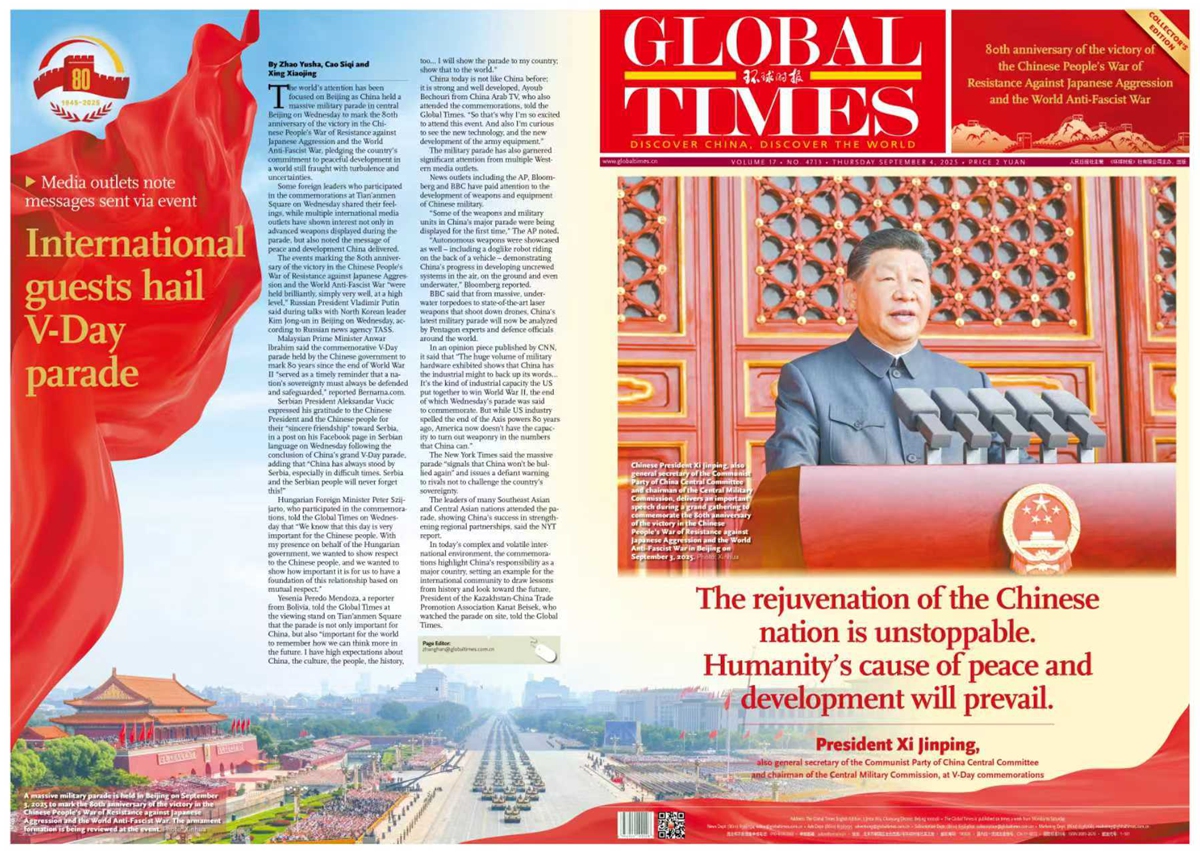
Photo: GT
October
China-US leaders' meeting draws global attention
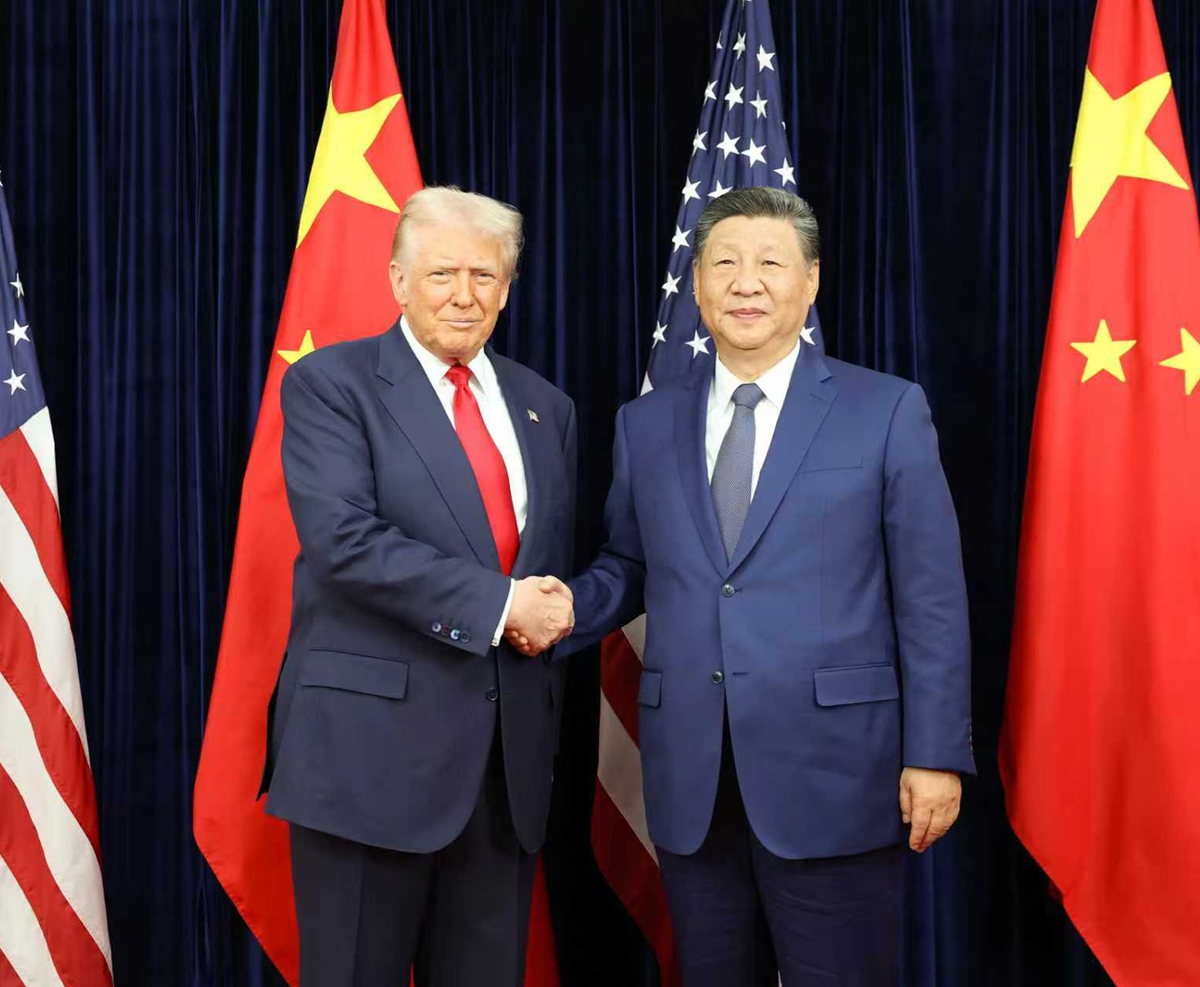
Chinese President Xi Jinping meets with US President Donald Trump in Busan, South Korea, October 30, 2025. Photo: Xinhua
"China's National Day Holiday - Welcome to South Korea." As these Chinese characters flashed across electronic signboards on the streets of Seoul, the world was reminded that the Chinese people were once again embracing their long holidays. This year, the holidays coincided with the Mid-Autumn Festival, creating an eight-day combined break. Yet while the Chinese public was immersed in festive celebrations, the US federal government shut down again at 00:00 local time on October 1 - the first such shutdown in nearly seven years. The impasse dragged on for 43 days, making it the longest US federal government shutdown on record to date.
Late October was packed with a flurry of major developments.
The 20th Central Committee of the Communist Party of China (CPC) convened its fourth plenary session in Beijing from October 20 to 23. Participants at the session also deliberated over and adopted the Recommendations of the Central Committee of the Communist Party of China for Formulating the 15th Five-Year Plan for Economic and Social Development.
Keywords such as the 15th Five-Year Plan, high-quality development through high-standard opening-up and mutual benefit and win-win results, which have sparked intense discussions among global media outlets and scholars, reflect the world's eager expectation to share in the new opportunities brought by China's development.
On October 25, 1945, Taiwan was restored to the motherland. 80 years later, on October 24, 2025, China's national legislature voted to designate October 25 as the Commemoration Day of Taiwan's Restoration, and stipulated that the country should hold commemorative activities in various forms on this day. Solemn and heartfelt commemorative events have connected the shared historical memories of both sides of the Taiwan Straits, embodied the profound bond that "compatriots on both sides of the Taiwan Straits are one family," and conveyed the firm conviction of achieving the complete reunification of the motherland.
Nearly a week earlier, on October 18, the Kuomintang held its chairperson election. Candidate Cheng Li-wun won 65,122 votes with a 50.15 percent vote rate and was elected as the new chairperson. Some media outlets in Taiwan island reported that Cheng's election made Lai Ching-te confront "the opponent the DPP fears most."
Yet we are well aware that no matter how intense the political struggles in Taiwan island are, they can never split China. The reunification of the motherland is inevitable.
From October 30 to November 1, President Xi attended the 32nd APEC Economic Leaders' Meeting in Gyeongju and paid a state visit to South Korea. The highly anticipated China-US leaders' meeting in Busan also took place as scheduled. The meeting was the first event of President Xi's visit to South Korea and the final event of President Trump's Asia tour. The two leaders' schedules aligned. Their meeting again after six years opened up a wealth of expectations for the world. After the meeting that lasted more than 100 minutes, the two leaders walked out the VIP lounge looking relaxed. Trump hailed the meeting as "amazing" and ranked it "12" on a 10-point scale in his interview with reporters.
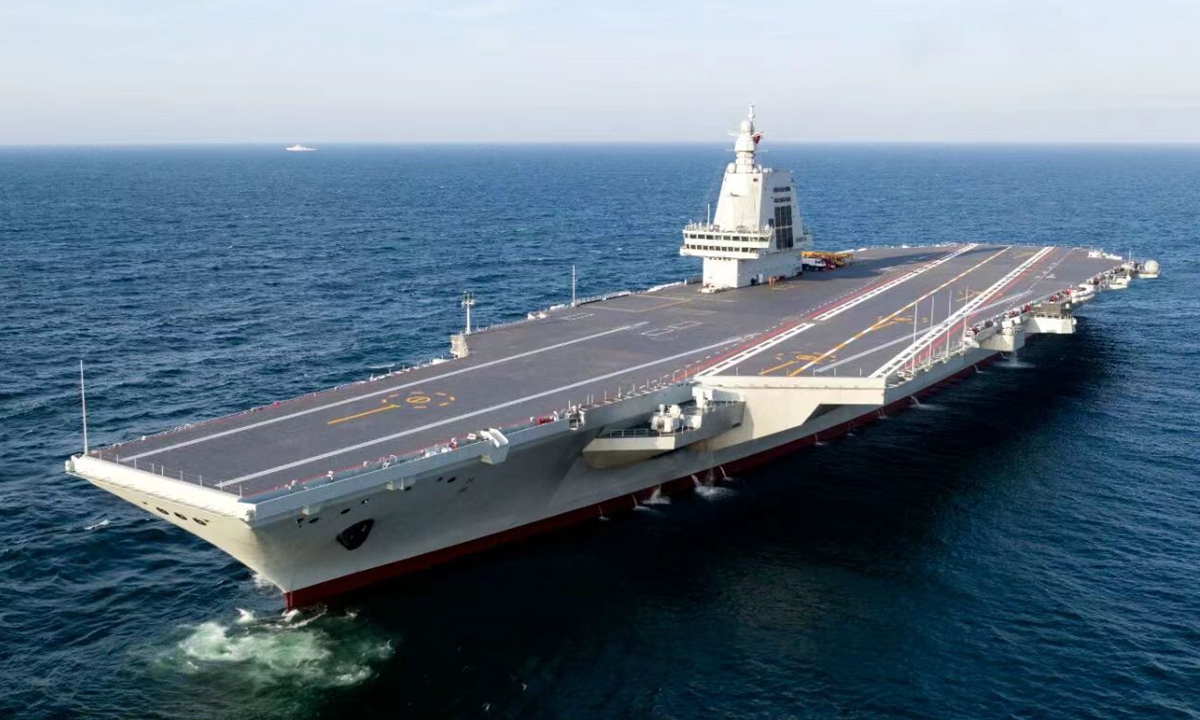
China's aircraft carrier The Fujian. Photo: VCG
November
You can always trust China's space capabilities; China officially enters the 'three-carrier era'
In November, China wrote a grand new chapter in its journey toward the stars and the sea.
On November 1, the Shenzhou-21 manned spacecraft successfully docked with the China Space Station in about 3.5 hours, setting a new record for the fastest rendezvous and docking.
Three taikonauts - Zhang Lu, Wu Fei, and Zhang Hongzhang - entered the space station and met with the Shenzhou-20 crew, marking the seventh "space reunion" in the history of China's manned space program.
On November 5, an unexpected incident caused concern when the return of the Shenzhou-20 crewed spacecraft was postponed due to an impact from tiny pieces of space debris.
But one thing remained clear: you can always trust China's space capabilities.
On November 14, the Shenzhou-20 taikonauts returned safely to the Dongfeng landing site aboard the return capsule of Shenzhou-21 spacecraft. On November 25, Shenzhou-22 was successfully launched, marking the first fully successful emergency launch mission in China's crewed spaceflight program. Within just 16 days - from launch to return - China's manned spaceflight capabilities demonstrated calm precision and confident mastery. Step by step, the Chinese people advanced steadily toward their starry dreams.
The surging tides of history also rolled toward the deep blue seas. On November 5, China's first electromagnetic catapult aircraft carrier, the Fujian, was officially commissioned, sparking global attention and signaling that China had formally entered the era of "three aircraft carriers." CNN described the Fujian as "the most advanced aircraft carrier," calling its commissioning a milestone for the Chinese navy. At around 5 pm on November 16, the navy's Sichuan amphibious assault ship completed its three-day maiden sea trial and returned safely to the shipyard, marking another major breakthrough in China's amphibious assault ship development and naval modernization.
On the evening of November 9, a major sporting event showcasing "Chinese standards and Chinese strength" - the 15th National Games - opened at the Guangdong Olympic Sports Center Stadium. For the first time, the Games were jointly hosted by Guangdong, Hong Kong, and Macao, bringing together athletes from 37 delegations across the country in the Greater Bay Area. On November 20, a poignant moment unfolded on the track: when time finally caught up with the wind, Chinese sprint legend Su Bingtian gently hung up his spikes. After completing his final appearance in the men's 4×100-meter relay final, he officially announced his retirement on December 9. The running Su Bingtian became history, taking his place in the annals of Chinese athletics.
By late November, it was hard not to feel a heavy heart.
On November 26, a rare five-alarm fire broke out in Wang Fuk Court, a public housing estate in Tai Po, Hong Kong's New Territories. Seven of the estate's eight residential buildings were engulfed in flames, resulting in heavy casualties, with at least 161 people losing their lives. The tragedy reflected the full spectrum of human experience: the grief of families, the helplessness of survivors, and the heroism of firefighter Ho Wai-ho, who sacrificed his life in the rescue efforts. It also revealed the tireless work of volunteers, the swift response of the Hong Kong Special Administrative Region's government, the high-level attention from the central authorities, and the coordinated emergency actions of multiple departments. Hong Kong police publicly expressed gratitude for the exoskeleton robots provided by the mainland to assist in rescue operations. Behind all this stood the deepest care and protection extended by the central government and people from the mainland to their compatriots in Hong Kong.
December
Japan's 'provocations'; China will never allow the historical tragedy to repeat itself
As December just started, global attention turned to China once again. French President Emmanuel Macron arrived in Beijing on December 3 to kick off his three-day state visit, his fourth trip to China. What made this visit extraordinary was the delegation of over 80 members he brought, including 6 cabinet ministers and 35 corporate executives from Airbus, Danone, EDF, luxury brands, and agricultural product sectors, which has further expanded the list of China-France cooperation. French media saw it clearly: This was a "vital strategic visit."
Beyond Beijing, Macron also traveled to Chengdu. He had a casual tea chat by the water with the Chinese leader at Dujiangyan, engaging in in-depth discussions on global affairs. He went for a morning jog at Jincheng Lake Park and interacted with teachers and students at Sichuan University. The photo of him running with a smile toward the enthusiastic crowd may well become his "life-defining photo." Some Western media noted that he received a rock star-like reception in China. Following Macron, UK Prime Minister Keir Starmer and German Chancellor Friedrich Merz are also reportedly planning visits to China in early 2026. Amid mounting global tensions and worsening trade imbalances, the fact that leaders of France, Germany and the UK have all turned their attention to China shows that China is an indispensable partner for Europe.
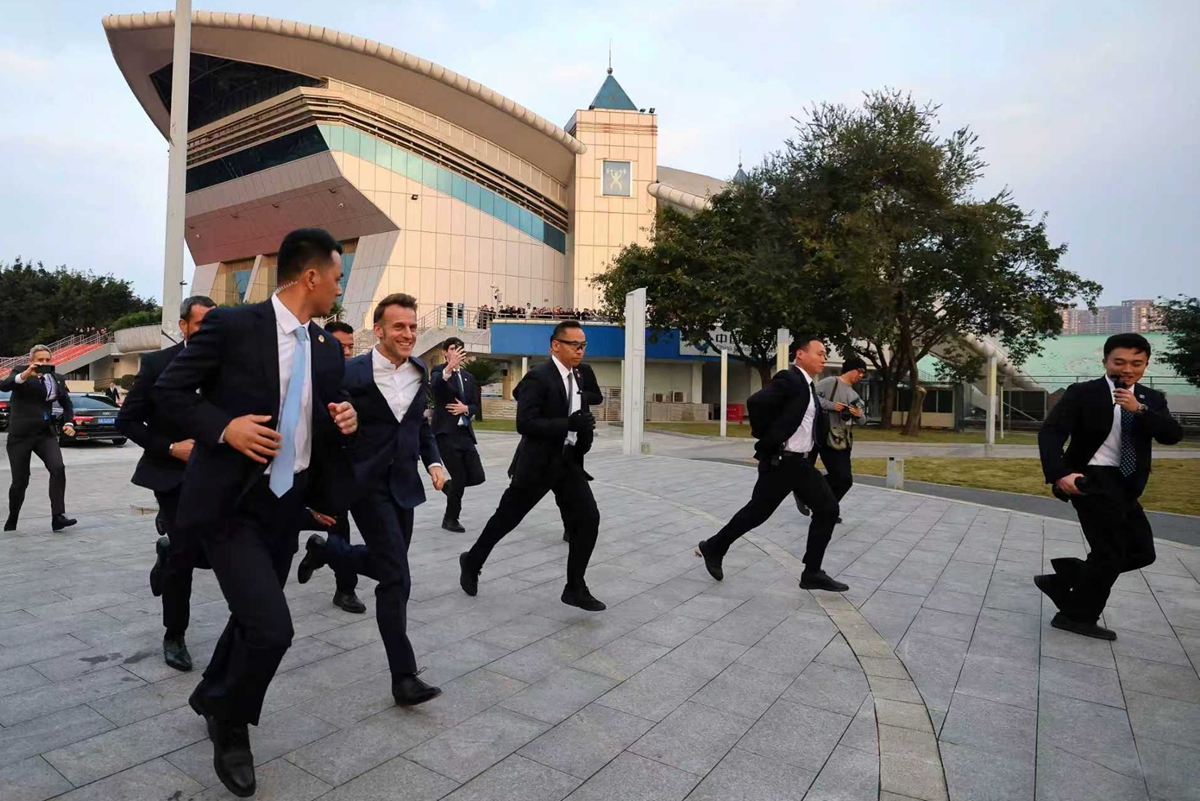
French President Emmanuel Macron visits Sichuan University on December 5, 2025, during which he jogged along the way and warmly shook hands and interacted spectators. Photo: VCG
While Europe turns its gaze eastward, some forces in Japan are engaging in reckless provocations. It all started on November 7.
On that day, Sanae Takaichi, who succeeded Ishiba Shigeru as Japan's first female prime minister, claimed during a Diet meeting on November 7 that the Chinese mainland's "use of force on Taiwan" could constitute a "survival-threatening situation" for Japan. Her erroneous remarks have sparked ongoing controversy in Japan. Subsequently, opposition parties repeatedly demanded in the Diet that she make clearer and more specific explanations on her Taiwan-related remarks, but Takaichi has consistently evaded giving clear answers on substantive issues.
Takaichi's erroneous remarks have aroused indignation among the Chinese people and prompted multiple solemn protests from the Chinese government. Faced with China's anger, Takaichi has refused to withdraw her wrong remarks, repeatedly resorted to word games, only claiming that Japan's policy on Taiwan as stipulated in the 1972 Sino-Japanese Joint Statement "has not changed," while refusing to clarify the specific contents of the unchanged. Such a reckless attitude of neglecting China-Japan relations has also triggered strong protests within Japan.
Meanwhile, the Takaichi cabinet, in order to hype up the so-called "China military threat," such as the so-called "Chinese aircraft carrier threat," even resorted to open lies on issues like the so-called "radar illumination" stunt. In action, it has promoted the relaxation of Japan's military restrictions, pushed for revising the Three Non-Nuclear Principles, and even dared to defy international public opinion by floating the claim that "Japan should possess nuclear weapons." Insightful figures in Japan and Chinese public opinion have reached a high degree of consensus: by taking the path of "neo-militarism," the Takaichi's administration is leading Japan to its own destruction. China will never allow the revival of militarism or the recurrence of historical tragedies.
From December 10 to 11, the annual Central Economic Work Conference was held in Beijing. It was noted at the meeting that 2025 is a truly extraordinary year, and the main targets for economic and social development will be successfully achieved. As the 14th Five-Year Plan (2021-25) is set to approach a successful conclusion, the meeting noted that over the past five years, China has effectively navigated various shocks and challenges, and achieved new major accomplishments in the cause of the Party and the country. The meeting also emphasized the need to more closely unite around the CPC Central Committee with Comrade Xi Jinping at its core, strive to achieve the goals and tasks for economic and social development next year and get the 15th Five-Year Plan period (2026-30) off to a good start.
December 18 marked a milestone in China's opening-up. The Hainan Free Trade Port officially launched island-wide special customs operations, welcoming the world with a more open stance. This is not a "wall" that shuts people out, but an open "door"- a "revolving door" and "fast lane" fully oriented toward both the Pacific and Indian oceans. The special customs system as offering "freer access at the first line," and "regulated access at the second line," close the old regulatory framework and tariff barriers while opening unprecedented levels of freedom and facilitation. In the role of a "pathfinder," Hainan invites the world to share in the new opportunities of China's development.
Just as one might have thought this report concluded, the PLA Eastern Theater Command's official WeChat account posted a notice at 7:30 am on December 29. Senior Colonel Shi Yi, spokesperson of the PLA Eastern Theater Command, announced that starting from December 29, the PLA Eastern Theater Command is dispatching its Army, Navy, Air Force and Rocket Force troops to conduct joint military drills code-named "Justice Mission 2025" in the Taiwan Straits and areas to the north, southwest, southeast and east of the Taiwan island, focusing on subjects of sea-air combat readiness patrol, joint seizure of comprehensive superiority, blockade on key ports and areas, as well as all-dimensional deterrence outside the island chain. With vessels and aircraft approaching the Taiwan island in close proximity from different directions, troops of multiple services engage in joint assault training so as to test their joint operations capabilities. It is a stern warning against "Taiwan Independence" separatist forces, and a legitimate and necessary action to safeguard China's sovereignty and national unity.
Some media on the island described the exercises as a PLA "Taiwan-surrounding raid."
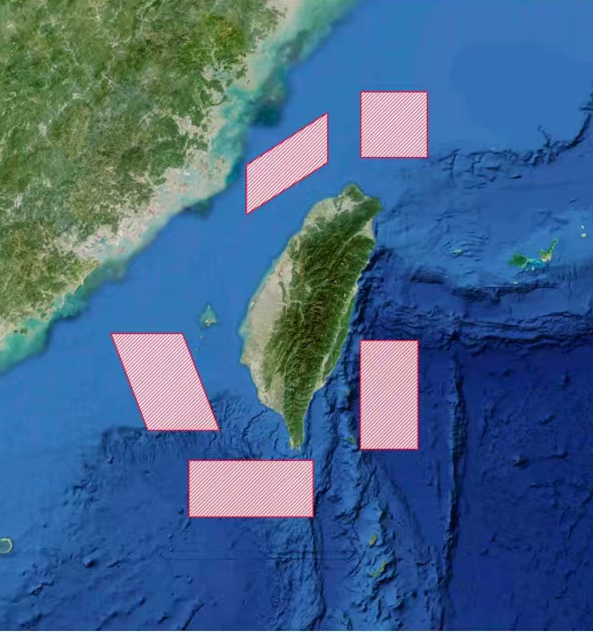
This photo shows a sketch map released by the Eastern Theater Command of the Chinese People's Liberation Army (PLA) to indicate the areas involved in joint exercises conducted around Taiwan Island. Photo: the PLA Eastern Theater Command
And so, 2025 has passed,
let's not dwell on nostalgia.
2026 is about to arrive,
and let's press onward,
calm, confident, and perfectly at ease.