Catering to self-reward trend, foreign brands tap China's booming emotional consumer market
Foreign brands tap China's booming emotional consumption market
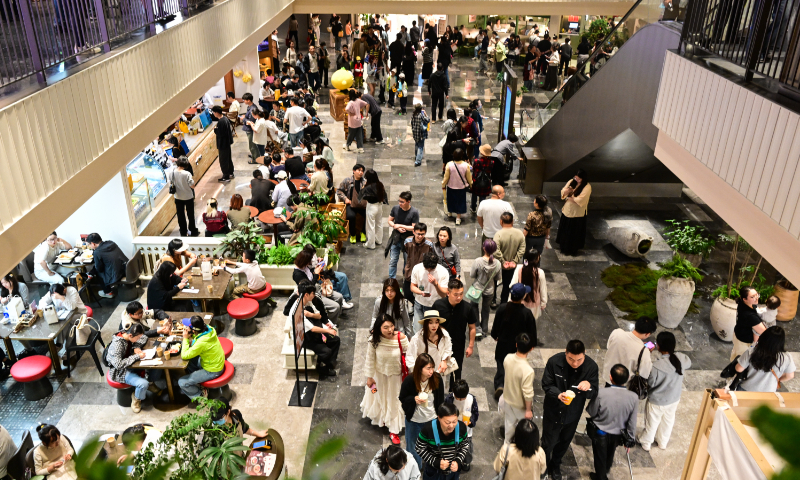
People shop in a department store in Suzhou, East China's Jiangsu Province, on May 4, 2026. Photo: VCG
As it enters its fifth year of operation, Universal Beijing Resort is doubling down on immersive experiences. The resort has unveiled two new offerings: Asia's first "Fast & Furious" indoor thrill ride and a nighttime spectacular at the Lagoon, aiming to upgrade its content portfolio and deliver enhanced immersive experiences.
As a benchmark foreign-invested cultural and tourism project, the resort's continuous IP development reflects a broader shift among foreign enterprises. Moving beyond traditional product-export strategies, international brands are now tapping China's growing experiential consumption market through content innovation, scenario building and emotional resonance.
Universal Beijing Resort is not alone. On September 10, a senior executive from The Walt Disney Company said that young Chinese shoppers are no longer purely purchasing physical goods but are also seeking emotional connection through shared interests and lifestyle scenarios.
A Chinese expert said that these strategic shifts show that foreign brands are moving from simple product exports to localized, emotion-driven operations, reshaping their China strategies to capture booming opportunities in the country's evolving consumer market.
Over the past three years, the number of foreign-invested enterprises operating in China has risen year on year, exceeding 530,000, while stock of foreign investment stock has surpassed $3.6 trillion. The vast majority of these foreign firms have chosen to deepen their presence in China and keep expanding their investments, according to the Ministry of Commerce in May of this year.
Beyond theme parks
This continued foreign capital is also reflected in how international brands are adapting their offerings to cater to the evolving local consumer preferences, especially the rising demand for emotional consumption.
Beyond theme parks, foreign brands are actively betting on China's emotional economy across diverse sectors.
At an industry conference on September 18, Daniel Hui, president of Amorepacific China, noted that younger Chinese consumers increasingly prioritize emotional value alongside product efficacy, urging brands to refine their localized strategies to adapt to the evolving demand, according to chinanews.com.cn.
"A new generation of Chinese consumers has grown into the '3D Generation,' equipped with sharp discernment and rational thinking - pursuing efficacy and value for money while also valuing emotional fulfillment," Hui said.
Meanwhile, consumer spending has expanded beyond traditional wedding and gift-driven demand.
Self-reward consumption, milestone purchases and mood-enhancing purchases have become mainstream forms of material-based emotional consumption.
International diamond brands have accordingly adjusted their localized marketing and product strategies to align with Chinese consumers' changing emotional preferences.
"What we emphasize even more is its emotional value," Loletta Lai, vice president of natural diamond marketing for APAC at De Beers Group, told the Global Times.
"How to win the Z-generation has become the core breakthrough and long-term key to tapping China's new emotional consumption market," Lai said.
Lin Qiang, president of the Shanghai Diamond Exchange, echoed this view. He said that young people have distinct consumption philosophies and patterns, forcing industry practitioners to fully rethink their business models. Diamonds can represent deeply personal emotions spanning family ties, personal anniversaries and friendships. Contrary to common stereotypes, quality diamond products are available for only several thousand yuan, not just high-end pieces costing hundreds of thousands, making them accessible for emotion-driven consumption.
Firm confidence
The State Council, China's cabinet, has released a set of measures in a circular to promote the high-quality and efficient development of the services industry, better leveraging its role in supporting industrial upgrading, meeting people's livelihood needs, and driving employment expansion.
According to the circular made public on April 21, the services sector will make significant progress in its high-quality development by 2030, with the total scale expected to reach 100 trillion yuan ($14.58 trillion).
As a growing segment of consumption, emotional consumption focuses on emotional resonance, psychological comfort and self-identity. Favored by young people, it has developed into a growing market covering a wide range of diversified business segments.
Starbucks has accelerated its "one store, one concept" strategy in China, launching experiential premium stores at landmark shopping malls. These spaces are designed not only for coffee consumption but also as quiet retreats for young urban dwellers seeking relaxation and mental respite, offering another example of foreign brands catering to emotional demands.
Sephora revamped its Shanghai flagship to create immersive social spaces, viewing China as a core source of innovation for its global business.
"The Chinese market is never an 'option', but an irreplaceable 'must-have.' Having operated in China for more than 30 years, we are a firsthand witness to its development," Hui from Amorepacific said. "We hold long-term confidence and trust in the Chinese market and will continue to invest steadily and strengthen our core capabilities."
"These market moves reflect foreign firms' sharp grasp of China's consumption upgrade and signal a shift in their China strategies," Hu Qimu, professor at the Maritime Silk Road Institute of Huaqiao University, told the Global Times on Tuesday.
Previously, foreign brands often replicated overseas products and business models in China. Now they have moved past this copy-paste approach. By adapting more closely to local consumer preferences, they are tapping Chinese shoppers' demand for stress relief, emotional comfort and self-expression.
By shifting from selling functional goods to crafting immersive experiences and emotional connections, foreign companies are adopting more refined, China-focused operations to tap opportunities in the country's growing emotional consumption market, he said.
China's consumer market showed a stronger move toward smart, health-related and higher-quality products in the first eight months of 2026, as the combined retail sales of goods and services rose 2.5 percent year on year in the January-August period.
Demand for tourism consulting and rental services, as well as cultural, sports and leisure services, maintained relatively rapid growth during the summer holiday season, as Chinese consumers increasingly spent on services alongside physical goods, according to an official from the National Bureau of Statistics.
RELATED ARTICLES