ARTS / CULTURE & LEISURE
Young makers from different countries build connections in Nanning
From AI to cultural exchange
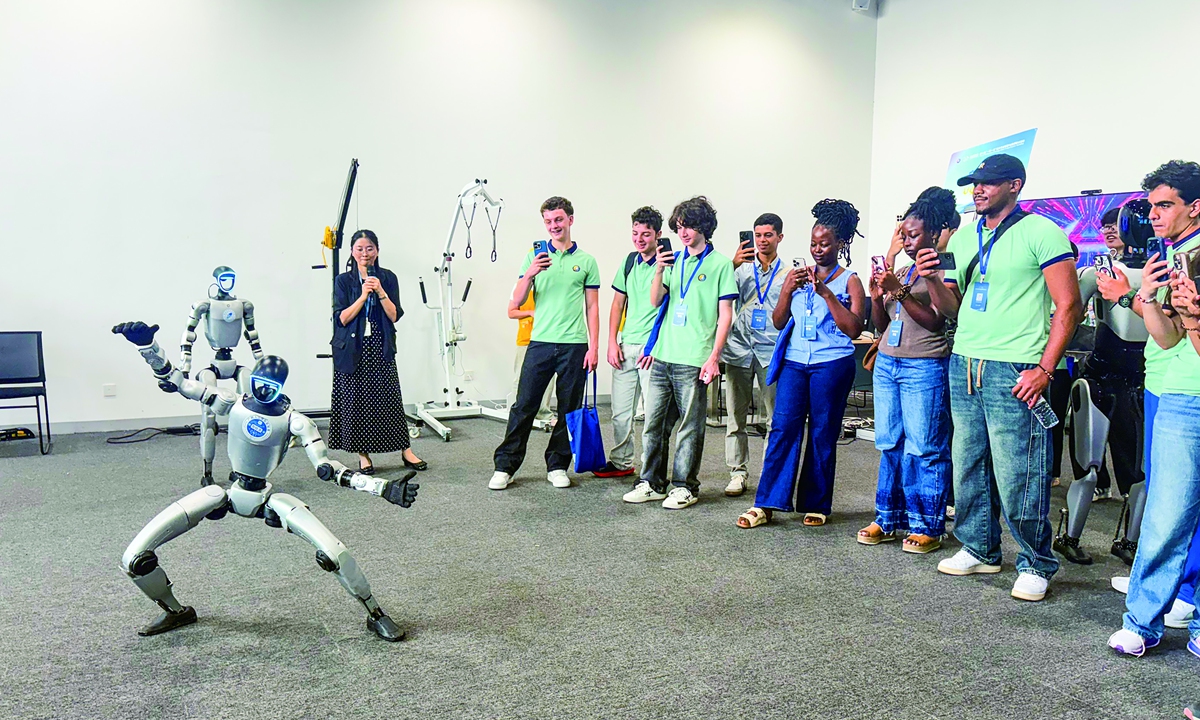
Foreign students watch a humanoid robot perform kung fu in Nanning, South China's Guangxi Zhuang Autonomous Region, on September 21, 2026. Photo: Li Hang/GT
"There are robot dogs, cars and manufacturing technologies, nail machines and AI coffee machines," Nang Si Thoung, a student at Brainworks International School in Myanmar, told the Global Times, recalling what she saw during her days in Nanning, South China's Guangxi Zhuang Autonomous Region. "They provided us with examples, not only explanations, so it was really clear."
For 16-year-old Thoung, it was one of the most memorable parts of her first trip to China.
Thoung is among the more than 200 students and teachers from 24 countries and regions taking part in the 10th Belt and Road Teenager Maker Camp & Teacher Workshop that was held in Nanning from September 18 to 23.
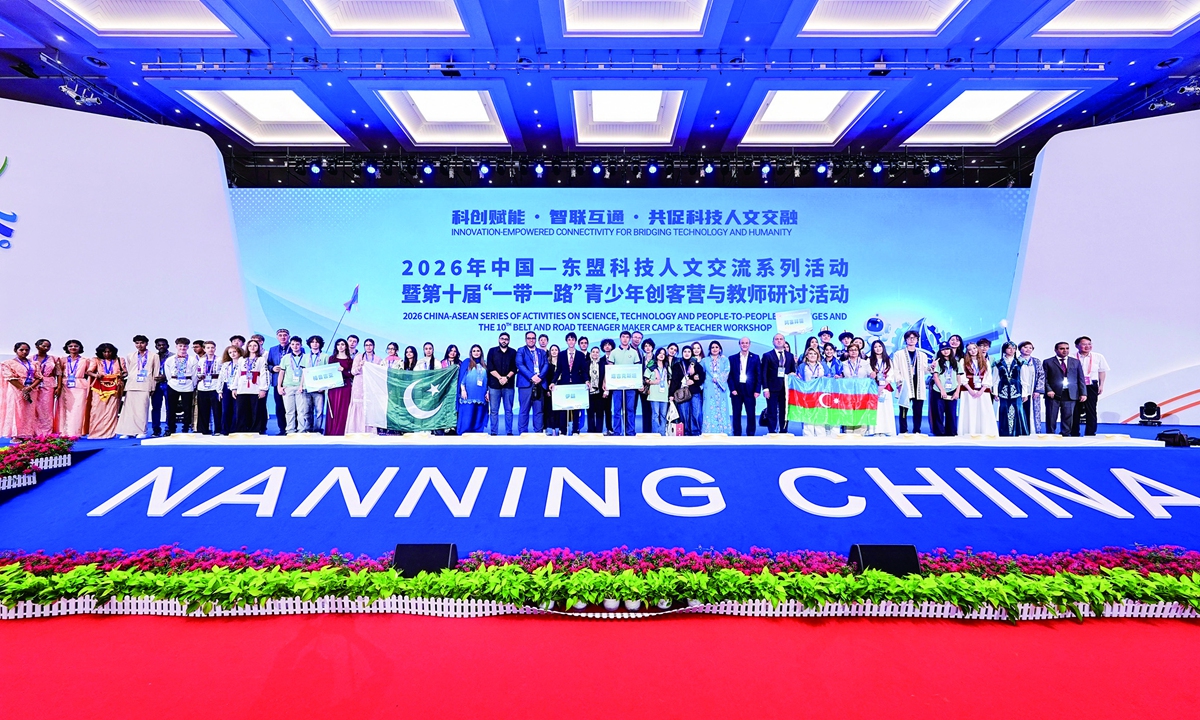
Students from different countries pose for a group photo in Nanning, Guangxi, on September 19, 2026.Photo: Courtesy of the organizers
Held under the theme "AI Education for a Better Future," the event brought together young people around two major themes, AI and the natural sciences, with 17 maker activities, visits to universities and research institutions, as well as science and cultural exchanges.
During their stay, the students visited local universities and took part in maker activities featuring smart AI watering systems, intelligent unmanned boats, intelligent voice cars, AI video agents and robot dogs.
For the young participants, the camp offered a chance to experience Chinese technology not simply through demonstrations, but by trying it out for themselves.
Seventeen-year-old Nene from Georgia was also visiting China for the first time, and the technology she encountered in Nanning left a strong impression.
"China is living in the future," she told the Global Times. "Seeing the robots interacting with me took me to another level."
One moment that stood out was watching a robot imitate a student who had started dancing. Nene said the robots she saw in Nanning appeared far more advanced than those she had seen online two or three years ago.
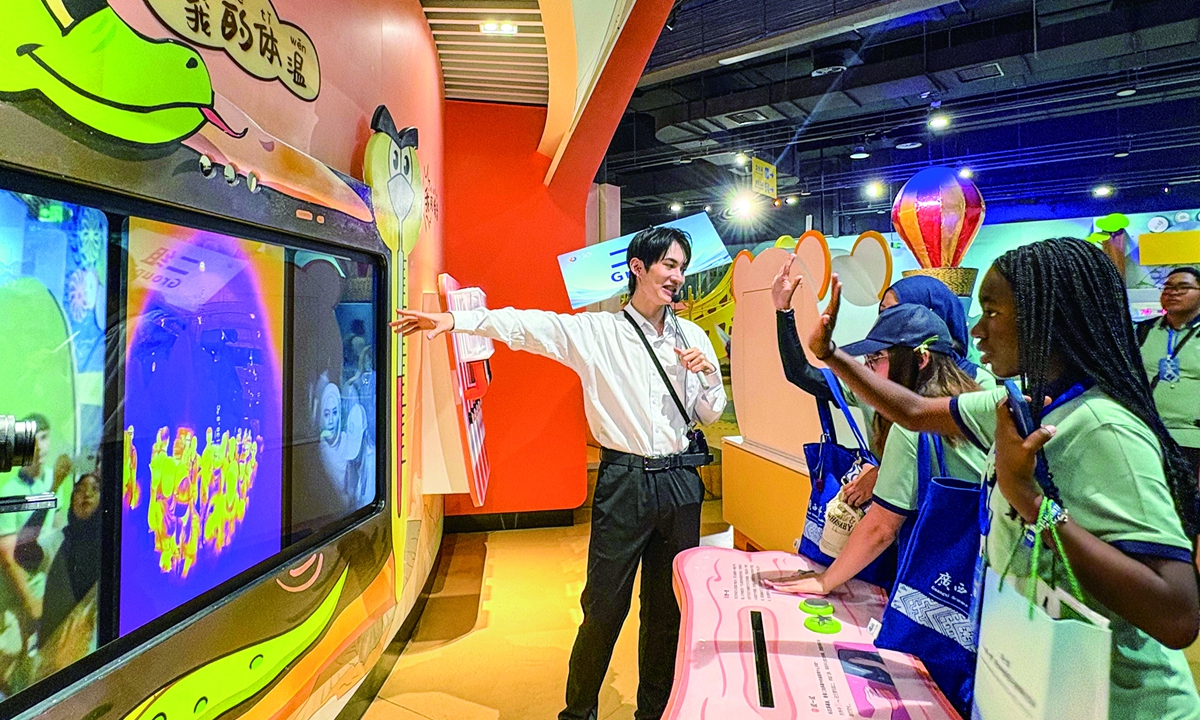
Students try out an interactive display at the Guangxi Science and Technology Museum in Nanning, Guangxi, on September 20, 2026. Photo: Li Hang/GT
The trip also gave her a chance to see other sides of China. She enjoyed visiting a botanical garden and exploring Nanning, where futuristic technology sits alongside natural surroundings.
Dinah Grace Anyait, a teacher leading the Ugandan delegation, saw the value of the program in both what students learn and who they meet along the way.
"This program has brought together people from different cultures, different countries, different races, and they work together to achieve one goal," Anyait told the Global Times. "So if they continue working together like this, that means the world is going to be a better place."
She also stressed the importance of introducing young people to technology early as it increasingly becomes part of everyday life.
"Currently you cannot do anything without technology, without AI," she said. "It is a way of life. It is the way to go."
For the organizers, the camp is also an opportunity to help young people build connections across borders.
Hatem Slimane, national president of the Tunisian Association of the Future of Sciences and Technology, told the Global Times that bringing students together through education can help them build connections that continue beyond the camp.
"Having connections, having more friends, making their future connections locally or nationally or internationally, I think it starts from here," he noted.
The camp is designed as a non-competitive environment in which students can experiment, make mistakes and learn from the experience, according to Slimane.
The organizers also hope that the relationships formed during the event will develop into longer-term connections.
Nene's experience offered one example. She shared with the Global Times that she made friends with participants from several countries, including China. Meeting people face to face also gave her a new impression of Chinese people, whom she found to be not only hard-working but also caring.
The students also explored Nanning's local culture, from its food and historic neighborhoods to its traditional crafts.
In Nanning's Sanjie Liangxiang, literally "three streets and two alleys," a renowned local historical and cultural area, the students stepped away from laboratories and technology exhibitions and into one of the city's historic neighborhoods.
They sampled local food, explored cultural products and admired Guangxi's distinctive Zhuang brocade, experiencing forms of Chinese culture through direct encounters.
Nene told the Global Times that she enjoyed traveling around Nanning and getting to know more about the local people during the trip.
The experience also changed the way Thoung saw China. Before the trip, her impression of the country had mainly come from TV dramas, movies and food.
After several days of visiting technology exhibitions, taking part in hands-on activities and meeting students from different countries, she gained a more varied impression of China.
This year's Belt and Road Teenager Maker Camp & Teacher Workshop, co-hosted by the China Association for Science and Technology and the Guangxi Zhuang Autonomous Region government, is centered in Guangxi, with parallel sessions held in Shaanxi, Xinjiang, Ningxia and Yunnan.
The program brings together participants from key Belt and Road regions, including ASEAN, Central Asia, the Arab world and the Lancang-Mekong region.
The annual exchange of the Belt and Road International Science Education Consortium (BRISEC) was held alongside the 10th Belt and Road Teenager Maker Camp & Teacher Workshop.
It marked the consortium's first return to Guangxi for annual exchanges since 2019, bringing together representatives from 27 member organizations in 17 countries and regions to deepen practical cooperation in science education among Belt and Road countries, according to the organizers.
RELATED ARTICLES