Tesla to audit Chinese suppliers to prepare for mass humanoid robot production: report
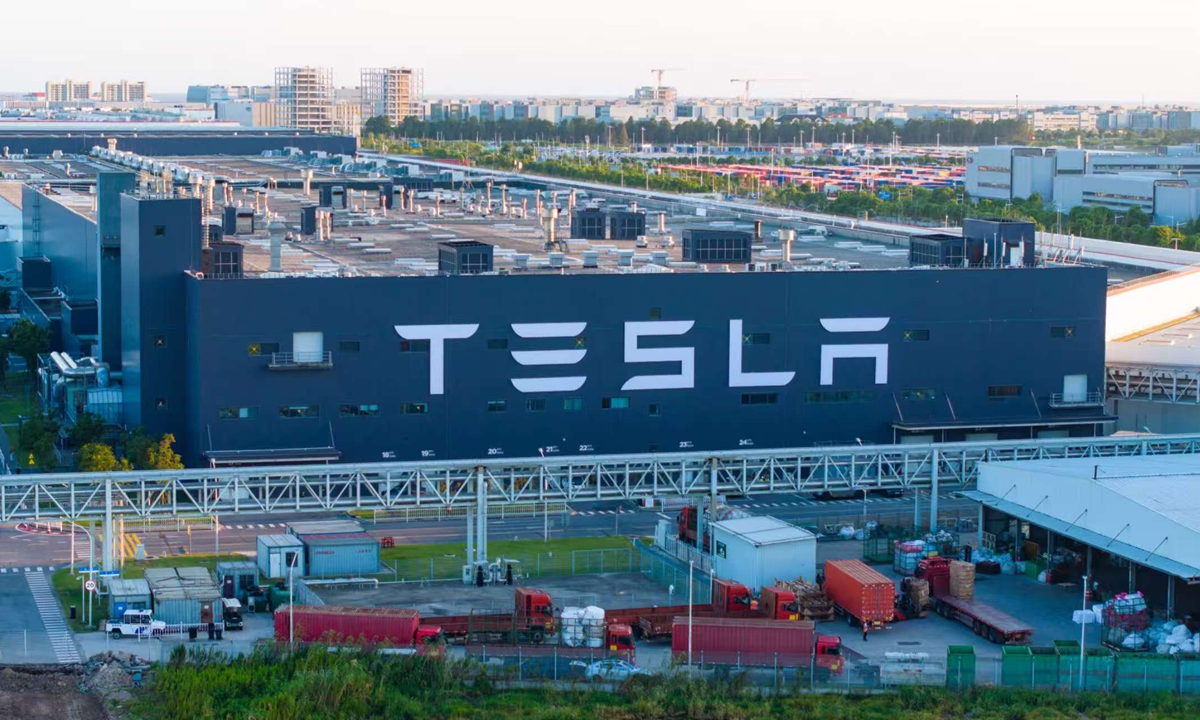
Tesla's Gigafactory in Lingang, Shanghai Photo: VCG
Tesla is reportedly auditing its suppliers in China to prepare for the production of Optimus brand humanoid robots, which reflects China's complete supply chain advantage in the robotics race, Chinese experts said.
Tesla's robotics team launched a new round of supplier audits in Ningbo, East China's Zhejiang Province, as the US electric vehicle maker prepares for mass production of Optimus robots, the Shanghai Securities News reported.
The Tesla team is said to have visited Ningbo-based Tuopu Group, Sanhua Intelligent Controls and Joyson Electronics.
Tesla's factory audits target mass production of Optimus, with potential orders likely to go to Chinese suppliers, according to the Shanghai Securities News report.
Tesla declined to comment.
The Global Times was unable to reach Tuopu Group for a response. When contacted by the Global Times, Sanhua Intelligent Controls and Joyson Electronics said that they had no knowledge of the reported factory audits and declined to comment on cooperation related to Tesla, citing commercial confidentiality obligations.
All three firms are suppliers of new‑energy vehicle (NEV) components and are developing robot‑related businesses, according to public information.
Tuopu Group said in its interim report that drawing on the company's accumulated expertise in electric‑drive systems, embodied artificial intelligence (AI) is poised to become a new growth driver. To accelerate the industrial‑scale roll‑out of its embodied AI business, the company has set up a dedicated robotics business division with an independent management structure and specialized professional teams.
Sanhua Intelligent Controls said in its interim report that leveraging its expertise in precision and large‑scale manufacturing, it is actively exploring emerging fields such as electromechanical actuators for bionic robots. It is advancing product research and development, customer validation and industrial capacity building, expanding its product portfolio and technical know‑how to foster new drivers of business growth.
Joyson Electronics has established a subsidiary focused on the software and hardware development of humanoid robots, its interim report said.
Humanoid robots and NEVs share many similarities. Robots run on electric power, and their control systems resemble those of smart vehicles and NEVs, relying on chips, controllers and algorithms.
Their perception systems including cameras and LiDAR sensors are also comparable, which is why some auto suppliers already manufacture sensors for robots, Zhang Xiang, secretary-general of the International Intelligent Vehicle Engineering Association, told the Global Times on Tuesday.
Industry experts said that the move, if confirmed, underscores China's complete supply chain advantage, given the significant overlap between its NEV supply chain and the humanoid robot industrial chain.
"Tesla's Shanghai Gigafactory has achieved a fairly high localization rate for its parts supply. Years of collaboration have fostered well‑established supply chain coordination between the two sides, laying a solid foundation for the large‑scale commercial rollout of humanoid robots," Wang Peng, an associate research fellow at the Beijing Academy of Social Sciences, told the Global Times on Tuesday.
Most of the Ningbo‑based enterprises reportedly undergoing factory audits have long been engaged in the NEV sector. They are familiar with Tesla's quality standards and production management, and can directly leverage their proven experience in mass production to quickly adapt to the requirements of manufacturing robots, Wang added.
In Ningbo, one of China's manufacturing heartlands, about 80 percent of humanoid robot component categories overlap with the NEV supply chain, according to the Ningbo Municipal Bureau of Economy and Information Technology.
Ningbo's NEV industrial ecosystem overlaps heavily with humanoid robot manufacturing. For major component categories, technologies and production capacity can be transferred directly without the need to build entirely new production lines, Wang said.
For industry participants, humanoid robots represent more than a single new product category. They constitute a new platform-based market that will reshape the division of labor across electromechanics, auto parts, semiconductors, industrial software and system integration, according to an industry report sent by Roland Berger to the Global Times.
Shi Shuai, a partner at Roland Berger, said that China's humanoid robot output exceeded 15,000 units last year, about 30 times the output in North America. The advantages of Chinese companies lie not only in production capacity, but also in a comprehensive manufacturing base, rapid supply chain responsiveness, richer application scenarios and strong policy support.
RELATED ARTICLES