Rising capabilities backed by ecosystem spanning makers, maintenance providers and insurers
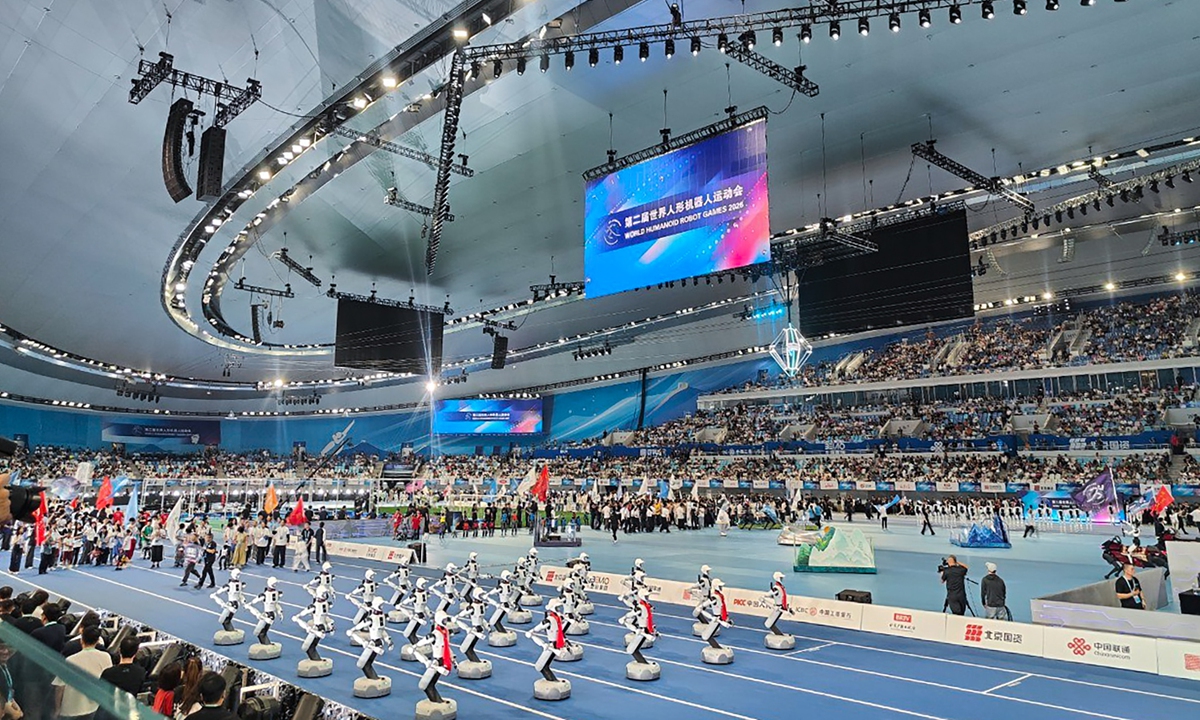
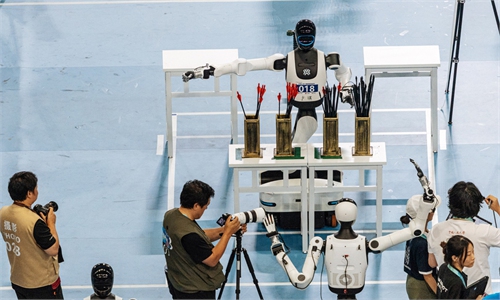
The opening ceremony of the second World Humanoid Robot Games is held at the National Speed Skating Oval, in Beijing on August 22, 2026. Photo: VCG
The humanoid crossed the finish line at full speed and hit the blue crash mats. Staff workers quickly carried it off, changed its battery and checked its joints. None of that support came from a robot maker – a small scene that captures the broader ecosystem evolving Chinese robotics sector.The track surface and crash mats were supplied by Shandong-based Taishan Sports Co. The bench, spare batteries and support technicians came from a service center set up by JD.com.
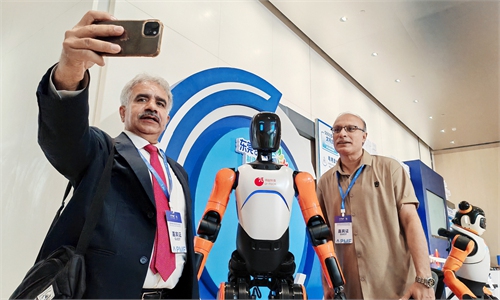
The second World Humanoid Robot Games (WHRG), which concluded on August 26 at the National Speed Skating Oval in Beijing, drew 666 teams and 2,056 robots from 16 countries. The robots attracted crowds of onlookers. Supporting the attending robot makers were sports equipment makers, e-commerce platforms, leasing companies and insurers.
The broader story is the ecosystem forming around the machines. “It has to be an ecosystem,” Shi Yi, deputy general manager of Beijing Robot Financing Leasing Company, told the Global Times. “You can’t do it without the robot makers. And, you can’t do it without the parts and software suppliers, maintenance providers, and insurers, and more.”
Rewriting specifications
The equipment inside the Oval looks much like what human athletes would need. Requirements for hardness, friction, abrasion resistance and static dissipation all differ from those of a conventional venue, Man Fangfang, vice director of Taishan Sports Co, told the Global Times at the venue.
So the recipes changed. The blue track compound was reformulated. The turf on the football pitches was made anti-slip and anti-static, because static is one of the things that robots least tolerate. The crash mats were given a specially treated surface to absorb a finish that carries far more force than a human runner’s. Samples went back and forth with the teams for months, and adjustments were made after they arrived and tested on site, said Man.
“We have supplied more than 3,000 sports competitions, but this was our first robot event,” she said, adding that the company’s plan is to keep developing gear built for robots, rather than for people.
The same adaptation was happening in logistics. Chinese e-commerce platform JD.com, the official after-sales partner of the WHRG, built a 7,000-square-meter service center holding more than 1,500 robots, 24 repair stations and nearly 200 charging cabinets. Every robot and every battery carries its own code, and check-in takes about 30 seconds by scan.
The company said it plans to build its after-sales service capacity across more than 100 countries in the coming five years. For teams the effect is mundane and immediate: foreign sides that ship their own robots pay excess baggage and transport insurance, while those using locally-supplied robots have repairs handled on the spot, Zhou Changjiu, president of the RoboCup Asia-Pacific Confederation, told the Global Times.
Paying and covering
The second issue concerns finance. Beijing Robot Financial Leasing provided a free public pool of 80 humanoid robots for this year’s competition, roughly half of them reserved for overseas teams, said Chen Yanyan, head of the company’s robot education business. Most teams in the football events used two or three robots from the pool along with their own.
The company is itself a product of the robotics boom. Founded in 2014 as a state-owned leasing firm, it was renamed and repositioned 18 months ago: equity funding had supported research and capacity, Shi Yi said, but getting robots into real settings needed a different instrument. It calls itself a full-scenario robot application service provider, covering hardware, installment payments, training, and repairs.
According to Chen, a football-playing humanoid robot sells for about 66,000 yuan ($9,823), a five-a-side team needs at least six robots, and a squad that wants to scrimmage against itself needs 10 or more robots, placing massive financial burden on the robot makers. Under the long-term lease the company recommends, a school pays roughly 20,000 yuan a year per robot, just one third of the selling price.
Risk is another part of the emerging ecosystem. Shi Lei, general manager of PICC Property and Casualty’s Beijing Economic-Technological Development Area branch, told the Global Times that coverage for this year’s Games included robot damage, third-party liability, and cyber-security risks. The package extended beyond the competition itself to cover venue preparation, equipment exhibition, on-site operations, and emergency response throughout the event cycle.
Paying out is where the industry’s newness shows. Insurance policies are written against a robot’s value, but payouts are calculated from component prices, and many joints and dexterous hands are non-standard parts built in-house with no market price, leaving valuation to be negotiated case by case. Insurers are assembling robot parts pricing databases modeled on the ones kept for cars, where every component of every model has a reference price.
The hardware has moved faster than the software, Shi Yi said. Coordination between a robot’s “large brain” and “small brain” is still being developed, and real-world data remains scarce. Shi divides progress into three stages – robots that can do the work, as seen in demonstration videos; robots that really do the work, autonomously but in a standardized, purpose-built settings, which is what the WHRG showed; and robots doing real work, replacing people in dangerous, strenuous and dirty jobs.
Every requirement a robot will have once it leaves the arena – the surface it moves on, the bench that repairs it, the lease that puts it in a classroom, the policy that covers it – now has a company working on it, and each of them is learning on machines that did not exist a few years ago.
RELATED ARTICLES