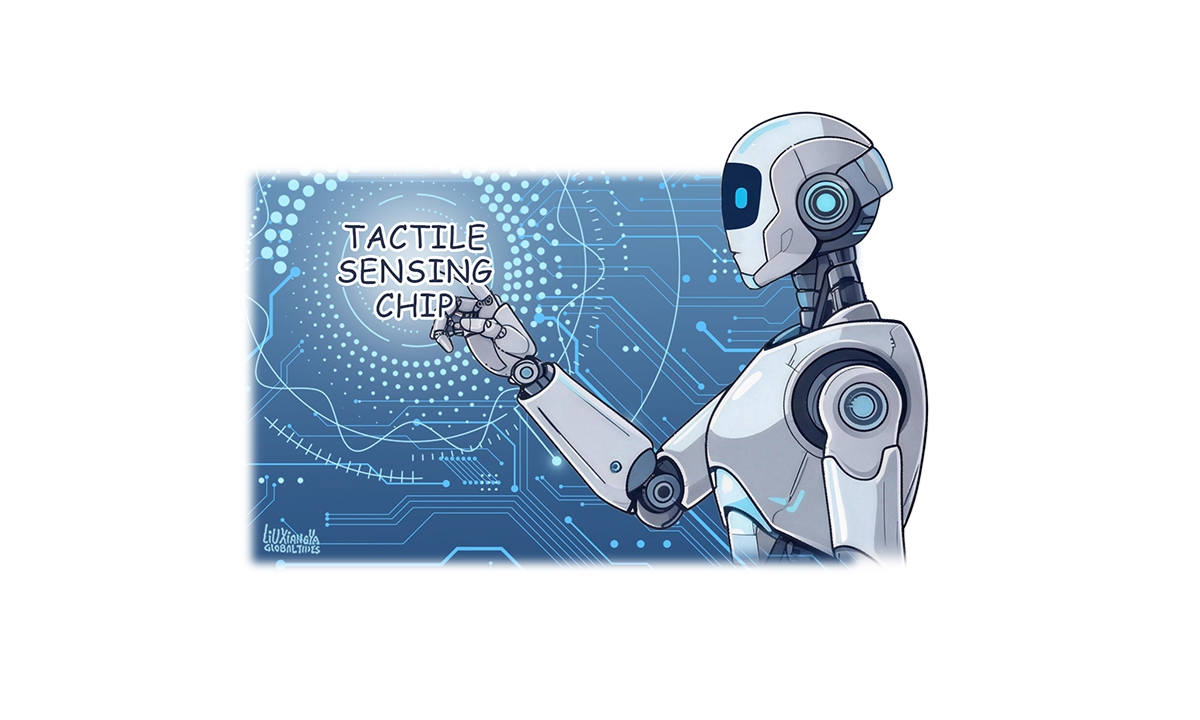
tactile sensing chip, robotics Illustration: Liu Xiangya/GT
A robot may look impressive when it walks, talks or waves. But its ability to screw a light bulb into a socket without breaking it depends on something far less visible: touch.
That part of robotics is gaining attention in China. PaXini, a Chinese robotics technology company, has shipped more than 1 million of its self-developed tactile sensing chips over the past year, according to media reports.
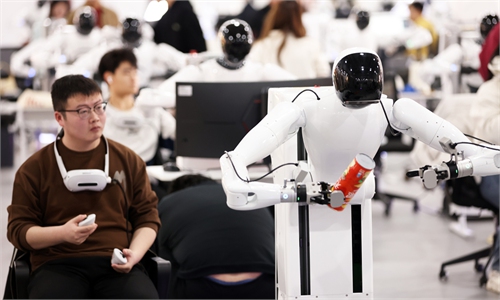
That figure of 1 million offers a glimpse of a deeper change in the robotics industry. As humanoid robots move from demonstrations to real-world tasks, competition is increasingly moving beyond the machines themselves to the sensors, hands, chips and other components that allow them to see, feel and handle objects with greater precision.
In China, robots are beginning to "learn" touch, adding another layer to their ability to interact with the physical world. Why is touch so important? The answer is simple: vision alone is not enough. By combining tactile information with visual data, robots can adjust their movements and the force they apply in real time, making them better suited to tasks that require greater precision and adaptability.
In medical settings, for example, tactile sensing could allow a robot to feel a patient's skin and adjust the force of its grip to avoid causing injury. In elder care, it could enable softer, more responsive grasping, making physical assistance safer and more comfortable. In factories, it could help machines take on dangerous or repetitive tasks.
Why is touch starting to matter more in Chinese robotics? One reason is cost. According to media reports, before 2019, less than 1 percent of high-end tactile sensors used in China were domestically produced. In 2021, imported products were still expensive but also prone to supply disruptions. A single six-axis force sensor could cost close to 100,000 yuan ($14,884), making it harder for domestic robotics companies to bring their products to market. In just a few years, the price of some of PaXini's tactile sensors has reportedly fallen to just a few hundred yuan.
Falling costs are making touch more accessible to China's robotics industry, allowing more robots to use the technology and helping their capabilities improve faster.
Touch is only one small part of the story. The same process is playing out across China's robotics industry. A robot's ability to see, move and interact with the physical world can each be broken down into a range of technologies and components. Chinese companies are working to improve these building blocks one by one, making each part more capable.
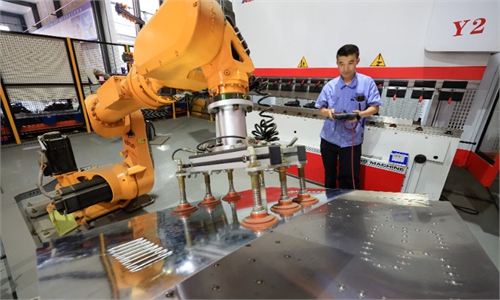
Taken together, these pieces are forming a robotics supply chain in China. A robot is not being built as a single product, but as a collection of technologies and components that can each be developed and improved. More companies are now working on different parts of the same machine, creating an ecosystem in which capabilities are built up across the industry.
China's robotics industry is attracting close attention around the world, with debate ranging from skepticism to admiration. So what does China's robotics industry really look like? Not just what a robot can do, but also what lies behind it: a growing supply chain with capabilities built across technologies, components and manufacturing.
That industrial ecosystem draws on decades of manufacturing development in China. A deep supply chain allows companies to work on individual parts of a robot, lower costs and scale production. As more companies develop different parts of the same machine, they can also iterate faster. This industrial base is an important asset for China's robotics industry.
Seen in this context, PaXini's shipment of more than 1 million self-developed tactile sensing chips over the past year is just one small part of a much larger story. Chinese robots are beginning to "learn" touch. But beneath the surface, many other capabilities are being built at the same time.
The author is a reporter with the Global Times. bizopinion@globaltimes.com.cn
RELATED ARTICLES