Elon Musk calls China ‘the biggest competitor’ in the humanoid robot market; remarks reflect recognition of growing strength of China’s robotics, AI ecosystem, says Chinese expert
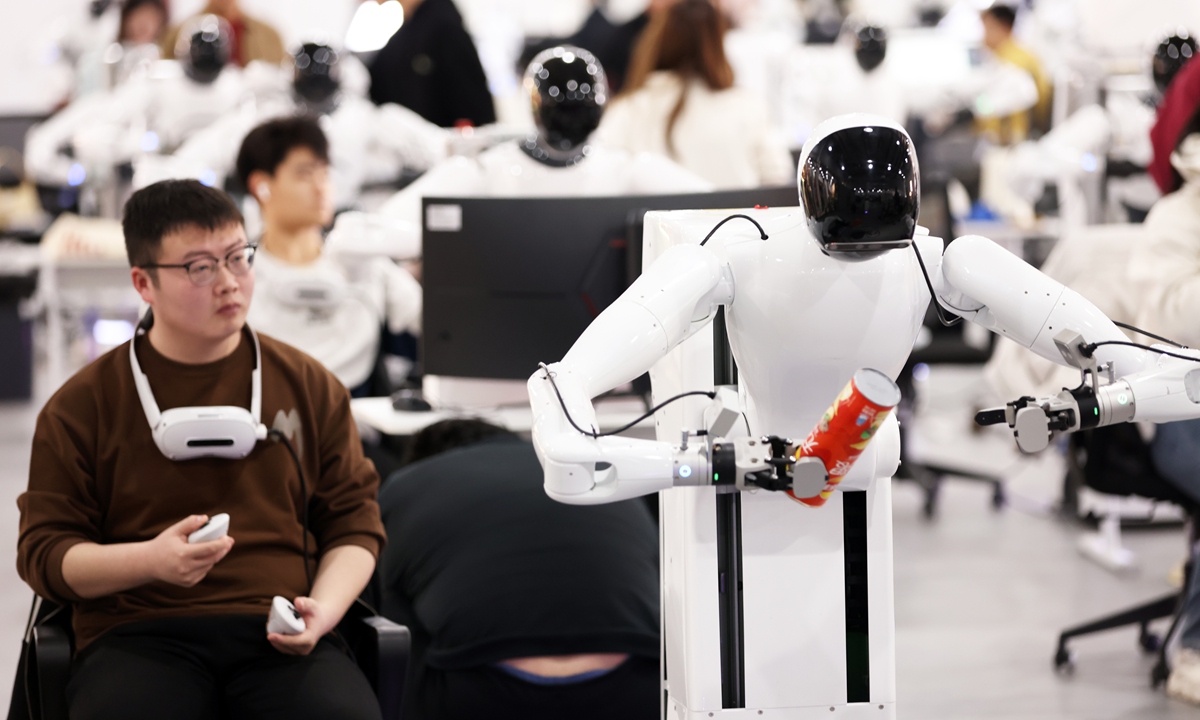
Employees train humanoid robots at an Agibot data collection factory in Shanghai on March 20, 2025. As of the end of December 2024, China had 451,700 intelligent robotics enterprises with total registered capital of 6.44 trillion yuan ($888.7 billion), data from the State Administration for Market Regulation showed. Photo: VCG
At US tech company Tesla's earnings call on Wednesday, local time, regarding competition in humanoid robots, CEO Elon Musk acknowledges that "China is good at scaling and manufacturing, and is also strong in artificial intelligence (AI)," while claiming that he believes China will be a key competitor in the humanoid robot market, and China will be the toughest competitor for Tesla. Chinese experts said the remarks reflect the growing strength of China's robotics and AI ecosystem, while they also said sound competitions in the sector are expected to drive the development of robotics technology for the benefit of society.
"I think China will be by far the biggest competitor in the humanoid robot market. China is extremely good at scaling and manufacturing, and is also strong in AI — the models being released there are already quite good and are improving rapidly," Musk said, in response to a question about the recent surge of startups — particularly from China — entering the humanoid market, and about the long-term competitive advantages that would keep Tesla ahead and how Optimus will fundamentally differ from these competitors.
That combination will make China the toughest rival for Tesla, and to our knowledge there are no significant competitors outside China, he stated.
China's development and progress in the field of robotics are increasingly being recognized by foreign industry peers and are drawing the attention of competitors, Chinese observers said.
Earlier in April 2025, in response to a question about competition between China and the US in the development of physical AI and drones, Musk claimed on an earnings call that" with respect to humanoid robots, I don't think there's any company in any country that can match Tesla," according to a Fortune report.
The shift in Musk's attitude showcases recognition of the growing strength of China's robotics and AI ecosystem, Zhong Xiangyun, a humanoid robot industry observer, told the Global Times on Thursday. Even if Tesla thinks it retains a technical lead in humanoid robots, Chinese companies are serious rivals when it comes to scaling, manufacturing and applying AI at volume, Zhong noted.
China's advantage lies in a complete intelligent-robot industry chain and abundant application scenarios, Tian Feng, president of the Fast Think Institute and former dean of SenseTime's Intelligence Industry Research Institute, told the Global Times on Thursday. The ability to mass-produce at low cost is also key to why Chinese robotics firms such as Hangzhou-based Unitree, Shanghai-based AgiBot, and Shenzhen-based LimX Dynamics can push humanoid-robot prices down to the tens of thousands of dollars or even lower, Tian noted.
China is the world's largest manufacturer and user of robots, and competitions in the sector are expected to drive the development of robotics technology for the benefit of society, and contribute to China's ambition of becoming a global technology powerhouse, Zhong said.
The country has become the world's largest market for robot applications. In recent years, the rapid growth of the country's robotics industry has led to the deployment of robots across various sectors, including warehouse logistics, education and entertainment, cleaning services, security inspection and medical rehabilitation, the Xinhua News Agency reported.
According to an industry report by Omdia, Chinese robotics firm AgiBot shipped over 5,100 humanoid robots in 2025, securing a 39 percent share of the global humanoid robot market. It ranked first in the world for both shipment volume and market share, Xinhua reported.
RELATED ARTICLES