Beijing-based humanoid robotics open-source dataset hits 20m global downloads, doubling in one month
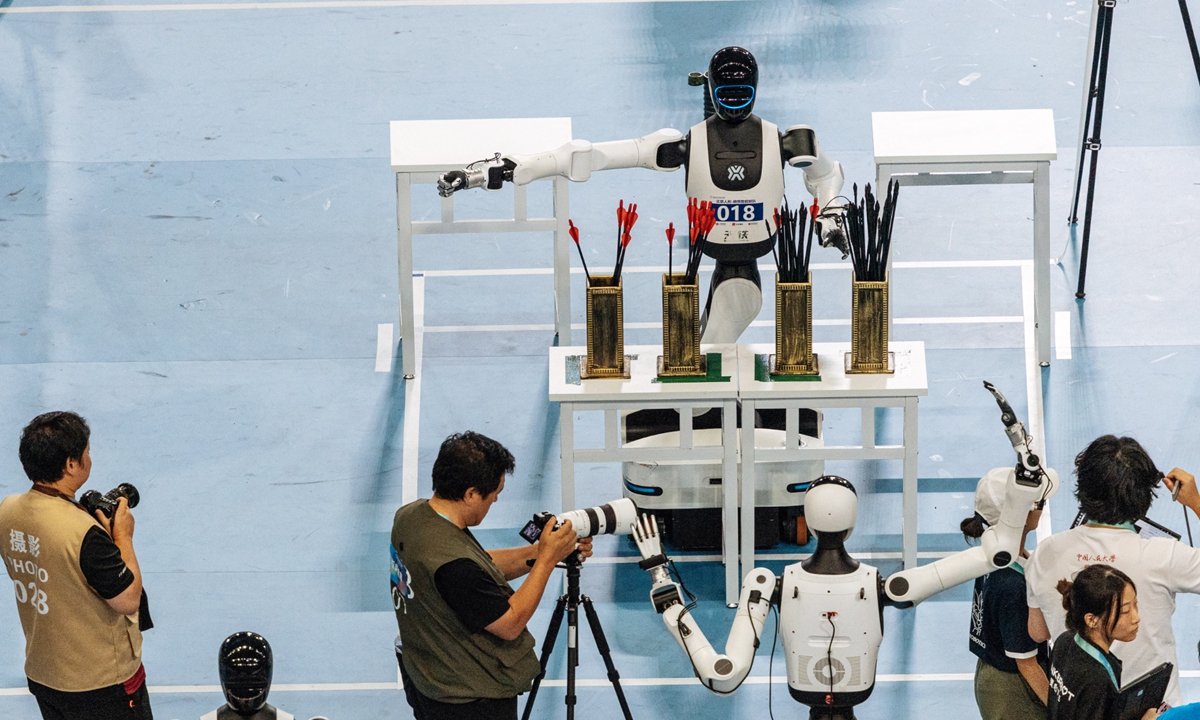
A humanoid robot participates in the pitch-pot competition at the 2nd World Humanoid Robot Games in Beijing on August 26, 2026. Photo: Li Hao/GT
The Beijing Innovation Center of Humanoid Robotics Co announced on Wednesday that its open-source dataset RoboMIND has surpassed 20 million cumulative global downloads, doubling within a month and emerging as a major platform for humanoid robotics data.
This milestone signals that embodied intelligence open-source resources offered by a Beijing-based robotics company are gaining broad recognition from the global research and development community, offering a critical pathway to address the long-standing bottleneck of high-quality data shortages that is holding back the humanoid robotics industry, according to an industry analyst.
RoboMIND, open-sourced in December 2025, includes more than 300,000 dual-arm manipulation trajectories and more than 700 real-world tasks, the center said. It is intended to provide an open and high-quality data base for research in humanoid robotics and embodied artificial intelligence (AI), the center told the Global Times on Wednesday.
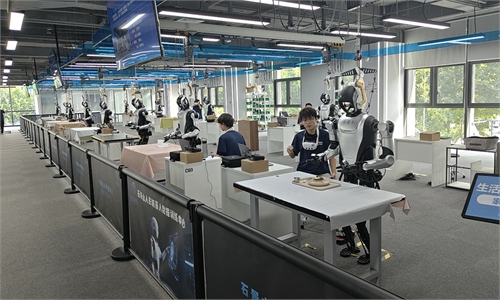
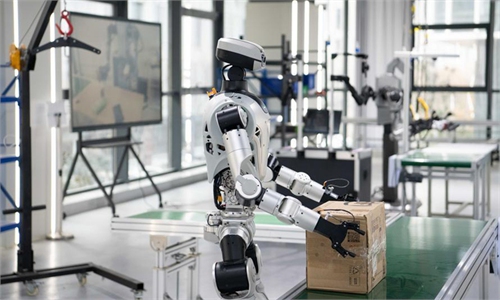
The center said that its training facility, covering nearly 6,000 square meters, includes more than 30 scenarios, and houses more than 150 robot units and 40 robot configurations, supporting what it calls a "matrix-style collection" across home, retail, industrial and medical settings.
Xia Hualin, the director of the training base, told the Global Times that the dataset is designed to address the shortage of real-world robot interaction data, while supporting embodied foundation model training, robot manipulation strategy development and algorithm evaluation.
Xia said that the training base has already delivered nearly 30,000 hours of high-quality data to external partners with a data qualification rate exceeding 95 percent. More than 70 percent of its production capacity now serves industry clients, including leading enterprises and research institutions engaged in model training and embodied brain development.
As humanoid robots move from laboratories into practical applications, data has become a key battleground in industry competition, analysts said.
Analysts said that the sector's main challenges remain concentrated in three areas: the shortage of high-quality data, the absence of unified standards and a fragmented ecosystem. In this context, databases and open-source datasets are seen as tools that can lower development barriers through scalable data production, standardized systems and an open-ecosystem approach.
The lack of high-quality, standardized and scalable data remains a key bottleneck for humanoid robots, Zhong Xiangyun, a humanoid robot industry observer, told the Global Times on Wednesday.
A recent research report by GF Securities said that training embodied AI models capable of practical deployment requires at least 10 million hours of multimodal interaction data, while current global data accumulation remains below 5 percent of that target, according to the People's Daily.
That gap suggests data supply capacity will be a decisive factor in determining whether the humanoid robotics industry can scale in the coming years, Zhong said, noting that unlike large-language models, which depend on vast bodies of text, embodied AI requires robots to carry out complex physical-world tasks such as grasping, carrying, organizing, climbing obstacles and coordinating with other systems.
"That, in turn, demands far greater precision in data collection, broader scenario coverage and more diverse action sets," he added.
A report by the China Academy of Information and Communications Technology showed that the construction of such training grounds in China has accelerated over the past two years. According to incomplete statistics, more than 70 training grounds had been completed and put into operation nationwide as of the end of June this year, while 46 were planned or under construction nationwide, according to the Xinhua News Agency.
By one industry estimate, China has only about 500,000 hours of compliant real-world physical-interaction data, while commercialization is believed to require tens of millions of hours, leaving a shortfall of more than 99 percent.
RELATED ARTICLES