Inside Beijing's Shijingshan robot training center, a new service sector takes off
Editor's Note:
With services now forming the bedrock of the Chinese economy, the country has elevated the sector's strategic importance to new heights. The 15th Five-Year Plan (2026-30) has called for improving the service sector's quality, efficiency and competitiveness, underscoring its role in supporting industrial upgrading, meeting people's livelihood needs and driving job growth. To document the sector's rapid development, the Global Times has launched this special column - China Services Momentum. This piece focuses on how the robotics industry has given birth to a new thriving service sector.
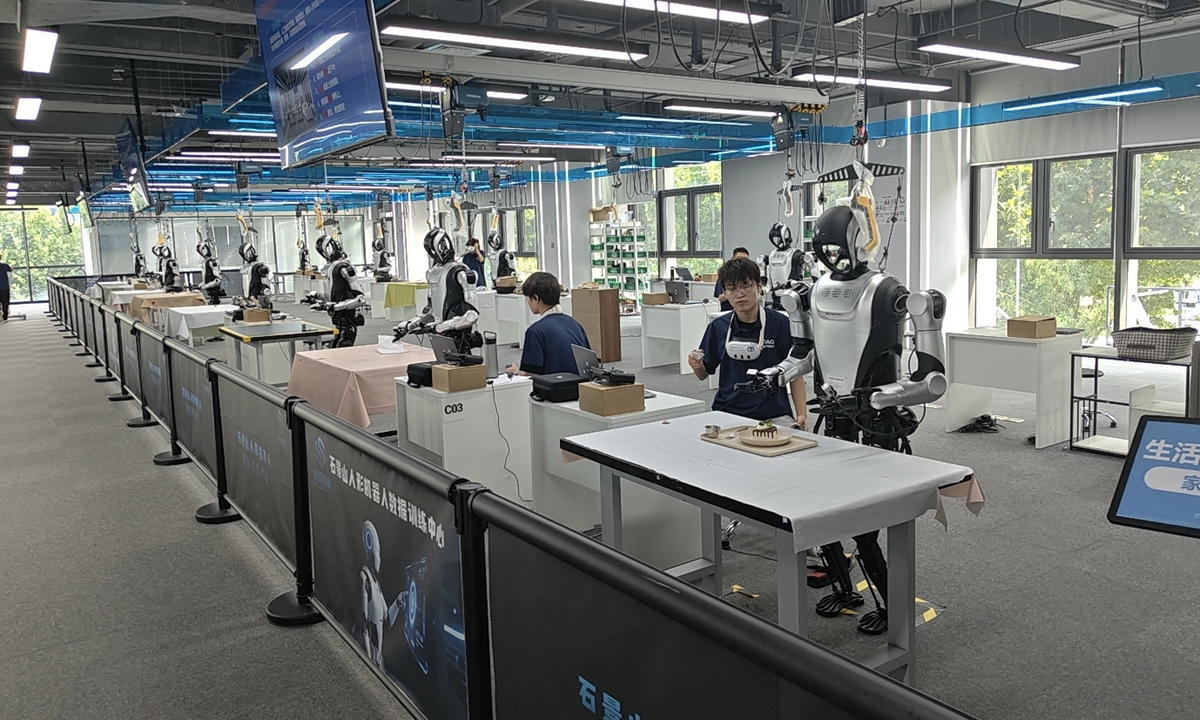
Workers train robots at the Humanoid Robot Data Training Center in Shijingshan district, Beijing on July 22, 2026. Photo: Zhang Yiyi/GT
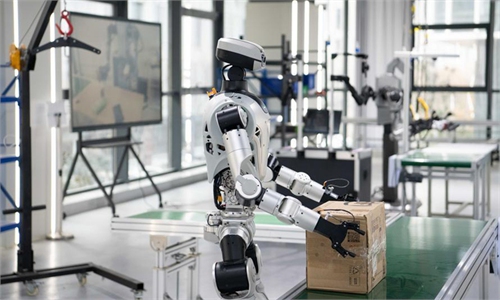
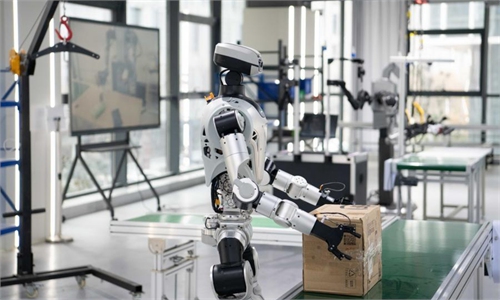
On a sweltering summer day at the Humanoid Robot Data Training Center in Beijing's Shijingshan district, a humanoid robot extends its arms, slowly picks up a medicine box, adjusts its orientation and places it in a designated spot.
Simple as the task may seem, it must be practiced repeatedly and still needs the human touch: Beside the robot, a young trainer wearing a VR headset and holding controllers guides it through the same sequence again and again via teleoperation.
Across the hall, workstations simulating industrial assembly, parcel sorting and household organization are arranged in rows. Some robots sort materials on mock production lines, while others practice grasping objects of varying shapes, textures and firmness. Each robot is paired with a trainer who repeatedly guides it through a task for the machine to replicate.
The resulting visual, motion and tactile data are cleaned and labeled before becoming "textbooks" for embodied AI models, helping robots progress from being able to move to being capable of performing real-world tasks.
This scene reflects a broader shift in China's producer services sector toward specialization and higher value. As AI moves from laboratories into real-world use, robot training, data annotation, testing and operational support are emerging as a new, thriving service sector, industry experts noted.
Emerging trend
"It is learning to clear the table," Zhao Ran, a 22-year-old humanoid robot data trainer at the Shijingshan center, told the Global Times, while pointing to a training cell in the facility's second phase. Following the trainer's movements, the robot performs a sequence of actions: opening its gripper, picking up fruit from the table and placing it in a box.
"During data collection, we must ensure stability and a high success rate, so the movements are slow but precise," Zhao said, adding that the center then delivers the collected data to clients, who use it to train models and deploy them on similar robots. "Once model development and training are complete, the robot will move much faster."
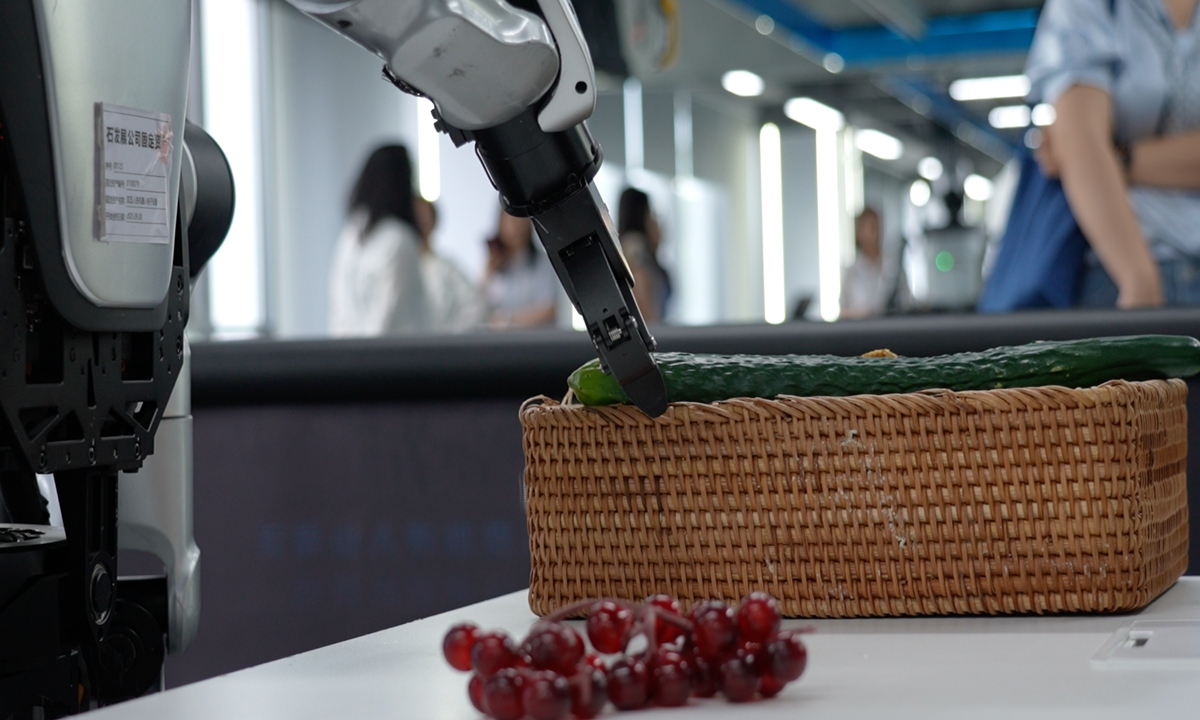
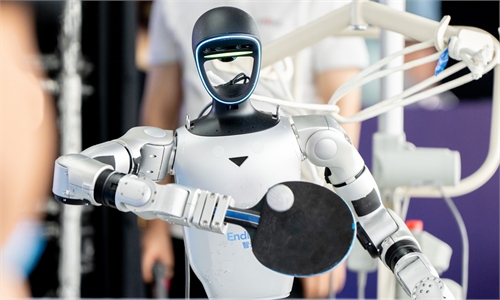
A robot arm picks up a cucumber at the Humanoid Robot Data Training Center in Shijingshan district, Beijing on July 22, 2026. Photo: Pang Yue/GT
At the training center, three cameras mounted on the robot's head and hands capture the entire sequence from different angles. Less visible but equally sophisticated are joint-angle and force sensors embedded in its body which simultaneously record physical data, all of which can be monitored on a back-end system.
Completed in September 2025, the center's second phase is one of China's largest data training facilities for full-size humanoid robots. It covers three main categories - industrial production, commercial services and household services - further divided into nearly 16 application areas based on companies' needs.
Its "curriculum" ranges from basic actions such as grasping, placing and carrying objects to complete tasks involving industrial assembly, logistics sorting and household organization, according to Zhu Kai, general manager of the training center.
Zhu said the center is being developed in five phases. Phase one focused on collecting basic operational data for desktop robots; phase two focuses on training full-size bipedal humanoids in complex settings; and phase three focuses on collecting tactile and multimodal data. The final two phases will support the training of embodied AI foundation models.
Its data collection methods include exoskeleton-based teleoperation, first-person data capture and spatial data collection for world models. To date, the center has built more than 600 training scenarios and conducted about 15,000 training exercises involving atomic skills, Zhu said.
While phase two teaches robots what to do after detecting an object, phase three, operated by Tashan Technology, goes a step further by training them how much force to apply when touching it.
Wu Hongxiao, an embodied AI algorithm engineer at the Phase Three Embodied AI Tactile and Multimodal Perception Data Training Innovation Center, cited USB insertion and removal as an example.
"The seemingly simple task involves a sequence of steps, including approach, alignment, insertion and removal, and requires a stable motion trajectory, precise tactile sensing and accurate force control at the robot's end effector," Wu said. "Too much force could damage the USB connector, while inaccurate force or positioning could prevent the task from being completed."
Notably, such "robot schools" are emerging across China. The outline of China's 15th Five-Year Plan (2026-30) calls for the coordinated development of embodied AI training facilities and the advancement of coordinated training and development of virtual and real environments.
As these activities become increasingly specialized, robot training is evolving from an in-house R&D process into a new form of producer service linking artificial intelligence with the real economy, experts said.
As data collection, data cleaning and annotation, model training, testing and validation, and scenario-based deployment evolve into specialized services, a new value chain supporting robot development and commercialization is taking shape.
Robot hardware is advancing rapidly, but development of robots' motion-control "cerebellum" is still in its infancy, Chen Jing, vice president of the Technology and Strategy Research Institute, told the Global Times.
"Robot data training is a typical producer service. Rather than being a consumer-facing product, it is an intermediate service in product development, model training and real-world deployment," Chen said.
Global competitiveness
Zhu said the center serves three main client groups: industrial companies deploying robots at specific workstations, embodied AI model developers seeking training data, and data-trading platforms listing data products. It also plans to expand overseas, with a cross-border data service platform set to launch during the China International Fair for Trade in Services in September, when the center expects to sign its first overseas data deal.
Previously, robotics firms bought equipment, built training scenarios and collected data in-house, an expensive and inefficient process. Public training centers now pool equipment, scenarios and personnel to provide these services at scale.
Chen said the shift from in-house facilities to public training platforms marks a move from fragmented, workshop-style data production toward specialized division of labor, citing figures from the center showing that an eight-hour shift initially yielded only about 0.9 hours of usable data per data collector. Following technical and process upgrades, the figure has risen to five to six hours a day.
Such specialized services are expanding rapidly across China. By the end of 2025, more than 30 embodied AI training facilities had been built nationwide, spanning Beijing, Shanghai and Tianjin, as well as Guangdong, Zhejiang and Jiangsu provinces, according to preliminary statistics from the China Academy of Information and Communications Technology.
"China's comprehensive manufacturing base, spanning sectors from 3C electronics, automobile manufacturing and semiconductor production to cold-chain warehousing and logistics sorting, provides robots with a rich variety of real-world training scenarios," Chen said. "However, data formats, collection methods and quality standards still vary across training centers, while data interoperability across facilities and robot platforms needs further improvement."
Future competition in the robotics industry will no longer be confined to hardware but will extend to data, software, application scenarios, deployment and maintenance. The delivery of a robot may no longer mark the end of a sale, but the beginning of a long-term service relationship, Chen said.
With production lines gaining "intelligent brains" and AI models serving as versatile assistants, producer services are becoming more specialized and moving up the value chain. This shift supports manufacturing upgrades, strengthens synergies between "made in China" and "Chinese services," and enhances Chinese firms' global competitiveness, Chen said.
RELATED ARTICLES