Xi’s upcoming US visit to chart course for bilateral ties
Leaders’ exchanges key to advancing constructive strategic stability: experts

Top News
At the invitation of US President Donald Trump, Chinese President Xi Jinping will pay a state visit to the US from September 23 to 25, marking an exchange of visits between the two leaders within six months.As changes unseen in a century are accelerating and uncertainties continue to grow around the world, the visit is expected to bring greater stability and predictability to China-US relations and beyond, according to the Xinhua News Agency.
Scholars, business figures and members of the public of the two countries express hopes for greater cooperation and more stable bilateral relations through this state visit.
Chinese and American interviewees described the reciprocal visits within half a year as a milestone of historic significance. They expressed hope that the strategic guidance of head-of-state diplomacy will help the two countries further develop a constructive relationship of strategic stability, explore how major countries can get along in the new era, and bring greater certainty to a turbulent world.
Greater cooperation
At their meeting in Beijing in May, Xi and Trump agreed on a new vision of building a constructive China-US relationship of strategic stability over the next three years and beyond, according to Xinhua. Scholars hope the upcoming meeting will build on that understanding and open more opportunities for cooperation.
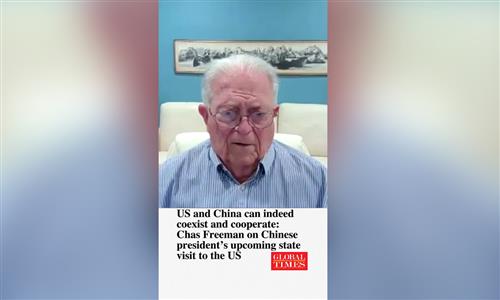
"The US, like China, needs a peaceful international environment in which to deal with many domestic problems. So, the two countries can indeed coexist and cooperate," said veteran US diplomat Chas W. Freeman Jr. in an interview with the Global Times. He emphasized that China and the US have different ideologies and different socioeconomic systems, yet they can cooperate to mutual advantage.
Anthony Moretti, an associate professor at Robert Morris University in Pennsylvania, said "potential" is the first word that comes to mind when he considers China-US relations.
"There is so much good that can come from the two nations working together to address the world's most challenging problems," Moretti told the Global Times. Realizing that potential, however, requires US political elites to shift their thinking, he told the Global Times. "Sure, hold to the values that are essential to the nation, but stop the chronic negativity," Moretti said.
Moretti envisages the two countries working closely to develop a legitimate global governance structure for AI, combat climate change, prevent the next pandemic and encourage more American students to study in China.
From government engagement to people-to-people exchanges, he hopes to see an affirmation that positive bilateral relations benefit both nations and the wider international community.
Chinese scholars echoed those expectations, highlighting the importance of sustained engagement at the highest level.
Head-of-state diplomacy is the anchor of China-US relations. Another meeting between the two leaders will help sustain stability in bilateral ties and continue advancing the new positioning of the relationship, said Diao Daming, a professor at the School of International Studies at the Renmin University of China.
Diao said the commitment to building a constructive relationship of strategic stability demonstrates a clear strategic understanding of bilateral ties on both sides and will help them find the right way for them to get along.
Wu Xinbo, dean of the Institute of International Studies at Fudan University, said the meeting would further consolidate the foundation for that relationship and chart its development in the next stage.
He expressed hope that the talks will "further strengthen China-US strategic mutual trust, help the two countries properly manage differences through dialogue and enhance practical cooperation, bringing stability and certainty to both countries and the world."
People-to-people exchanges
On the streets of Washington DC, hopes for cooperation emerged in conversations with Americans. Many interviewees welcomed the prospect of the upcoming summit and maintaining friendly ties.
"I would love for our relations to be more open," Joe McDonald, a professor at George Washington University, told the Global Times in Washington DC.
"I would not see any threat from China or any other country, we all have to learn how to get together somehow."
McDonald recalled the public reaction to former US president Richard Nixon's visit to China. "I'm old enough to remember when Richard Nixon went to China. Everybody thought that was an incredible thing, because we knew nothing about China, and then all of a sudden the world started opening up to another culture," he said.
Kenn, a visitor to Washington DC from Florida, also welcomed regular communication between the leaders.
"I think it's a good thing that the leaders get together, talk things out frequently. Be more friendly," he said. "There seems to be disagreement in some areas. I think we should smooth that out and be reasonable and fair."
For younger interviewees, the meeting also raised hopes for cooperation on technologies shaping their future.
"When presidents meet, I would really like to see some progress. I want us to be friends," Ethan Wilcox, a local college student, told the Global Times.
Wilcox said he particularly hoped for cooperation on AI, acknowledging his unease about the technology. "But increased cooperation, of course, is never a bad thing," he said.
Besides calls for broader people-to-people exchanges and cooperation, experts also expect more stable China-US trade relations. "The American economy and American development obviously depend on business. The vast majority is private enterprise, which is very sensitive to instability and to the uncertainties that cause it," Robert Lawrence Kuhn, chairman of The Kuhn Foundation, told the Global Times.
"You don't need to know much economics to see why stability in US-China relations matters," Kuhn said.
He also noted the great importance of Chinese goods in the US market, hoping a stable China-US relation could bring more goods to the US. "Chinese goods offer good quality at the lowest cost. That is why they succeed in a market economy. Almost everyone buys Chinese products, from Christmas decorations, socks and shoes, to home appliances, and then higher up the value chain: electric vehicles, batteries, solar, and new technologies coming. If the relationship is stable, those products will be more available," Kuhn said.
In an interview with People's Daily, Craig Allen, a senior fellow at the Asia Society Policy Institute's Center for China Analysis and former president of the US-China Business Council, stressed the potential for cooperation and expressed the hope that the two countries will further strengthen practical cooperation and make greater contributions to the global public good.
China's Foreign Ministry spokesperson Guo Jiakun emphasized dialogue and cooperation on Tuesday, when he was asked about the message and purpose of a Foreign Ministry video titled "Constructive Strategic Stability," released the same day.
"China is ready to work with the US to enrich the China-US constructive relationship of strategic stability, enhance dialogue and cooperation and properly manage differences to contribute to the well-being of both peoples and to a peaceful, stable and prosperous world," Guo said.
RELATED ARTICLES