ARTS / CULTURE & LEISURE
Where wild boar came from: Chinese-led study traces its roots
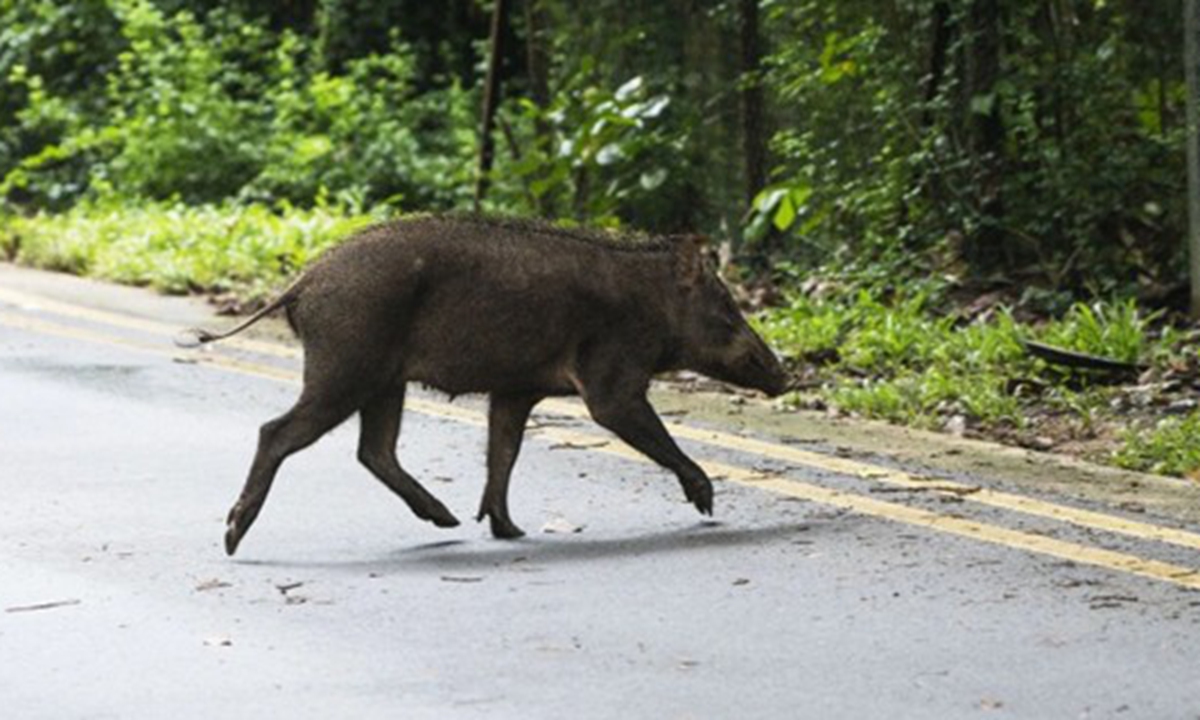
A wild boar Photo: Xinhua News Agency
A Chinese-led international research team has shed new light on the origin of wild boar, the ancestors of domestic pigs, finding that modern wild boar arose from tropical mainland Asia rather than the islands of Southeast Asia, according to Xinhua News Agency.The study identified South Asia and the Himalayan region as potentially important centers of early wild boar evolution. The findings, titled Ancient introgression drives wild boar expansion and phenotypic diversification of domestic pigs, were published online in the journal Science on Friday.
Researchers used 745 genomes from wild and domestic pigs across Eurasia to reconstruct the evolutionary history of wild boar. They found that wild boar expanded from South Asia during the Middle Pleistocene.
"The genetic patterns and genetic resources of pigs were shaped over the course of their evolution and domestication, and studying them can provide theoretical and technical support for genetic improvement of breeding pigs," said Shu-Hong Zhao, a co-corresponding author of the paper and an academician of the Chinese Academy of Engineering.
However, the long-standing lack of genomic data from South Asia has left the geographic origin of modern wild boar unresolved. Previous studies suggested that island Southeast Asian wild boar populations were among the earliest to diverge and retained more ancestral genetic features, contributing to the prevailing view that modern wild boar originated on the islands of Southeast Asia.
After more than a decade of research, the team integrated pig genomic data from populations across different regions and used segment-by-segment genome comparisons and recombination-based analyses to reconstruct their evolutionary history.
The researchers found that the apparent early divergence of island Southeast Asian wild boar was misleading, as gene flow with closely related local pig species had made the populations appear older than their actual divergence. After accounting for this genetic exchange, wild boar from South Asia and neighboring regions emerged as the earliest-diverging modern wild boar lineages identified so far.
The findings led the team to propose that modern wild boar originated on tropical mainland Asia, with South Asia and the Himalayan region potentially serving as important centers for their early diversification and expansion.
The study also found that, before the major expansion of modern wild boar from tropical mainland Asia, their ancestors exchanged genes with an extinct archaic pig lineage in South Asia about 3 million to 5 million years ago. The gene flow introduced a key segment of the X chromosome that was associated with larger body size and greater cold tolerance, according to the researchers.
The genetic material may have helped wild boar adapt to temperate and colder environments, enabling their subsequent expansion into northern Asia and Europe.
"Understanding where wild boar, the ancestors of domestic pigs, originated and how they spread across Eurasia is fundamental to understanding pig domestication and the development of genetic diversity," said Han Jianlin, a co-corresponding author of the paper.
According to Han, the study offers a new explanation for the origin of modern wild boar and identifies genetic segments that could provide new clues for breeding pig varieties with higher meat yields and greater resilience.
The findings also reveal a long-lasting evolutionary legacy of this ancient introgression, which provided genetic material that was later shaped by natural and artificial selection, according to the paper.
Global Times
RELATED ARTICLES