ARTS / CULTURE & LEISURE
China’s silkworm farming tradition spread to C.Asia 4,000 years ago, study shows
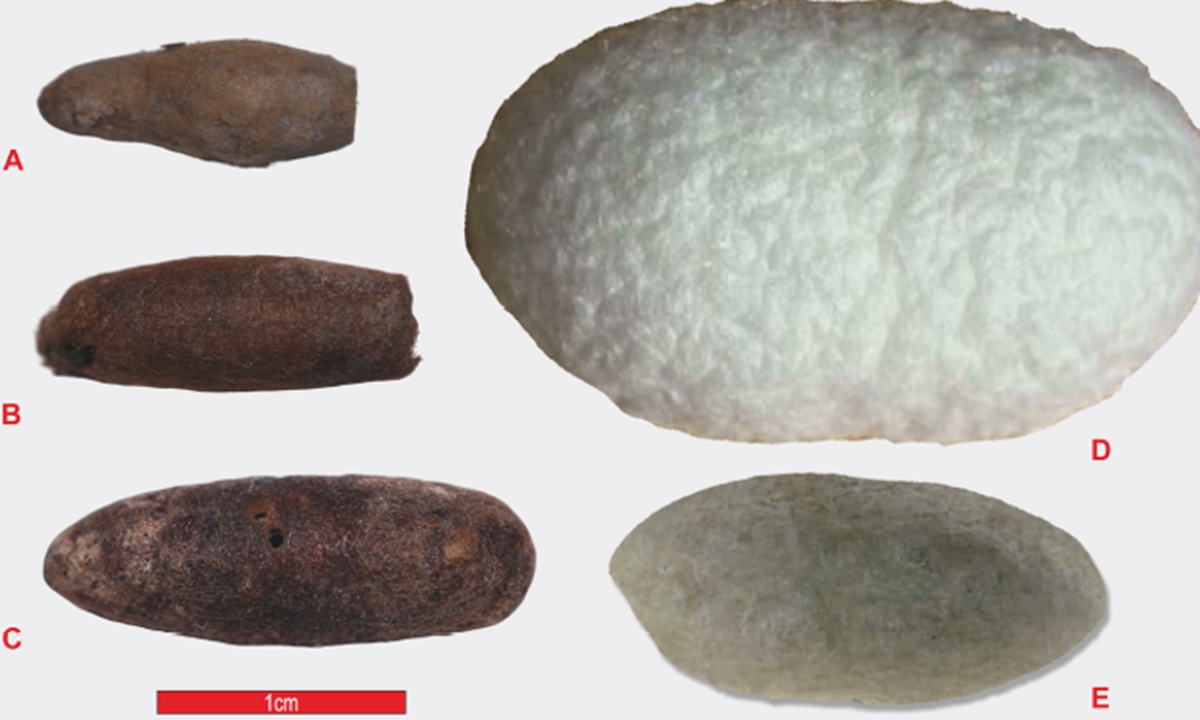
Photo: Courtesy of the Institute of Vertebrate Paleontology and Paleoanthropology (IVPP), Chinese Academy of Sciences
China's silk-making tradition, long regarded as one of the defining symbols of Chinese civilization, reached Central Asia far earlier than previously believed, according to new archaeological evidence discovered by the Institute of Vertebrate Paleontology and Paleoanthropology (IVPP), Chinese Academy of Sciences, which shows that domesticated silkworms and mulberry-based sericulture had spread westward about 4,000 years ago.The findings, published in the international journal Science Advances, suggest that the westward spread of China's sericulture techniques began nearly 2,000 years before the opening of the ancient Silk Road during the Han Dynasty (206BC-AD220), according to IVPP.
The results are based on the analysis of three silkworm cocoons unearthed at the Sapalli Tepe archaeological site in southern Uzbekistan. Soil samples from Sapalli Tepe yielded the three cocoons alongside thousands of plant remains. Scanning electron microscopy revealed fiber structures consistent with those of Bombyx mori cocoons. The ancient fibers were notably finer than those of modern domesticated or wild silkworms, suggesting that they represented an earlier stage of domestication.
Researchers confirmed that the three cocoons belonged to domesticated silkworms (Bombyx mori), dating them to between 1940BC and 1765BC, making them the earliest-known domesticated silkworm remains discovered so far, according to the study.
Meanwhile, based on the identification of plant remains, the research team provided the first evidence of widespread mulberry trees in Bronze Age Central Asia. Together with the silkworm cocoons, the findings suggest that communities of the Bactria-Margiana Archaeological Complex not only had access to silk but also practiced elements of sericulture.
The discovery reshapes the understanding of the history of sericulture and silk production in Central Asia, while pushing back the westward spread of ancient Chinese silk-making technology by nearly 2,000 years, according to IVPP.
One of the authors and a research fellow of IVPP told the Global Times that from a biological perspective, neither wild mulberry trees (Morus alba) nor domesticated silkworms were native to Central Asia; both species are associated with East Asia. Archaeological evidence points to China as the earliest-known center of sericulture, with discoveries including 8,000-year-old silk protein traces, ancient silk remains and silkworm-shaped carvings from prehistoric sites across the country.
Modern genomic studies also indicate that China was the center of silkworm domestication, with neighboring regions later influenced by its spread, he added.
Mulberry charcoal remains were found in sediment layers from all three sites studied - Sapalli Tepe, Djarkutan and Molleli - with their presence increasing over time. The discovery of citrus wood remains, though limited in quantity, marked the first identification of ancient citrus remains in Central Asia.
The study establishes the earliest-known archaeological record of mulberry-based sericulture outside China. The team suggested that early silkworms and mulberry trees may have been introduced to Central Asia along the southern slopes of the Himalayas, although other routes could also plausibly explain the observed pattern.
According to the research team, the findings are part of a broader story of early exchanges among Eurasian civilizations. About 4,000 to 5,000 years ago, crops and domesticated animals began moving across the continent: wheat, barley, cattle, goats and sheep from West Asia spread eastward into East Asia, while crops originating in East Asia, including millet from the Yellow River region, also traveled westward to Central Asia.
The spread of mulberry trees, silkworms and silk-making techniques was part of this wider network of prehistoric exchanges, reflecting the outward influence of early Chinese civilization.
These interactions developed gradually through centuries of contact among different communities, rather than through direct state-to-state exchanges. In contrast, Han Dynasty ambassador Zhang Qian's missions to the Western Regions marked a later stage of more formal and intensive communication between China and Central Asia.
RELATED ARTICLES