ARTS / CULTURE & LEISURE
Chinese and Thai archaeologists identify ancient glass making techniques
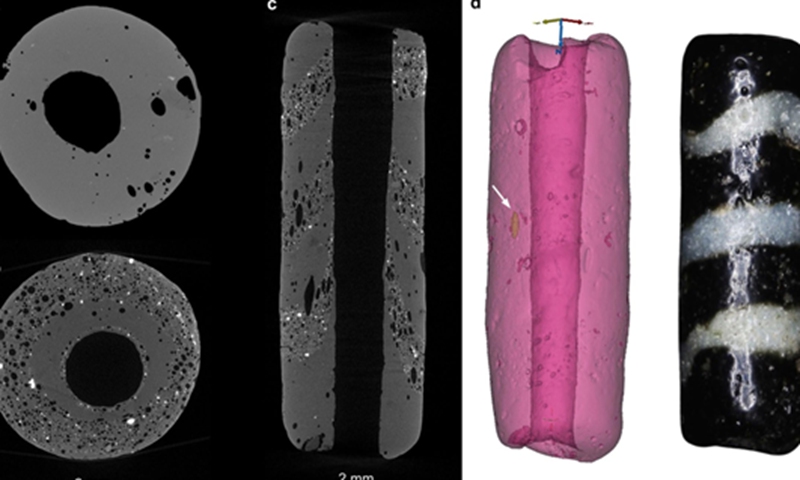
Micro-CT analysis of glass beads Photo: Courtesy of the University of Chinese Academy of Sciences
Chinese and Thai archaeologists have determined that the black-and-white glass beads designed to imitate banded agate, unearthed at the 2,000-year-old Phromthin Tai site in central Thailand were produced using a combination of the winding and drawing techniques.
The finding overturns the long-held assumption that these Iron Age beads were made with the folding method. The research results were recently published in Archaeological and Anthropological Sciences, offering new insights into the development of ancient glass-making techniques and trade networks across South and Southeast Asia.
"During the early Iron Age, roughly 2,000 years ago, people across South and Southeast Asia were not only fond of adorning themselves with agate beads, but had also mastered sophisticated techniques to imitate such beads using glass," Xu Siwen, a postdoctoral researcher at the University of Chinese Academy of Sciences (UCAS) and a member of the research team, told the Global Times on Sunday.
"These black-and-white imitation agate beads carry high artistic value and serve as key material evidence of ancient cross-regional cultural exchanges and trade. However, research into their manufacturing techniques has remained limited, largely lacking systematic scientific rigor."
Their analysis revealed that the beads were made using a deliberate combination of two distinctive glass types. The white segments are mineral soda-lime-alumina glass that uses tin dioxide as an opacifier, while the black segments are m-mixed-Ca-Al glass, whose coloration derives from the combined effect of iron-sulfur chromophores and tetravalent manganese.
According to team member Yang Yimin, provenance analysis suggests that the white glass used in the beads may have originated in southern India, while the black glass was likely produced by remelting a mixture of mineral soda-lime-alumina glass and mineral potash (m-K) glass.
When considered alongside the South Asian characteristics reflected in both the glass types and production techniques, the findings reinforce evidence that central Thailand maintained close ties with southern India and Sri Lanka through the Indian Ocean maritime trade network during the Iron Age. They also highlight how strong demand for South Asian agate ornaments in Southeast Asia stimulated innovation in local glass-making techniques at the time, as reported by the China News Service.
In this study, the Chinese and Thai collaborative team employed advanced analytical technologies including micro-CT scanning and X-ray photoelectron spectroscopy to systematically examine the composition, coloring mechanisms and manufacturing process of the beads.
Researchers noted that the collaboration builds on earlier archaeological partnerships. In December 2024, the Hunan Provincial Institute of Cultural Relics and Archaeology and Thailand's Silpakorn University signed a memorandum of cooperation on China-Thai archaeological and cultural exchange. The agreement was prompted by discoveries showing that glassware and amber products unearthed at the ruins of ancient Dutou city in China were closely linked to glass- and amber-production handicraft sites identified in Thailand.
The joint archaeological survey, carried out by Chinese and Thai teams, began at the U-Thong ancient city site in central Thailand. Covering caves, ancient settlements, museums, temples, and private collections, the broad expedition examined more than 50 locations.
The diversity of sites, including cave, sand-dune and ridge sites, yielded a wide array of artifacts such as ceramics, bronze wares, iron tools and glass objects. A notable number of Chinese cultural relics were also identified during the investigations.
According to Xu, the UCAS research team is collaborating closely with Silpakorn University, and the joint archaeological project received support from the academy's international visiting scholar program.
"Thailand's unique geographical location has given it an important role in ancient cultural exchanges between the East and the West," Xu said.
"These collaborative archaeological projects are significant not only for the technological discoveries revealed by the excavated artifacts, but also for what they show about the cultural and commercial exchanges among countries along the ancient Maritime Silk Road, including China, Thailand and others in Southeast Asia," the researcher noted.
RELATED ARTICLES