China announces 10 outcomes from latest trade talks with US, including tariff cuts, AI dialogue
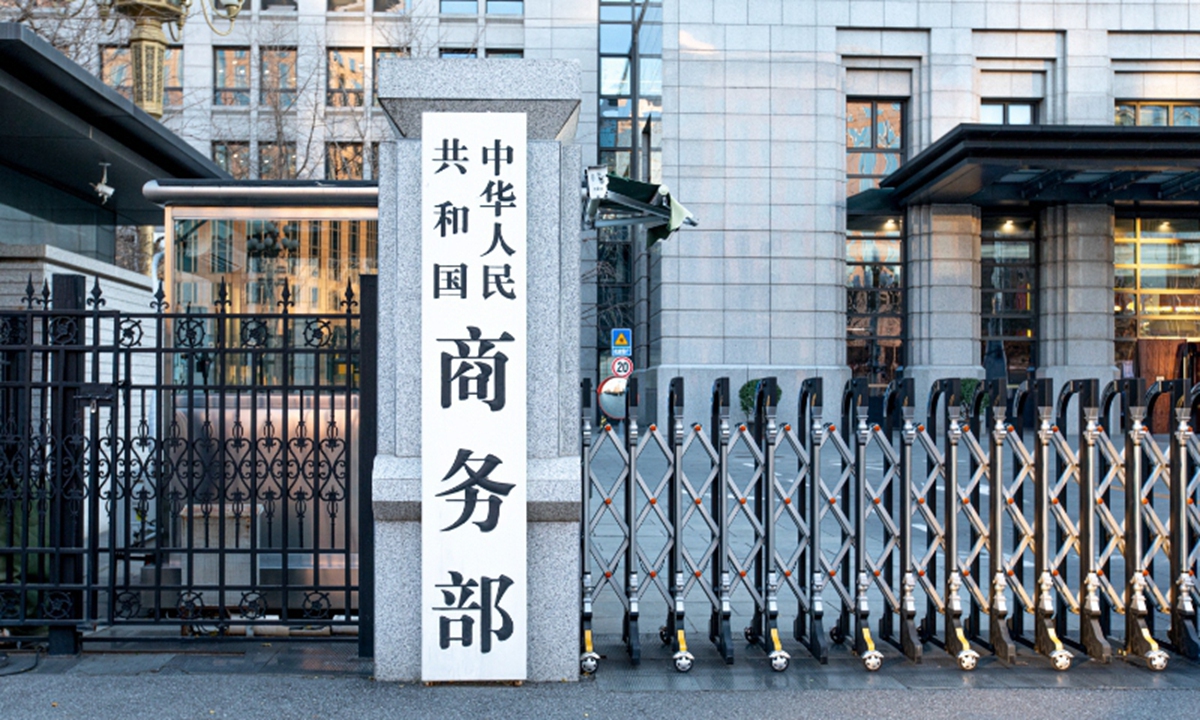
The Ministry of Commerce of China File photo: VCG
China's Ministry of Commerce (MOFCOM) on Monday announced 10 outcomes from the latest China-US economic and trade talks, including reciprocal tariff reduction on $30 billion worth of imports, the arrangement for the artificial intelligence (AI) dialogue, and an extension of the Kuala Lumpur trade arrangement to January 10, 2027.
The Chinese and US economic and trade teams held consultations in New York and Washington DC from September 20 to 23, during which they reached positive consensus and contributed economic and trade outcomes to the meeting between the two heads of state, an official from the MOFCOM's Department of American and Oceanian Affairs said.
Specifically, China and the US have agreed to reduce tariffs on about $30 billion worth of imports from each other on a reciprocal basis, with tariffs on about 90 percent of the products on each side to be lowered to most-favored-nation (MFN) rates, according to the MOFCOM.
In a separate announcement on Monday, the MOFCOM said that the US will reduce tariffs on about $30 billion worth of imports from China, including toys, home appliances, baby products, kitchen and bathroom products, and holiday gifts, while China will reduce tariffs on about $30 billion worth of imports from the US, including agricultural products, personal care products, medical devices and coal.
The two sides agreed to jointly release their respective lists of products subject to the tariff reductions. The reductions will take effect simultaneously after both sides complete their respective domestic legal procedures.
The arrangement will help stabilize China-US trade and create more favorable conditions for exports of relevant Chinese products to the US, while also helping meet domestic market demand and strengthen bilateral trade cooperation in areas including agricultural products, energy, manufactured goods and consumer products.
As part of the positive outcomes, China and the US have agreed to establish a China-US Board of Trade under the bilateral economic and trade consultation mechanism, with the main task of improving two-way trade. The economic and trade teams from both sides have reached a consensus regarding the board's mandate, structure, responsibilities, and consultation arrangements; details will be released subsequently, according to the MOFCOM.
Notably, tariffs on China's coal imports from the US will be included in the "$30 billion for $30 billion" reciprocal tariff reduction framework, as part of the consensuses reached by the Chinese and US economic and trade team. This will facilitate China's coal imports from the US in both 2027 and 2028.
The MOFCOM noted that coal imports from the US would be a useful supplement to China's domestic coal market while bringing stable revenue and jobs to the US coal industry. They would also help stabilize and expand bilateral trade, the MOFCOM official said.
"It is hoped that, through joint efforts, China and the US will continue to deepen cooperation in the coal sector and achieve mutual benefits," the official said.
Agriculture products is also included in the "$30 billion for $30 billion" reciprocal tariff reduction framework as agreed in principle in the bilateral economic and trade consultation in May. Against the backdrop, the two sides have agreed in this round of talks to establish an agricultural working group under the China-US Board of Trade,with relevant regulatory agencies from both countries participating.
The board is also expected to provide an important platform and institutional guarantee for "lengthening the list of cooperation and shortening the list of problems in the economic and trade field," and to help keep China-US economic and trade relations on a stable, positive track, the MOFCOM official said.
Another highlight of the outcomes is the creation of the AI dialogue. The two sides, in this round of talks, agreed that under the China-US economic and trade consultation mechanism, Chinese Vice Premier He Lifeng and US Treasury Secretary Scott Bessent, as the two sides' respective lead person in economic and trade talks, would establish an AI dialogue. And they have held the first session, exchanging views on the risks and benefits of AI, according to the MOFOCM.
China and the US have agreed to convene the next AI dialogue before the end of November this year, and to set up a communication channel for AI-related incidents, the MOFCOM said.
Meanwhile, during the latest round of bilateral economic and trade consultations, China and the US have also agreed to extend the Kuala Lumpur trade arrangement, under which certain tariff and non-tariff measures were suspended through November 10, 2026, to January 10, 2027, while continuing active discussions aimed at reaching a solution agreed by both sides.
The ministry noted that the arrangement provides both sides with room to take stock of and assess its implementation, and to consider how to advance China-US economic and trade relations in the next stage. The combination of a time-bound extension and continued active discussions would also provide a relatively stable and predictable policy environment for cooperation between Chinese and US businesses, it said.
The MOFCOM said it believes the two sides will continue their efforts and, through high-level economic and trade interactions before the end of the year, seek a positive solution on a further extension.
The other outcomes of this round of talks also include exchanging views on increasing direct passenger flights and an agreement to maintain communication on adding more China-US flights and related matters.
In addition, the MOFCOM said that China will review and approve, in accordance with laws and regulations, applications by financial services institutions from various countries, including US-funded institutions, to conduct business and establish branches in China.The Chinese side also hopes that the US will also provide a fair, transparent, and stable policy environment for Chinese-funded financial institutions, the MOFCOM official said.
During the latest consultations, China and the US also reaffirmed and renewed their commitment to continuing to implement the consensus reached in previous rounds of economic and trade consultations. The MOFCOM said this would "create favorable conditions and a stable environment for bilateral economic and trade cooperation, while also contributing to global economic development."
The two sides have held eight rounds of economic and trade consultations since last year, reaching a series of mutually beneficial, balanced and positive outcomes on important economic and trade issues of common concern, including the promotion of bilateral trade and investment. Those outcomes have helped maintain the overall stability of China-US economic and trade relations, according to the MOFCOM.
Global Times
RELATED ARTICLES