NIO, Geely cross-share to merge battery swapping, taking it from exclusive service to public infrastructure
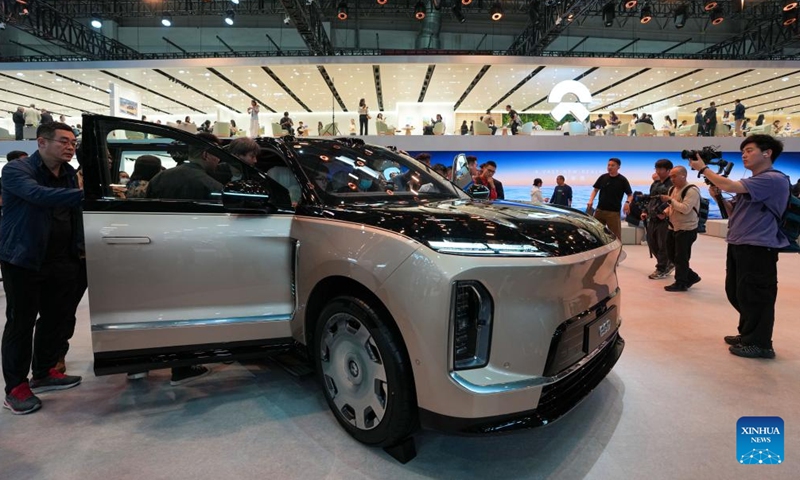
People visit the booth of NIO during the 2026 Beijing International Automotive Exhibition in Beijing, capital of China, April 24, 2026. The exhibition kicked off here on Friday and will last until May 3. (Xinhua/Ju Huanzong)
Chinese electric vehicle maker Nio and Geely Holding Group announced a comprehensive partnership in charging and battery swapping on Monday, including cross-investments in their energy businesses and plans to support battery-swappable vehicles for individual consumers, Nio's WeChat official account said.
Under the agreement, Geely Holding will acquire a stake in Nio Power by contributing its entire equity interest in Yiyi Interconnection and 640 million yuan ($94.96 million) in cash, while Nio will invest in Geely Holding's Haohan Energy. Geely Holding will also develop battery-swappable models for individual consumers, with Nio Power providing battery-swapping services.
Under the agreement, Geely Holding will hold a 30 percent stake in Nio Power, and Yiyi Interconnection's battery-swapping business for commercial fleet vehicles will be integrated into Nio Power. Nio Power will continue to improve the operation of the battery-swapping network serving these vehicles, supporting Yiyi Interconnection's commercial fleet business. The two sides will jointly develop unified battery-swapping technologies and standards for individual consumers.
The partnership will also accelerate the expansion of Nio's battery-swapping network. Nio Power plans to have 10,000 battery-swapping stations by 2030, when the network's annual electricity demand is expected to exceed 10 billion kilowatt-hours.
In smart charging, Nio will acquire a 10 percent stake in Geely Holding's Haohan Energy. The two companies will fully connect their charging resources to expand network coverage and improve operational efficiency.
By the end of 2027, Geely plans to have more than 22,000 charging stations with more than 100,000 charging points, including more than 15,000 Geely smart charging stations with more than 50,000 smart charging points. It aims to be the first to achieve full coverage of county-level cities across China.
Nio founder and chairperson Li Bin said that the partnership supports China's 15th Five-Year Plan (2026-30) for the intelligent connected new-energy vehicle industry by curbing excessive competition and improving resource allocation.
The partnership marks a shift from fragmented, carmaker-owned charging and battery-swapping networks toward shared industry infrastructure, Wang Peng, an associate research fellow at the Beijing Academy of Social Sciences, told the Global Times. Separate networks have led to duplication and higher operating costs, he noted. By linking their energy businesses through equity investments, Nio and Geely are pursuing a more efficient use of resources through coordination and shared access.
Wang said that the deal offers a market-based approach to implementing the 15th Five-Year Plan's emphasis on curbing excessive competition and improving resource allocation. Cross-shareholdings allow the companies to integrate charging and battery-swapping resources while retaining their brand independence and operational flexibility, potentially providing a model for wider industry cooperation.
Over the longer term, the partnership could encourage automakers to place greater emphasis on services throughout a vehicle's life cycle, alongside sales of new cars, Wang said. Greater network connectivity could reduce barriers among brands and improve convenience for users, while closer cooperation on technical standards, operations and interaction with the power grid could help build a more efficient and accessible low-carbon mobility ecosystem.
The partnership comes amid a policy push on both charging infrastructure and anti-involution. On September 11, the Ministry of Industry and Information Technology (MIIT) and eight other departments released the 15th Five-Year Plan (2026-30) for the Intelligent Connected New Energy Vehicle Industry, calling for "accelerating the improvement of charging and battery-swap infrastructure, rationally deploying high-power charging facilities, shoring up rural gaps, and continuously enhancing service efficiency." The shift from "construction" to "service efficiency" marks a move from building more to the better use of what exists.
Anti-involution has likewise become institutionalized. In January, the MIIT, the National Development and Reform Commission and the market regulator pledged to "resolutely resist disorderly price wars." While regulators draw red lines on pricing, infrastructure integration offers another path: asset collaboration over separate builds, network sharing over duplicated investment.
RELATED ARTICLES