ARTS / CULTURE & LEISURE
Check-in and become an ‘actor or actress’: immersive hotels turn stays into dramas
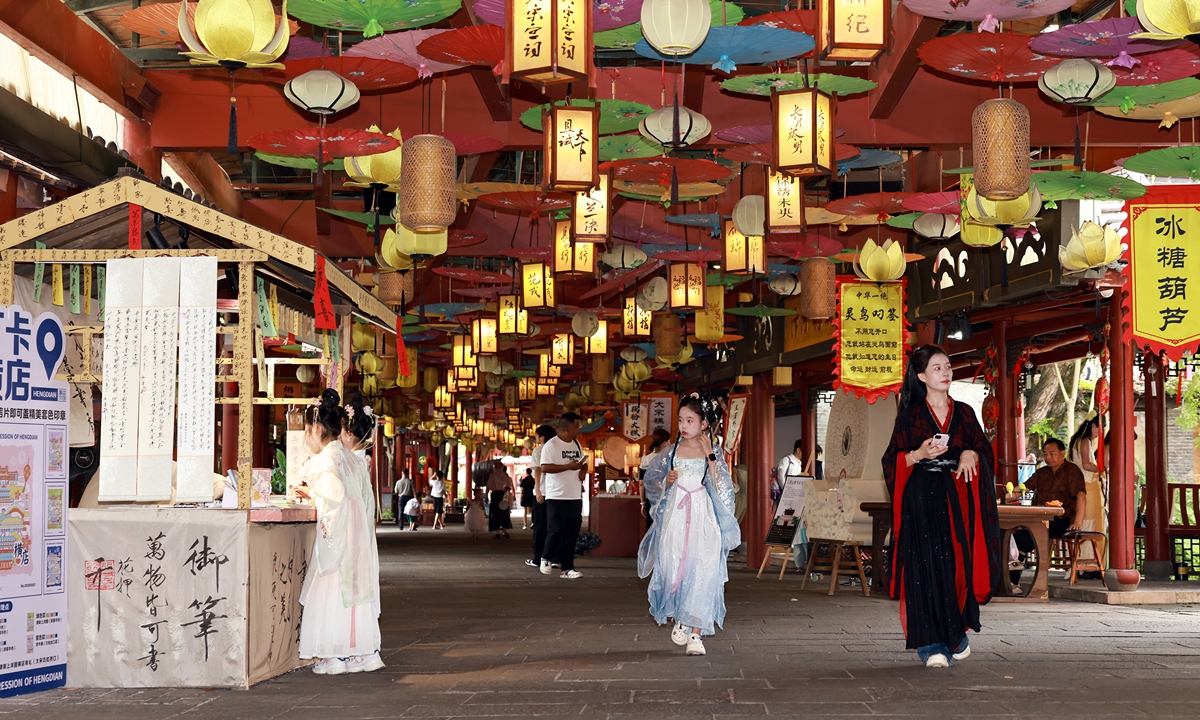
Photo: VCG
For 28-year-old Zhang Zhe, checking into a hotel in Hengdian, East China's Zhejiang Province, during the Mid-Autumn Festival holidays was more than getting a room for the night. By staying in Hengdian, one of China's major film and television production bases, she was stepping into the world of dramas.
As soon as she entered the hotel lobby on Friday, an actress dressed as a landlady approached her, called her "Actress Zhang" and handed her a "production bonus." Dressed in period-style costumes and surrounded by an old-timey setting, Zhang was quickly drawn into the story.
At the hotel, check-in is called "starting production," while checking out means "wrapping up." Guests receive call sheets, take on roles, complete tasks and earn virtual "pay" that can be exchanged for experiences, turning a night at the hotel into a period-drama adventure.
"Hotels are something you have to book anyway, so why not try one that lets you experience what it's like to be an actor in a period drama?" Zhang told the Global Times.
Zhang is among a growing number of young travelers drawn to so-called "drama hotels," where accommodation becomes part of a larger story. Combining role-playing, immersive theater and local culture, the experience allows travelers to step into a character, follow a plot and explore a destination from within the story.
Data from travel platform Tongcheng Travel shows that searches and bookings for hotels and homestays featuring keywords such as "drama hotel," "scripted murder mystery" and "immersive experience" have risen sharply since the start of the 2026 summer travel season. Users aged 18 to 27 accounted for more than 70 percent of searches.
For many young travelers, the appeal lies in becoming part of a story rather than simply watching one unfold. They can take on different identities, interact with strangers and explore a place through its stories and characters.
"The hotel itself has a built-in entertainment experience," Zhang said. "You don't have to get up early to rush from one attraction to another. You can take your time at the hotel and scenic area."
The experience does not necessarily end at the hotel. Some "drama hotels" turn surrounding historic districts into giant game boards, combining accommodation with story-based games inspired by local history and culture.
Liang Qing stayed at a drama hotel in August and took part in a story-based game set in a historic district in Wuhan, Central China's Hubei Province. After changing into period costumes and receiving props, she and other participants took on different roles, followed clues and interacted with characters through the hotel and surrounding area.
"It's like an upgraded version of the games we used to play indoors," Liang told the Global Times. "Instead of sitting around a table, you get to walk into the story and become part of it."
Bu Xiting, an associate research fellow at the School of Cultural Industries Management at the Communication University of China, told the Global Times that immersive experiences are becoming an increasingly visible part of how young people spend their leisure time and experience travel. "Drama hotels" are one example, bringing role-playing and storytelling into everyday travel.
In the past, immersive experiences were more commonly found in performances, scenic areas and commercial streets. "Drama hotels" bring that approach into accommodation, making the hotel itself part of the story.
According to Bu, the appeal of "drama hotels" ultimately depends on the strength of their stories and immersive experiences. As more hotels adopt the concept, operators will need to keep developing fresh storylines and interactive elements while avoiding repetitive or formulaic experiences.
RELATED ARTICLES