COMMENTS / EXPERT ASSESSMENT
EU should address China trade tensions with pragmatism, not confrontation: China WTO expert

A China-Europe Railway Express train passes through Ulanqab, North China's Inner Mongolia Autonomous Region. File photo: VCG

However, as China's economic strength and political influence grew, the EU's approach toward China began to shift. Its 2016 China strategy called for a reassessment of the relationship, placing greater emphasis on reciprocity and the management of differences. The shift became more pronounced in 2019, when the EU's Strategic Outlook defined China simultaneously as a cooperation partner, a negotiating partner, an economic competitor pursuing technological leadership and a systemic rival promoting alternative models of governance.
Since then, Brussels has expanded its economic-security and trade policy tools, with China increasingly emerging as a key target of restrictions. In practice, this has marked a substantive departure from the EU's commitment to a comprehensive strategic partnership, as narratives of economic security, market distortions and fair competition are increasingly invoked to justify tougher measures toward China.
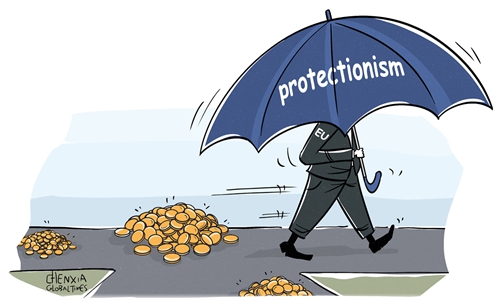
By 2026, China-EU trade tensions had intensified further. In September, the European Commission (EC) warned of additional restrictions if the two sides failed to make tangible progress by mid-October. Days later, EC President Ursula von der Leyen claimed that the trade deficit with China had reached a tipping point and warned of a second "China shock" contributing to deindustrialization in Europe.
Objectively speaking, the EU's declining capacity for innovation and competitiveness, combined with China's growing economic and political strength, has left a bloc that once enjoyed formidable advantages grappling with an unprecedented sense of frustration and crisis. This is the fundamental reason behind the profound shift in the EU's China policy since 2016. Geopolitics, economic security, industrial and supply-chain security, common values and claims about gaps in international rules have instead become pretexts for restricting and excluding China, as the EU seeks to address its own difficulties.
Whether the EU resorts to traditional trade remedies such as anti-dumping and anti-subsidy measures, newer instruments targeting foreign or transnational subsidies, or more targeted restrictions on China in the future, none of these can change the reality that China will continue to grow stronger, more competitive and more innovative. Successive rounds of US trade restrictions against China since 2018 have already laid bare the limits of such an approach.
The EU has frequently presumed, without sufficient evidence, that Chinese products and investment benefit from market-distorting subsidies, and has imposed restrictions accordingly. By doing so, it has overlooked, or been unwilling to acknowledge, that China's competitiveness is fundamentally rooted in continuous innovation and complete industrial chains that help bring down costs.
At the same time, the EU itself has gradually moved away from the original rationale of its state-aid regime, continually expanding the scope of industrial subsidies that can be exempted. In July 2026, for example, the EC approved 659 million euros ($750 million) in German state aid to support four first-of-a-kind facilities across the semiconductor value chain.
Earlier, under the European Chips Act, which entered into force in September 2023, the EC approved about 14.2 billion euros in state aid from EU member states to support semiconductor technology development and deployment. In June, the EC proposed upgrading the Chips Act to strengthen support for semiconductor research and development.
In recent years, the EU has introduced new restrictive measures on the grounds that existing World Trade Organization (WTO) and other international rules do not adequately cover certain areas. It has sought to fill what it sees as regulatory gaps through its own legislation while maintaining that such measures do not violate international rules. Yet these measures have led to significant adverse effects on other countries and businesses and are, in practice, discriminatory and arbitrary, making them inconsistent with WTO principles and rules.
Against this backdrop, in subsequent negotiations the EU should abandon its hardline approach and take a pragmatic view of the real causes of the trade imbalance, rather than focusing on claims of "market distortion" and "economic security" as grounds for demanding unfair concessions from China. It should move beyond geopolitical and confrontational thinking, and fully leverage the opportunities presented by China's innovation and development to expand cooperation in areas such as green development, new energy and the digital economy, with a view to achieving mutual benefit.
On WTO reform, China and the EU should work together on the critical issues that will determine the future of the multilateral trading system. They should uphold fundamental principles such as most-favored-nation treatment and consensus-based decision-making rather than undermine the foundations of the WTO.
China and the EU should choose cooperation over confrontation. China has already established a range of legislative countermeasures and has both the capacity to respond and the ability to sustain a prolonged contest, as demonstrated during China-US trade frictions.
Confrontation cannot resolve the problems between China and the EU. Instead, the EU should strengthen dialogue and communication with China through both bilateral and multilateral frameworks, manage differences in good faith, expand practical cooperation, and work to restore and further advance the China-EU comprehensive strategic partnership.

Shi Xiaoli Photo: Courtesy of Shi Xiaoli
The author is director of the WTO Law Research Center at China University of Political Science and Law.
RELATED ARTICLES