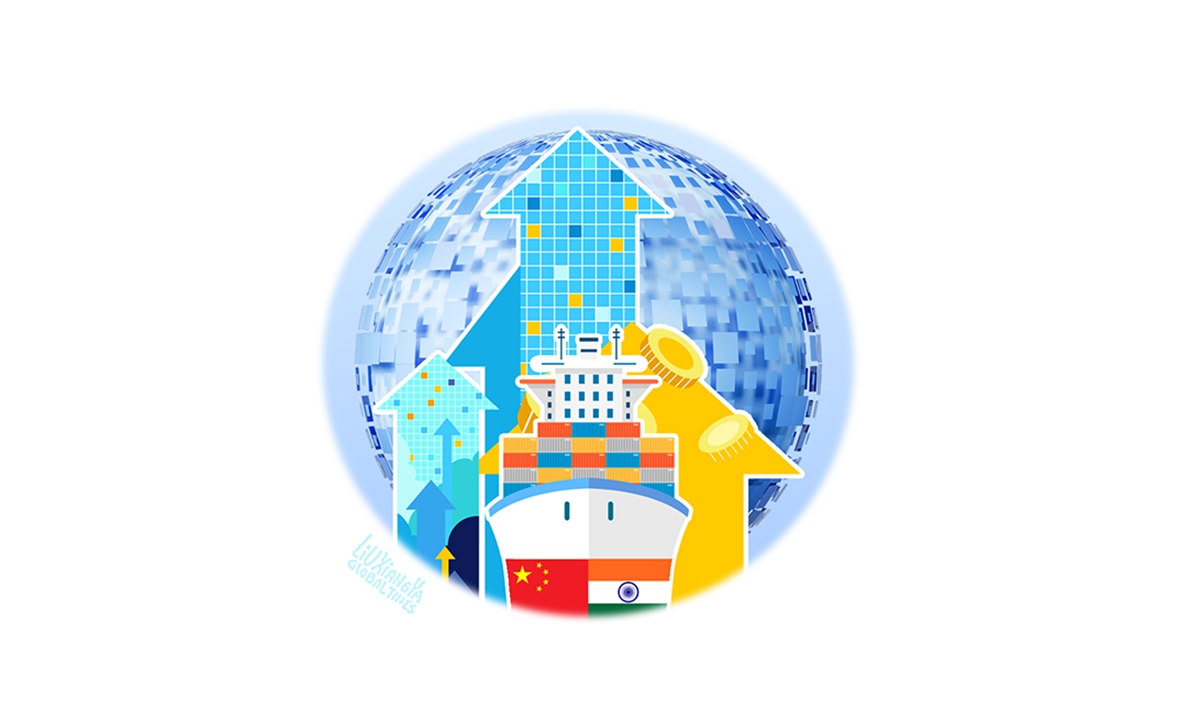
Illustration: Liu Xiangya/GT
China's market is becoming harder for India to overlook. Indian news agency ANI reported that India's Consul General in Shanghai, Pratik Mathur, said that India and China are working toward strengthening trade ties, people-to-people contacts and cultural exchanges, while focusing on greater market access for Indian products and technologies in China.
India's recent export data offers a concrete reason to watch the Chinese market more closely. India's exports to China rose 52.35 percent year-on-year in August, almost double the 26.12 percent growth in India's overall merchandise exports.
India's export growth comes against a subdued global trade backdrop. The seasonally adjusted volume of world merchandise trade grew 3.2 percent year-on-year in the first quarter, according to WTO/UNCTAD data. Protectionist measures in some advanced economies are adding to uncertainty for exporters.
In this environment, India's 26.12 percent export growth in August is a positive sign. Sustaining that growth as global trade becomes more uncertain will require India to look more closely at markets that offer strong and growing demand.
China is one such market. China's imports rose 28.2 percent year-on-year in August, according to Chinese customs data. As the world's second-largest import market, this growth represents a sizeable expansion in demand for goods from overseas suppliers. It suggests further room for exporters, including those from India, to tap into the Chinese market, particularly as China's manufacturing sector continues to generate demand for industrial goods, raw materials and intermediate products.
More importantly, amid unilateralism and protectionism in international trade, China has continued to open its market to the world and promote greater inclusiveness in the global economy. For overseas suppliers, that means China's growing import demand can translate into more opportunities to tap into one of the world's largest import markets.
As India seeks to sustain export growth, the Chinese market is becoming an increasingly important part of the picture. The 52.35 percent rise in India's exports to China in August provides a new signal that the Chinese market is taking on greater importance for India's export prospects, particularly as protectionism makes some traditional markets harder to navigate. The task now is to capture that signal and turn it into new momentum for China-India trade.
This is also why the remarks by Pratik Mathur are worth noting. According to ANI, Mathur said that China has again become India's largest trade partner and highlighted the importance of addressing trade-related issues.
As the Chinese market becomes more important, the broader environment for China-India economic engagement should evolve with it. Mathur's emphasis on people-to-people contacts and cultural exchanges is an important part of that effort. Trade does not grow in isolation. Stronger connections among people and businesses can build the understanding and trust needed for closer economic ties.
The direction for deeper China-India economic engagement is becoming clearer. The Chinese market is emerging as an important driver of that process. Its growing role in India's export prospects also underscores the value of two things: creating opportunities through mutually beneficial cooperation and addressing each side's trade concerns in a balanced way.
For India, creating a more supportive environment for China-India engagement would be a useful complement to the growing importance of the Chinese market. This could cover a range of areas, from trade and investment to business and people-to-people exchanges. The faster this process moves forward, the more room India will have to tap into the opportunities offered by the Chinese market and turn growing trade into a broader source of economic engagement.
As the Chinese market grows in importance, the opportunity to deepen China-India trade grows with it. Changes in the Chinese market and its growing demand deserve closer attention, alongside a balanced approach to addressing the trade concerns of both sides.
The author is a reporter with the Global Times. bizopinion@globaltimes.com.cn
RELATED ARTICLES