India’s new rules bar Chinese CCTV camera brands, jeopardizing fair trade and harming its own market: Chinese expert
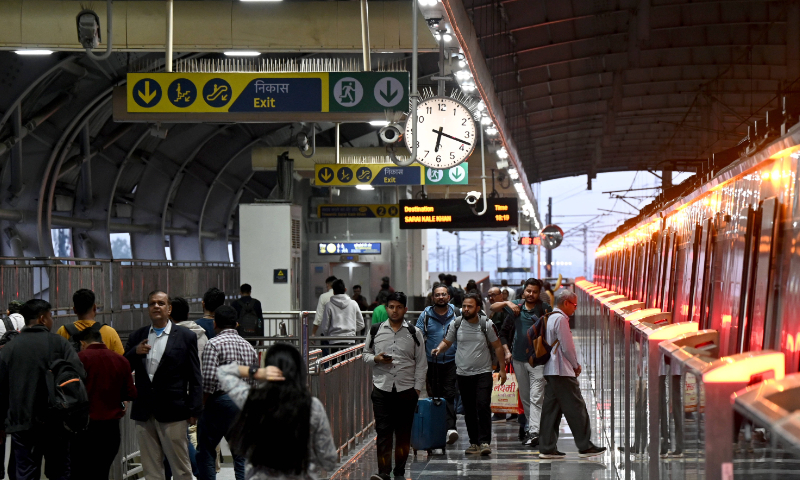
Passenger are seen at a train station in New Delhi, India, on February 22, 2026. Photo: VCG
Chinese video surveillance companies such as Hikvision, Dahua and TP-Link will be barred from selling internet-connected CCTV cameras and other video surveillance products in India starting April 1, when the country's new certifying rules officially take effect. Chinese experts and industry insiders have sharply criticized the move, arguing that it is essentially a discriminatory trade protection measure disguised as "cybersecurity."
which not only violates international trade rules but also harms India's own market interests.
According to industry executives cited by India's Economic Times on Monday, the Indian government is explicitly refusing to certify products made by Chinese video surveillance companies and those using Chinese chipsets, effectively shutting these firms out of the Indian market.
Zhang Xiaorong, director of the Beijing-based Cutting-Edge Technology Research Institute, told the Global Times on Monday that India's new rules lack reasonable justification and constitute targeted trade discrimination.
"India has rejected Chinese companies' products and Chinese chipsets on national security grounds without providing any substantive evidence. This clearly violates the principles of fair trade," said Zhang.
Zhang also pointed out that Chinese security products are widely accepted and compliant in many countries around the world. India's unilateral restrictions are not based on objective safety standards, but rather represent a trade barrier disguised as technical certification. "The move is highly exclusionary and politically motivated."
According to the Economic Times, the restrictions stem from essential requirements norms for CCTV cameras introduced by the Ministry of Electronics and Information Technology of India in April 2024, giving the industry a two-year transition window to certify each product.
The rules for CCTV equipment require manufacturers to declare the country of origin of critical components such as the System-on-Chip and the devices tested against vulnerabilities that could allow unauthorized remote access, per report.
This had sparked international concern. In May 2025, Reuters reported that global surveillance equipment makers had clashed with Indian regulators over the contentious rules, which require submission of hardware, software, and even source code for government lab assessment.
The policy had triggered a dramatic shift in India's market share. In 2024, Chinese players collectively held one-third of the market, while Indian vendors held another one-third. However, as of February 2026, Indian vendors controlled over 80 percent of the market, according to Counterpoint Research, with US-based brands such as Bosch and Honeywell dominating the high-end segment, Economic Times reported.
Indian industry insiders said that many Chinese manufacturers have been forced to either exit the market or form joint ventures and shift away from Chinese supply chains to survive.
"The dramatic shift in market share is a direct result of Indian administrative intervention and the forced exclusion of Chinese companies," said Zhang.
For India's own supply chain, Zhang warned of negative consequences. "Over the long term, although domestic firms may temporarily gain higher market share, detaching from the global mature supply chain will slow technological iteration. High-end segments will still rely on imports, making the industry prone to low-level self-sufficiency. This will ultimately weaken India's overall competitiveness and the reliability of its security systems," Zhang noted.
India on March 10 approved easing restrictions on Chinese investments in select sectors, the government said, to help ease a capital squeeze and mark a reset of economic ties after six years of friction, Reuters reported.
Analysts said that the move showed that India is striving to develop its key sectors including semiconductors, artificial intelligence and new-energy vehicles.
"All these industries rely heavily on Chinese technical talent. Yet India's opening-up is by no means comprehensive. India only opens areas it urgently needs, while keeping others blocked," a representative of a Chinese enterprise operating in India told the Global Times.
RELATED ARTICLES