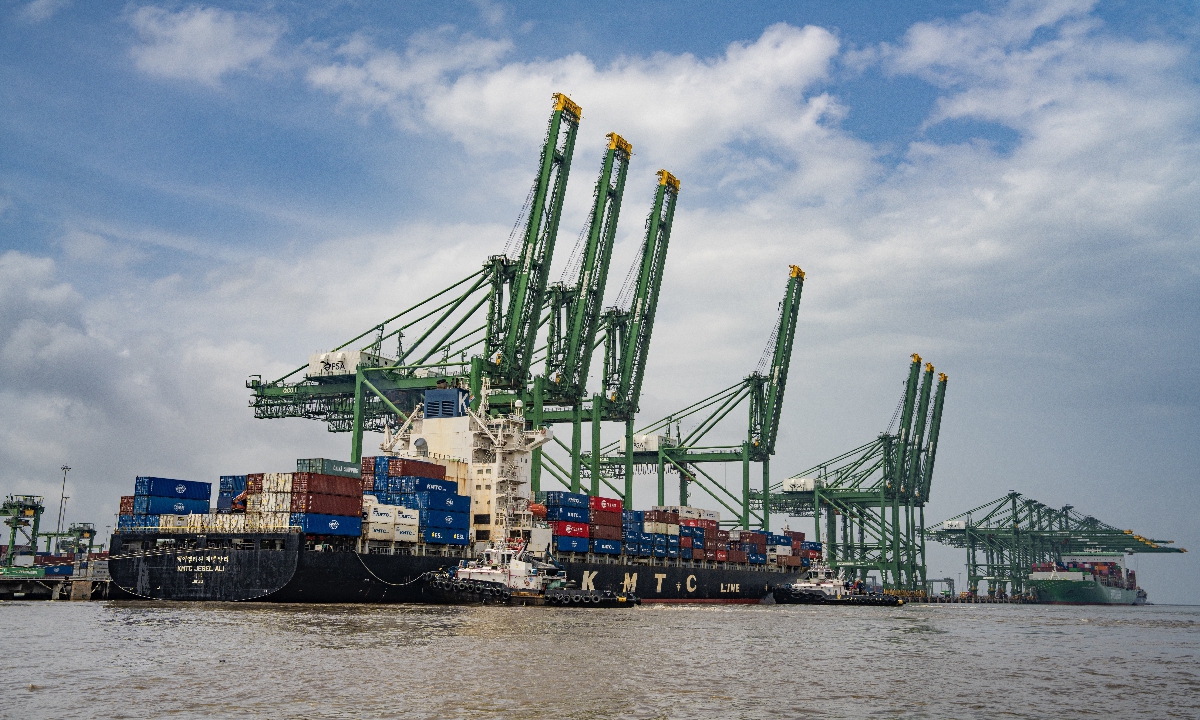
Shipping containers stacked on the KMTC Jebel Ali container ship at Jawaharlal Nehru Port in Navi Mumbai, Maharashtra, India, on August 9, 2025. Photo: VCG
India has declined to support incorporating the Investment Facilitation for Development (IFD) agreement into the framework of the World Trade Organization (WTO) as an Annex 4 Agreement, claiming it poses a risk of eroding the institution's functional limits, the Economic Times reported on Sunday, citing India's commerce and industry minister. It is worth noting, however, that the article pointed out that India's move comes as other nations, including Bangladesh, have agreed to join the pact.In April 2017, China and a group of developing and least-developed WTO members launched an informal dialogue on investment facilitation for development. WTO members participating in the talks announced in 2023 the conclusion of the negotiations on the text of the IFD agreement. According to the Xinhua News Agency, the agreement aimed to establish international rules, improve the transparency of investment measures, speed up and streamline investment-related administrative procedures, and enhance international cooperation.
In the latest development, Bangladesh announced its decision to join the IFD agreement, bringing the total number of the agreement's co-sponsors to 129. This move underscores the broad support the pact has garnered among WTO members and highlights a growing interest in investment facilitation, according to a report on the WTO's website on Saturday.
India may need to consider why 129, or roughly three-quarters, of WTO members have opted to support the IFD agreement. This support stems from the belief that the agreement could help attract and retain higher-quality investment, while also accommodating the varying development priorities of its members.
Global investment flows are increasingly uneven. While global foreign direct investment (FDI) increased by 14 percent in 2025, rebounding after two years of weakness, according to the latest Global Investment Trends Monitor by UN Trade and Development, more than $140 billion of the increase came from higher flows through global financial centers.
Excluding these conduit flows, global FDI rose by only about 5 percent, highlighting how limited the recovery remains in underlying investment. Notably, flows to developing economies declined by 2 percent to $877 billion. Lower-income countries were hit hardest, with three-quarters of least-developed countries experiencing stagnant or declining inflows.
In this situation, investment facilitation has become more crucial than ever. If India were to join the majority of WTO members in supporting such efforts, it would not only contribute to global economic stability, particularly for developing economies, but also create benefits for India's own growth prospects.
To support the growth of its manufacturing sector, India will need to attract FDI. Such development plays an important role in expanding production capacity and securing the advanced technologies and expertise required to enhance productivity and global competitiveness. By attracting foreign investment, India stands to improve the efficiency of its manufacturing base, stimulate innovation, and create jobs - essential elements for long-term economic development.
Foreign investment brings both capital and technical expertise, key drivers for the growth of India's manufacturing sector. Increased FDI would provide benefits to an economy that is still in need of investment. Attracting foreign capital hinges on improving the business environment and building investor confidence.
If India adopts a more pragmatic approach to attracting FDI - strengthening investment facilitation and taking a constructive stance on the IFD Agreement, including joining it and supporting its incorporation into the WTO framework as an Annex 4 Agreement - such efforts could help boost international investors' confidence in India.
India's reported concerns over the IFD agreement are both unfounded and unnecessary. The agreement has been negotiated at the WTO against the backdrop of an increasing and reinforcing relationship between trade and investment. Incorporating the investment facilitation agreement into this framework is a logical step, one that will help drive investment, particularly to developing economies.
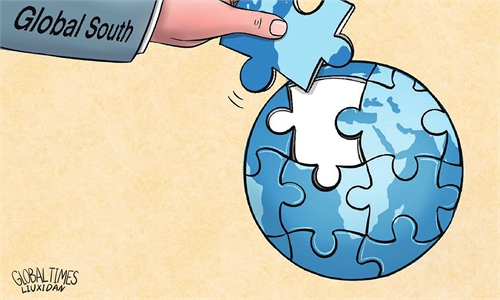
Like China, India is an important member in the Global South. In light of growing uncertainty in the global economic landscape, it is important for Global South economies to enhance cooperation within both regional and multilateral frameworks. By doing so, they can collectively protect the interests of developing nations and promote more balanced, inclusive global economic growth.
RELATED ARTICLES