ARTS / CULTURE & LEISURE
Earliest confirmed swimming mammal discovered in China
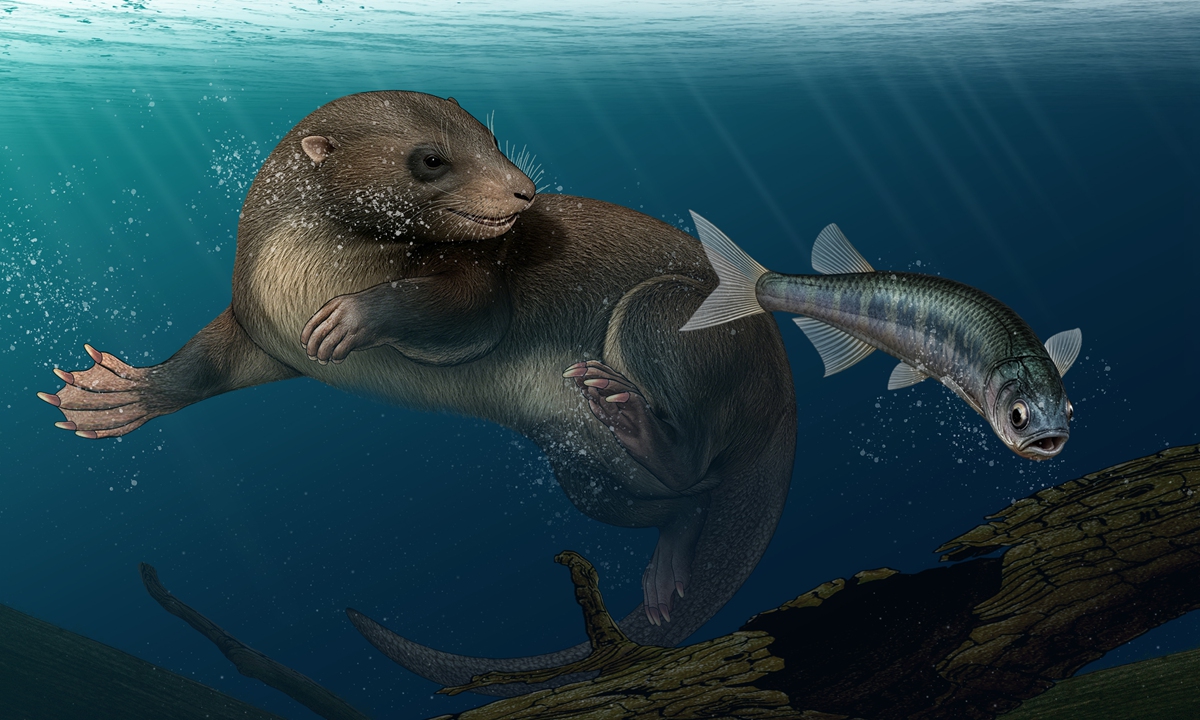
A reconstruction
A newly identified fossil from the Early Cretaceous of China shows that a small mammal living about 125 million years ago possessed clear adaptations for a semi-aquatic lifestyle, making it the earliest confirmed swimming mammal discovered to date.The study, titled "A polyphyodont, semiaquatic eutriconodontan mammal from the Early Cretaceous of China," was published on Monday in the journal Nature Communications.
The newly identified species, Dongoconodon platycauda, was discovered by Chinese and international researchers. The species shows clear adaptations to a semi-aquatic lifestyle and preserves rare reptile-like polyphyodont dentition, as well as finely preserved middle-ear structures, providing key fossil evidence for understanding the early ecological diversification of mammals, patterns of tooth replacement and the origins of the mammalian middle ear, according to a press release from Nanjing University.
The species shows a distinctive combination of adaptations for a semi-aquatic lifestyle.
It is the earliest known member of the mammalian crown group that shows evidence of the ability to swim. Its forefeet and hind feet have pronounced lateral expansions that resemble the webbed feet of modern platypuses, suggesting that the animal may have had well-developed webbing.
The arrangement of its metacarpals, metatarsals and finger and toe bones would also have allowed the digits to spread outward, increasing the surface area in contact with water and helping the animal generate thrust while swimming.
Its tail, however, was built quite differently.
The fossil preserves at least 19 tail vertebrae. Those near the base and middle of the tail have distinctly flattened vertebral bodies and relatively broad transverse processes, indicating a tail that flattened from top to bottom.
But unlike the broad, paddle-shaped tails of modern beavers and platypuses, the tail of the species gradually narrowed toward the tip. In this respect, it was more similar to the tail of the modern coypu, a semi-aquatic rodent.
Based on the structure of the limbs and tail, the researchers suggest that it may have relied mainly on its strong, broad forefeet, possibly equipped with webbing, to propel itself through the water.
Its flattened, tapering tail may have played a greater role in steering and stabilizing the body, similar to the tail of a coypu.
In other words, the small mammal that lived alongside dinosaurs may have combined platypus-like feet with a coypu-like tail, creating a previously unknown combination of swimming adaptations.
Some mammaliaforms that lived earlier have also been considered semi-aquatic.
One example is Castorocauda, a Middle Jurassic mammaliaform with clear adaptations for life in water. It is generally classified as a mammaliaform rather than a member of the mammalian crown group.
Dongoconodon platycauda, meanwhile, belongs to the eutriconodontans, an extinct group of early mammals. Its discovery therefore provides new evidence for the early entry of mammals into aquatic ecological niches.
The fossil also reveals an unusual pattern of tooth replacement. Living mammals typically have two generations of teeth, known as diphyodonty, while reptiles generally can replace their teeth repeatedly throughout their lives, a pattern known as polyphyodonty.
Tooth replacement is a key area of research into mammalian evolution. Diphyodonty has long been regarded as a defining feature of mammals and is closely associated with key biological traits, including precise occlusion, suckling and determinate growth.
However, because early mammalian fossils discovered to date have generally shown diphyodonty, the timing and process of the evolutionary transition from polyphyodonty to diphyodonty have remained unclear.
The newly discovered specimen preserves teeth at multiple developmental stages, a rare find. The finding provides further evidence that polyphyodont tooth development persisted within the mammalian crown group during the Early Cretaceous, suggesting that tooth evolution in mammals was far more complex than previously understood, according to the press release.
RELATED ARTICLES