ARTS / CULTURE & LEISURE
Giant Xinjiang hydropower project begins operation with benefits for flood control
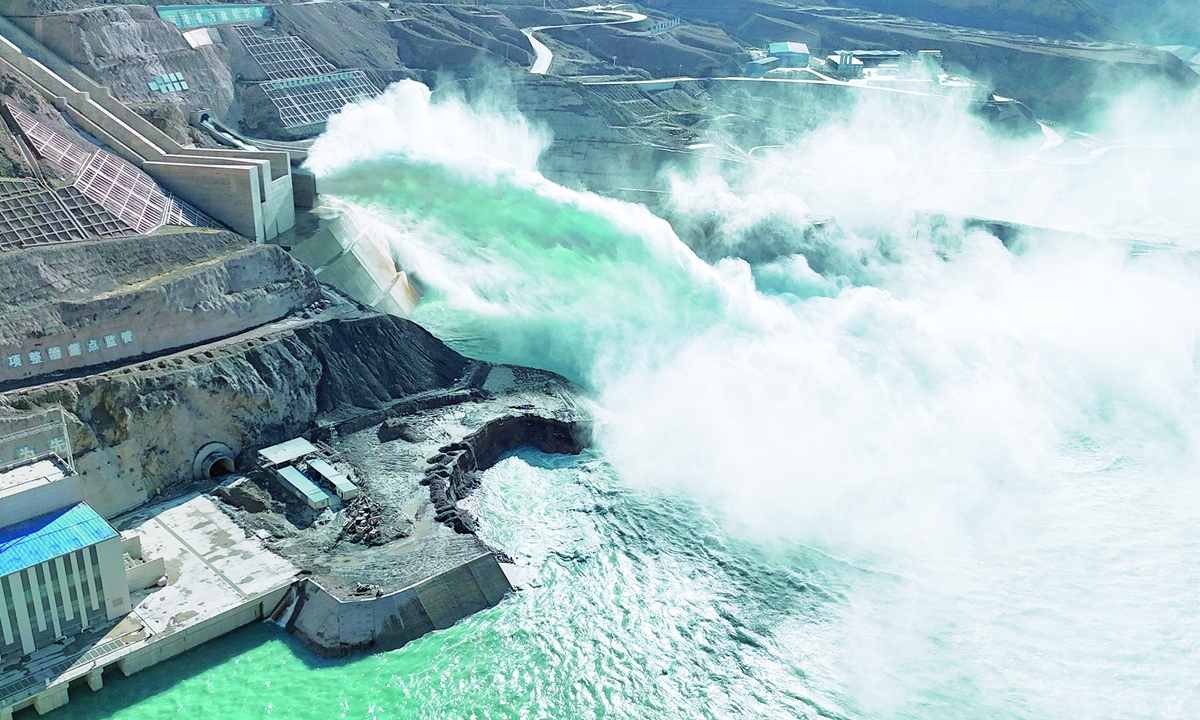
An aerial view of the Dashixia Water Control Project in Aksu, Northwest China's Xinjiang region. Photo: VCG
A dam as tall as an 80-story building now stands deep in Northwest China's Xinjiang region. At 247 meters high, the Dashixia Water Control Project has set a record as the world's tallest concrete-faced sand-gravel dam.
Its significance goes far beyond height. After its first two generating units were connected to the power grid on Tuesday, the mega project began transforming water from the Tianshan Mountains into electricity, irrigation resources, ecological flows and flood protection for southern Xinjiang, according to the Xinhua News Agency.
"The Dashixia reservoir is like installing a 'tap' on the upper reaches of the Tarim River," Zhou Junfang, chief engineer of the Dashixia Water Control Project, told the media.
According to Zhou, the reservoir controls the Kumalak River, which has an average annual runoff of 4.879 billion cubic meters. As one of the main sources of the Aksu River, a major tributary of the Tarim River, the Kumalak River provides nearly three-quarters of the Aksu River's water flow.
"Building a key water control project here is crucial for water allocation and flood control in southern Xinjiang," Zhou said.
The project is located in the middle and lower reaches of the Kumalak River in Aksu, and is one of the 172 major water-saving and water supply projects identified by China's State Council. The hydropower station has a total installed capacity of 750,000 kilowatts, equipped with three 250,000-kilowatt hydroelectric generating units.
The construction site faces harsh conditions, including dry and windy weather, complex geological structures and high sediment levels in the river. According to Xinhua, construction teams used digital management systems to ensure the precise installation of key components, with trial operations showing stable performance in key indicators.
"The significance of the Dashixia project is not only its record height, but also how it overcame the challenges of building an ultra-high dam in such a complex environment," Deng Bowen, a construction engineering expert based in Shanghai, told the Global Times.
"A higher dam means greater water pressure and stricter requirements for structural stability, seepage control and long-term operation," Deng said. He added that the project also explored solutions for operating large hydropower units under high water heads and heavy sediment conditions.
Such technological breakthroughs are ultimately aimed at addressing practical needs.
According to Xinhua, once fully operational, the Dashixia project is expected to generate 1.893 billion kilowatt-hours of electricity annually, enough to supply about 600,000 households with a year's worth of power. It will also support peak-load regulation for the power systems of four prefecture-level areas in southern Xinjiang, helping to ease regional electricity supply pressures.
Beyond electricity generation, water scarcity has long been a key factor affecting agricultural development and ecological protection in southern Xinjiang.
According to Xinhua, after completion, the reservoir will provide 3.42 billion cubic meters of ecological water replenishment to the Tarim River each year, help relieve water shortages affecting more than 6.8 million mu of farmland in the Aksu River basin, and improve the flood-control standard of downstream river channels from once-in-10-years to once-in-50-years events.
According to the Xinjiang Water Resources Department, the once-devastating floods will become a calm reservoir, while clean electricity will light up thousands of households. The dam, it said, is helping build a more harmonious relationship between people and water.
RELATED ARTICLES