Chinese travelers to Europe, South America, Australia and NZ up over 40% for Golden Week while Japan drops out of top 10: travel agencies
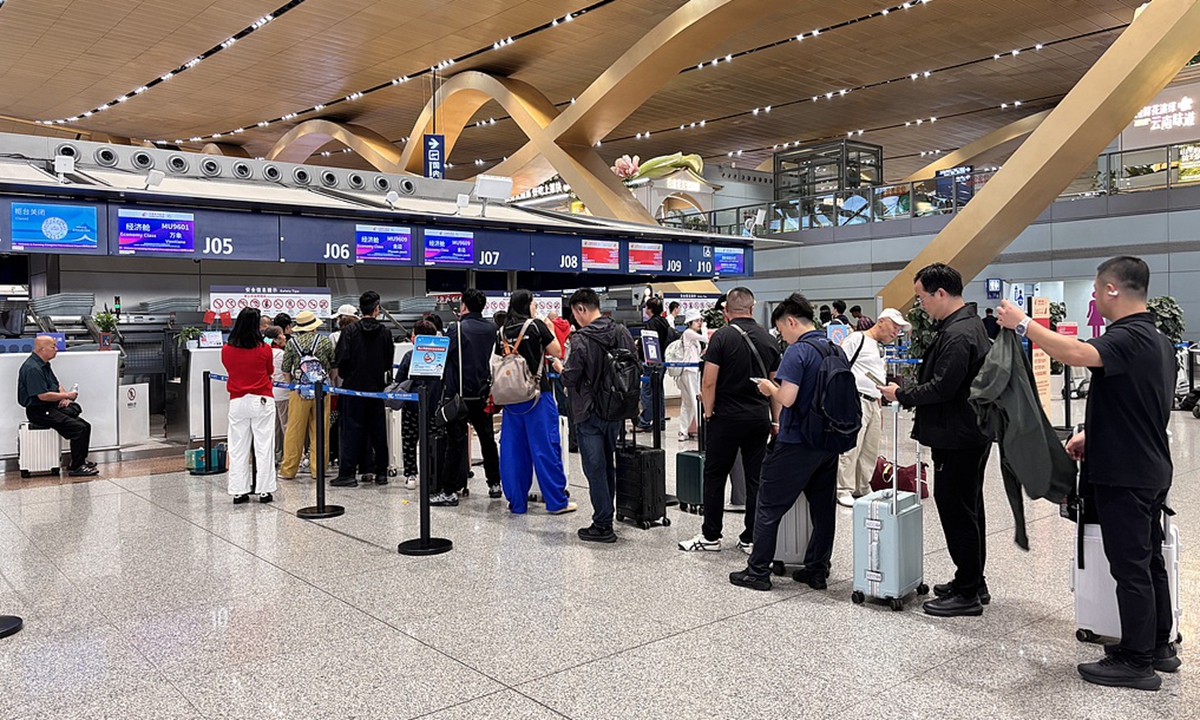
Photo: VCG
China’s week-long National Day holiday began Thursday, extending a travel peak that started with the Mid-Autumn Festival holiday from September 25, with travel agency data showing that Chinese globetrotters are opting to customize their outbound trips to combine multiple destinations into a single itinerary.The Mid-Autumn Festival, traditionally an occasion for family reunions, fell on September 25 this year. National Day followed on Thursday beginning a week-long public holiday. With only three working days between them, people who took those days off could combine the two breaks into a 13-day holiday ending on October 7.
Data from travel platform Qunar shows that on the first day of the National Day holiday, ticket bookings for long-haul flights over 2,000 kilometers increased by more than 40 percent year-on-year.
According to a report by The Paper.cn, data from online travel platform Fliggy shows that on Thursday, orders on the platform for overseas airport transfers and local activities rose 43 percent and 37 percent respectively, compared with last year.
Chinese tourists would check in at hotels in more than 2,000 cities worldwide on the first day of the National Day holiday, according to travel platform Qunar. Bangkok, Seoul, Hong Kong, Kuala Lumpur and Singapore were among the most popular short-haul destinations, while travel products for Europe, South America, Australia and New Zealand rose by more than 40 percent year-on-year.
Multi-country itineraries are also gaining popularity, with hotel orders for combinations such as “Singapore + Malaysia” and “France + Italy” up 1.2 times year- on-year.
Per working calendar, three days off could connect the Mid-Autumn Festival with National Day holiday, making a 13-day vacation possible. China’s civil aviation regulator forecasts strong holiday travel demand. Chinese airlines are expected to carry 31.19 million passengers from September 25 to October 7, up 3.6 percent from the same period last year, according to the Civil Aviation Administration of China (CAAC). International flight bookings for the period were up 22.5 percent year-on-year as of September 24, the CAAC said. Flights to Thailand, Malaysia, Vietnam and Laos increased by about 20 percent, while those to Britain, Germany and Spain rose by about 15 percent.
In a notable shift, Japan has reportedly fallen out of the top 10 outbound destinations for Chinese travelers during this holiday period.
Kyodo News, citing Chinese travel service provider Tuniu, reported that when planning trips for this year’s Mid-Autumn Festival and National Day Golden Week, Japan dropped out of the top 10 overseas travel destinations for Chinese tourists.
This marks a significant shift from previous holiday period, when Japan consistently topped the list for outbound Chinese travelers last year. According to Tuniu, Indonesia, Turkey and South Korea are now among the most popular overseas destinations, Kyodo News reported.
A Nikkei report on Thursday, reported that travel by Chinese tourists to Japan has continued to cool amid diplomatic friction between the two countries. Data from Tongcheng Travel showed that during the holidays, the most popular outbound travel destinations were Bangkok, Kuala Lumpur and Seoul. No Japanese city made it into the top 10.
Yang Han, a data research fellow at the Qunar Big Data Research Institute, said the extra-long holiday has boosted long-haul travel. On the Qunar platform, hotel bookings in popular countries increased by 48 percent year-on-year, and ticket bookings for long-haul flights over 8,000 kilometers rose by more than 30 percent.
As it is spring in the Southern Hemisphere, flight bookings to Cape Town, South Africa increased 4.3 times year-on-year. Benefiting from visa-free policies and new flight routes, air ticket bookings to distant destinations such as Brazil, Portugal and Chile, which are more than 10,000 kilometers away, doubled, The Paper.cn reported.
Jiang Yiyi, a professor at the School of Leisure Sports and Tourism at Beijing Sport University, told the Global Times on Friday that Chinese travelers are no longer satisfied with a simple “fly in, stay, fly out” model; instead, they are seeking multi-country, multi-city itineraries that maximize both value and experience during a limited holiday window.
This shift highlights stronger demand for customized travel products, expanding appetite for long-haul destinations, and a growing preference for immersive leisure experiences such as theme parks, cultural attractions and cross-regional trips, Jiang said, adding that the changing destination mix suggests that geopolitical and market factors can quickly reshape travel flows, as seen in Japan’s decline from the top tier of holiday choices.
China’s inbound tourism market has also seen renewed momentum during the National Day holiday, with a more diverse mix of visitors and a growing trend toward immersive cultural experiences.
One example is in Huzhou, East China’s Zhejiang Province. Rather than simply sightseeing, many foreign visitors are choosing to enjoy a cup of tea, taste traditional pastries and take part in Chinese-style cultural activities. According to Xisai Mountain tourist resort, foreign travelers accounted for over 25 percent of total visitors during the holiday, making them a standout segment of the tourist flow.
As Chinese travelers continue to explore global destinations, more overseas visitors are coming to China to experience its landscapes, heritage and cultural richness. This two-way tourism boom is helping unlock the potential of service trade and cultural exchanges.
“On the one hand, tourists’ spending on accommodation, dining, transportation, shopping, and other services at their destinations directly drives regional economic growth. On the other hand, inbound consumption is of great significance in reducing the deficit in travel services trade and promoting high-quality development of the sector,” Jiang said.
RELATED ARTICLES