EU, China need sustained dialogue to identify common ground, address disagreements

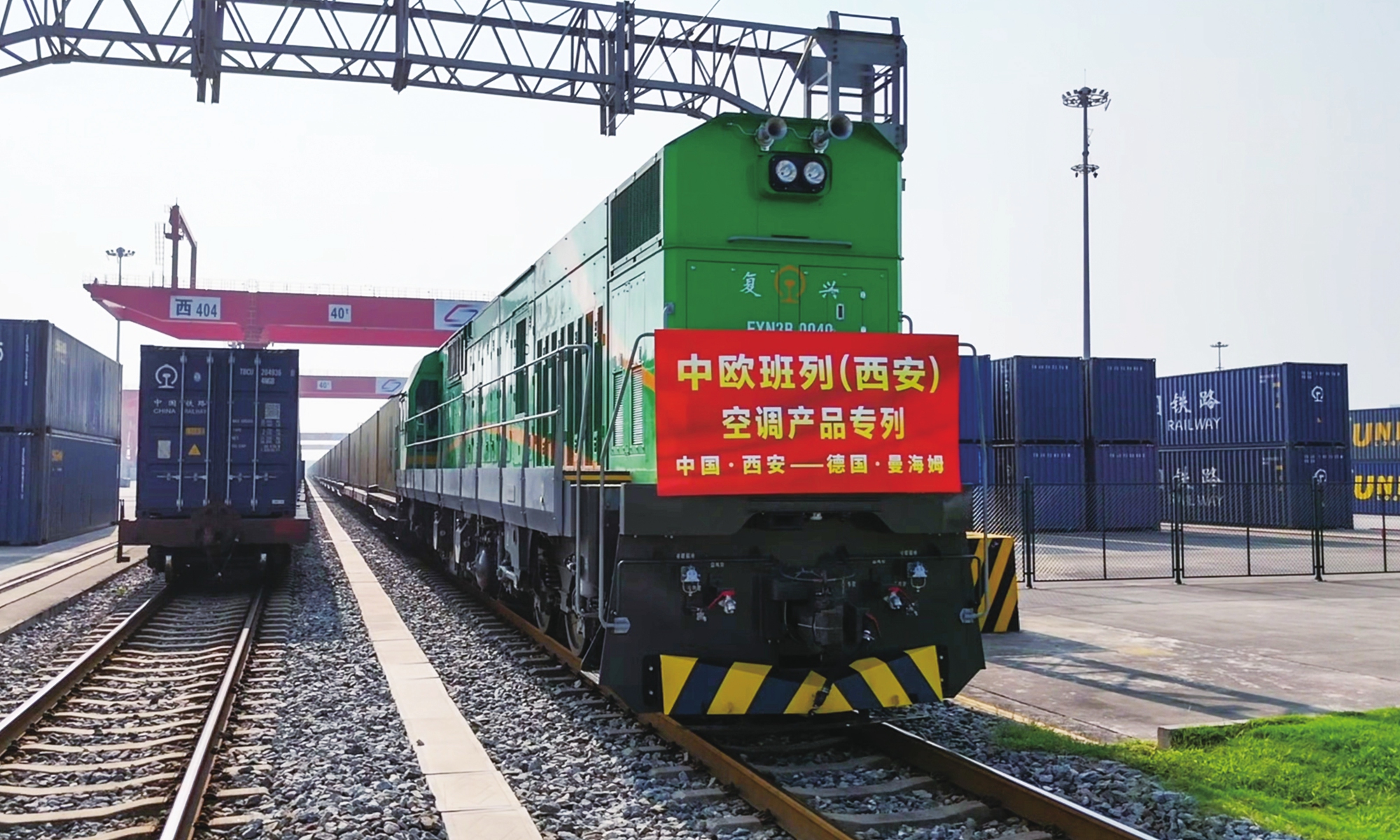
A China-Europe freight train carrying Chinese air conditioners departs Xi'an for Mannheim, Germany, on August 24, 2026. Photo: VCG
The EU's economic and trade policy toward China has become more assertive this year, with legislative proposals including the revised Cybersecurity Act and the Industrial Accelerator Act, reflecting a stronger emphasis on economic security. Europe has legitimate reasons to strengthen its productive capacity, but restrictions and protective measures cannot serve as substitutes for real investment, affordable green energy, and a better-integrated single market. If such measures become excessively broad, they risk raising production costs, reducing competition, and slowing the green transition.
The true measure of success should be whether Europe becomes more innovative and resilient, not how much trade is restricted. Confidence between the two sides is built not through political statements but through stable rules, transparent approval processes, and reliable mechanisms that businesses can actually use.

Sonia Bressler
To evaluate any policy, three questions matter: what is it seeking to protect, how narrowly is it designed, and does it leave room for cooperation?
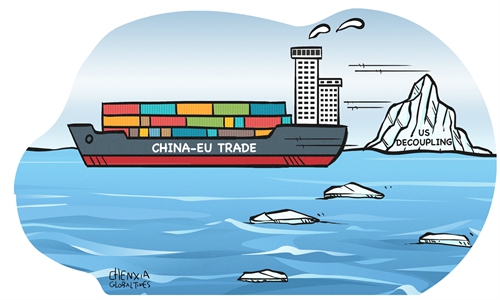
De-risking, properly understood, addresses identifiable vulnerabilities through diversification, safeguards, and contingency planning. Decoupling, by contrast, seeks a much broader separation of economic and technological systems. The risk is that "strategic" becomes an ever-expanding category within the EU that covers almost every advanced industry.
In semiconductors, AI, and green technologies, overlapping restrictions can create practical separation even when governments explicitly state they oppose decoupling. Europe could lose access to competitive technologies and Chinese customers. Security assessments must consider technical vulnerabilities, which should be proportionate, transparent, and regularly reviewed.
China's recent innovation achievements deserve serious international recognition. From the development of large commercial aircraft and advances in shipbuilding to AI models such as DeepSeek-R1 and robots developed by Unitree Robotics that have captured global attention, China is demonstrating a powerful ability to combine research, engineering, manufacturing, and rapid deployment. The capacity to move from a laboratory result to production at scale is itself a formidable source of innovation.
DeepSeek-R1 is a notable example: by making its model weights available under a permissive license, it allows researchers and businesses elsewhere to examine, adapt, and build on the technology, showing how Chinese innovation can directly contribute to the international technology ecosystem. European audiences should recognize the diversity of Chinese innovation, which spans universities, private companies, public institutions, and competing regional ecosystems. China's achievements invite Europe to reflect on its own capacity to translate research into useful products, while keeping international scientific exchange open.
China and the EU are two of the world's major economies. In 2025, EU-China trade in goods totaled 771 billion euros, reflecting deep economic interdependence. While a trade imbalance warrants serious discussion, a trade surplus alone does not prove industrial overcapacity; proper assessment requires sector-specific evidence on demand, capacity utilization, subsidies, and prices.
Promising areas for cooperation between the two sides include electricity grids, energy storage, industrial decarbonization, recycling, and technologies supporting ageing populations. Joint work should extend beyond general statements to concrete research, standards development, maintenance, and skills training. Chinese investment in Europe can strengthen cooperation when it creates durable local value and operates within European rules, while European companies need predictable and equitable opportunities in China. The ongoing trade and investment consultations should yield practical, verifiable commitments that businesses can act upon.
The EU and China need sustained dialogue to identify common ground and address their disagreements. Concepts that seem self-evident in one society often require careful explanation in another. Today's China is best understood through its diversity: its researchers, entrepreneurs, writers, younger generations, and regional variations. Appreciating these experiences helps European audiences move beyond one-dimensional narratives.
Europeans should take seriously China's aspirations for development and technological progress. Understanding does not require agreement on every issue; it requires sufficient knowledge to identify genuine disagreements and sufficient confidence to pursue shared interests. Cultural exchange, publishing, education, and scientific cooperation build that capacity and deserve sustained support, especially when political relations face headwinds.
Both Europe and China seek stronger productive capabilities, economic security, and predictable access to markets. Both sides share an interest in managing interdependence responsibly. The path forward requires concrete, verifiable cooperation and a shared commitment to managing disagreements. What the EU-China relationship needs most today is the practical willingness - in an age of strategic competition - to treat each other as partners with whom they can negotiate, cooperate, and competed fairly. That willingness must be rebuilt through concrete actions, mutual respect, and sustained dialogue.
This article is based on an interview with Sonia Bressler, a French writer and expert on China. bizopinion@globaltimes.com.cn
RELATED ARTICLES