ARTS / BOOKS
How a Chinese grocery store owner found her way to promote rural reading
Turning books into light
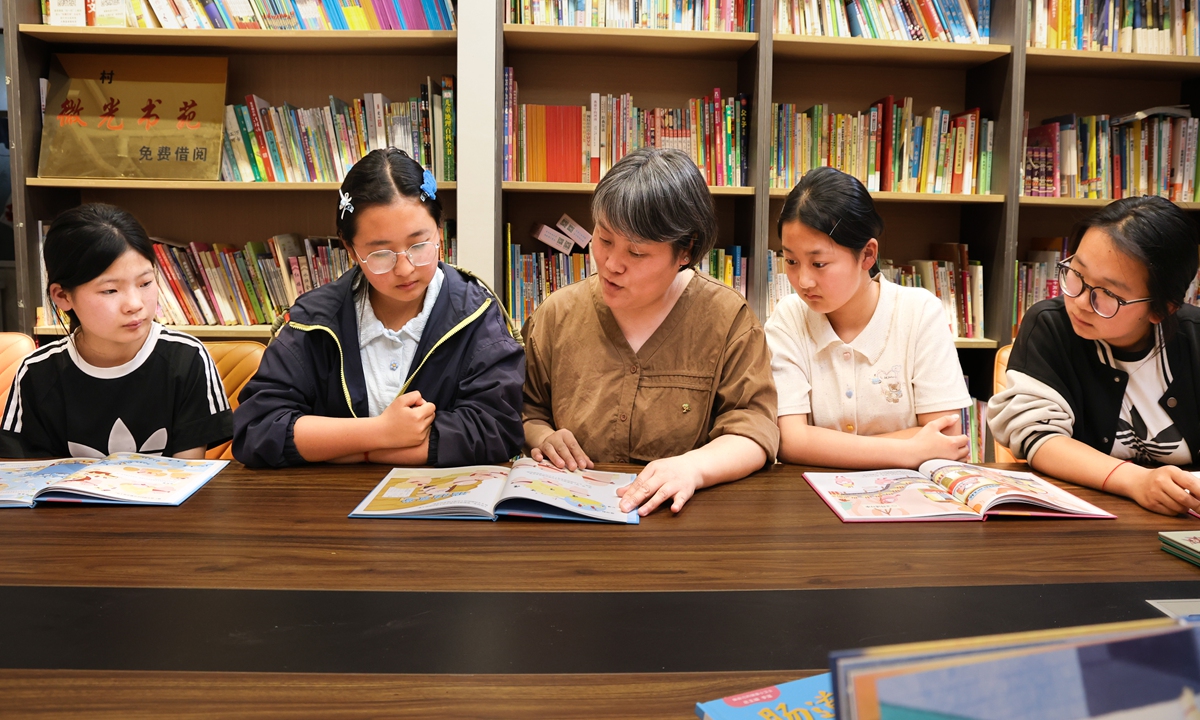
Li Cuili (center) reads a book with students at Weiguang Library in Central China's Henan Province. Photo: Courtesy of Tian Lin
In a village in Central China's Henan Province, a grocery store sells the things people come for every day - cooking oil, snacks, drinks and household goods.
But in one corner of the store in Lishi village, Neihuang county, there is something less ordinary: a reading space lined with books. Villagers can stop by to borrow books, join reading activities or simply sit down and read. And sometimes, while waiting for customers to finish shopping, the store owner, Li Cuili, does the same.
Li is now known as the founder of the Weiguang Library and a deputy to the 14th National People's Congress. But before she became known as a rural reading advocate, she was simply someone who loved books.
For Li, reading and writing were never about exams, recognition or making a living. They were simply things she continued to do, even after returning to a small village and settling into an ordinary life.
And eventually, the books that had stayed with her found their way onto the shelves of her grocery store.
A reader's turning point
Born in 1980, Li grew up in a family where reading and writing were part of everyday life. Her grandfather loved calligraphy and martial arts novels, and often told her stories from The Romance of the Three Kingdoms, while her father subscribed to newspapers and periodicals. As a girl, she developed an interest in reading and a vague dream of becoming a writer.
She did not make it to college. After two years at a vocational school, she returned to her village and opened the grocery store in 2005. Her days were soon filled with stocking goods, keeping accounts and looking after her children. But she kept reading whenever she could find the time.
She was especially fond of Wang Guozhen's modern poetry and read writers including Liu Zhenyun and Yu Hua. Li told the Global Times that she particularly enjoyed Liu's books for their down-to-earth style and keen observations of social realities. She also liked the fact that Liu, like her, is from Henan, she joked.
Talking enthusiastically about Liu's latest novel, Salty Jokes, she said it felt both "authentic" and "poignant."
Over the years, she never gave up on her dream of writing. She has written more than 1,000 poems, none of which has ever been published.
A home among books
In 2008, something happened that made her think about what children around her were reading.
A performing troupe came to the village. Li noticed that some of the content was inappropriate for children, who were watching and later imitating what they had seen. The experience stayed with her.
She remembered a line she had read: "Planting fields of golden crops is the best way to clear weeds from the wilderness."
For Li, the idea was simple. If she wanted to keep children away from unhealthy influences, telling them what not to watch was not enough. There had to be something better to offer them.
Books were the answer she knew best.
In the spring of 2008, Li cleared a section of the grocery store that had been used for selling liquor and turned it into a reading space. She brought out about 200 books from her own collection and spent her own money on another 300 used books. She printed the words "Weiguang Shuyuan," or "Weiguang Library," on four sheets of A4 paper and taped them to the wall. "Weiguang" means a faint glow.
At first, hardly anyone noticed.
Some villagers barely noticed that the store had a library. Others wondered why a rural shopkeeper would give up valuable shelf space for books that did not make money.
Li did not give up.
When children came into the store, she began offering them candy if they borrowed a book. When they returned it, she would ask questions about what they had read. Children who could answer could receive pencils or erasers, while those who wrote reading reflections could get notebooks.
It was an uncomplicated strategy, but it worked.
Some children initially came for the candy and stayed for the books. "For children who do well in school, reading can broaden their horizons and expand their perspective. For those who may be struggling a little, reading can help them find confidence and a sense of direction."
Li Mengjie, one of the library's early readers, is one example. She recalled that she had first read to obtain the sweets but eventually started reading for the pleasure the books brought her. She said she read an autobiography of Marie Curie three times and sometimes became so absorbed in a book that she hurried through meals.
Some adults began asking whether they could receive gifts for reading, too. Li prepared small items such as towels and toothbrushes.
The reading room began to draw people in.
What Li had started with a few hundred books slowly became a community reading space. Donations arrived from individuals, organizations and public institutions.
Today, the library's collection has grown to more than 5,000 books, ranging from Chinese and foreign classics and revolutionary literature to novels by renowned writers and books on health and wellness, offering something for readers of all ages.
"I've always said that I use my livelihood to support my ideals. I use the income from my grocery store to keep the Weiguang Library running, so the funding can fluctuate. When business is good, I can organize more elaborate activities. When money is tighter, the activities may be simpler. But I've always kept them going," she said.
Now, Li is thinking about doing something new for the elderly in her village.
"I was born and raised in the countryside," she said. "Elder people need more attention and care. There are so many stories behind their lives that deserve to be shared. So, I've been thinking about telling those stories in the form of a novel. I don't know whether I can write it well, but I'm willing to give it a try."
RELATED ARTICLES