ARTS / CULTURE & LEISURE
Reading made cool again as stand-up comedy meets classics in Shanghai
By Published: Jul 21, 2026 09:44 PM

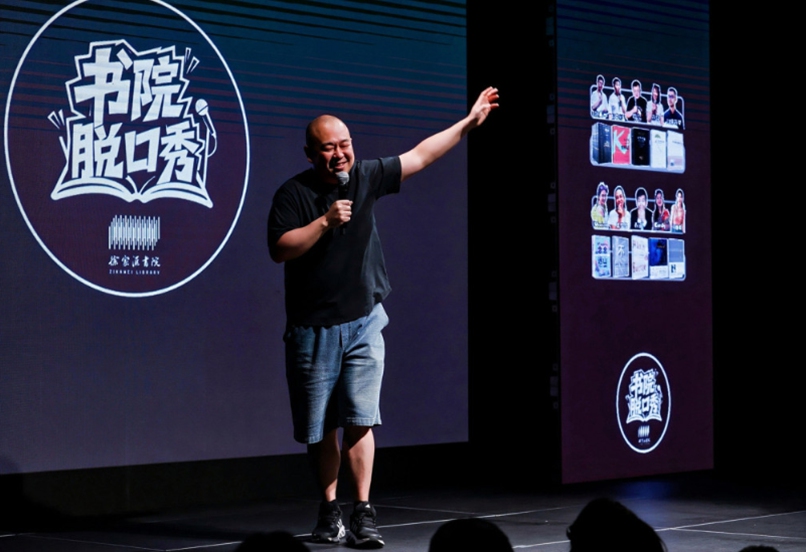
Book Academy Talk Show
It was a Saturday night. A comedian in a black T-shirt and denim shorts commanded the stage at Shanghai's West Bund Theater, microphone in hand, one arm raised high as laughter rolled through the audience. As the punchline landed, laughter rippled through the crowd.Behind him, a large circular logo lit up the screen alongside photos of performers and stacks of book covers, reminding us that this was not a conventional literature lecture or a standard comedy night.
As the logo revealed, this was the debut open-mic performance of the Book Academy Talk Show, a new initiative by the city's Xuhui District Library that asks participants to create five-minute stand-up routines rooted in the actual ideas of published books.
The first season boasts the slogan "Gather Punchlines, Read Endlessly," and it aims to create an interactive, performative reading experience that feels young, accessible and relevant. Unlike ordinary stand-up, every routine must be grounded in the central ideas of actual published books.
At the Saturday debut, performers dissected modern workplace anxiety through classics including The Metamorphosis, The Little Prince, The Crowd: A Study of the Popular Mind and books on rejecting toxic work culture.
Audience members were not mere spectators. Equipped with scoring devices, they acted as "original judges," sharing voting power with professionals to decide which contestants advanced to the final set for the Shanghai Book Fair.
The project addresses a familiar challenge in the digital age: While reading has become more fragmented, deep engagement with books often feels daunting. By wrapping "knowledge points" in laughter, the Book Academy Talk Show tries to build a bridge from page to stage. It also creates a full talent pipeline - from open auditions that began on World Book Day, through a professional comedy training camp run, to live performances.
The approach reflects a broader shift in how Chinese cities think about public cultural services. Instead of top-down lectures, the emphasis is on participation and grassroots energy. It treats ordinary citizens as potential cultural transmitters, not just consumers. In doing so, it taps into a growing interest in meaningful leisure and self-expression among younger professionals who face intense work pressure.
Of course, risks exist. Compressing a complex novel into a five-minute routine can lead to simplification or even misinterpretation. Striking the right balance between accessible jokes and intellectual honesty remains an ongoing challenge.
Organizers need to ensure that the pursuit of laughs does not erode the depth that makes the original works valuable.
In an era when many worry about declining attention spans, initiatives like this demonstrate that reading can still thrive when presented creatively. It does not diminish classics; it gives them new life and new audiences. Books move from a solitary experience to a communal event - something to laugh about, argue over, and remember together.
The Book Academy Talk Show offers one striking example of how reading promotion can adapt to modern habits without losing its essence. By turning the love for books into performances and dialogue, it helps make "having read" less important than "having thought" and "having shared." In the laughter echoing around the West Bund Theater, one catches a glimpse of what active, joyful engagement with literature can look like. It may not solve every challenge in cultural participation, but it points toward an engaging path forward.
The author is a reporter with the Global Times. life@globaltimes.com.cn
RELATED ARTICLES