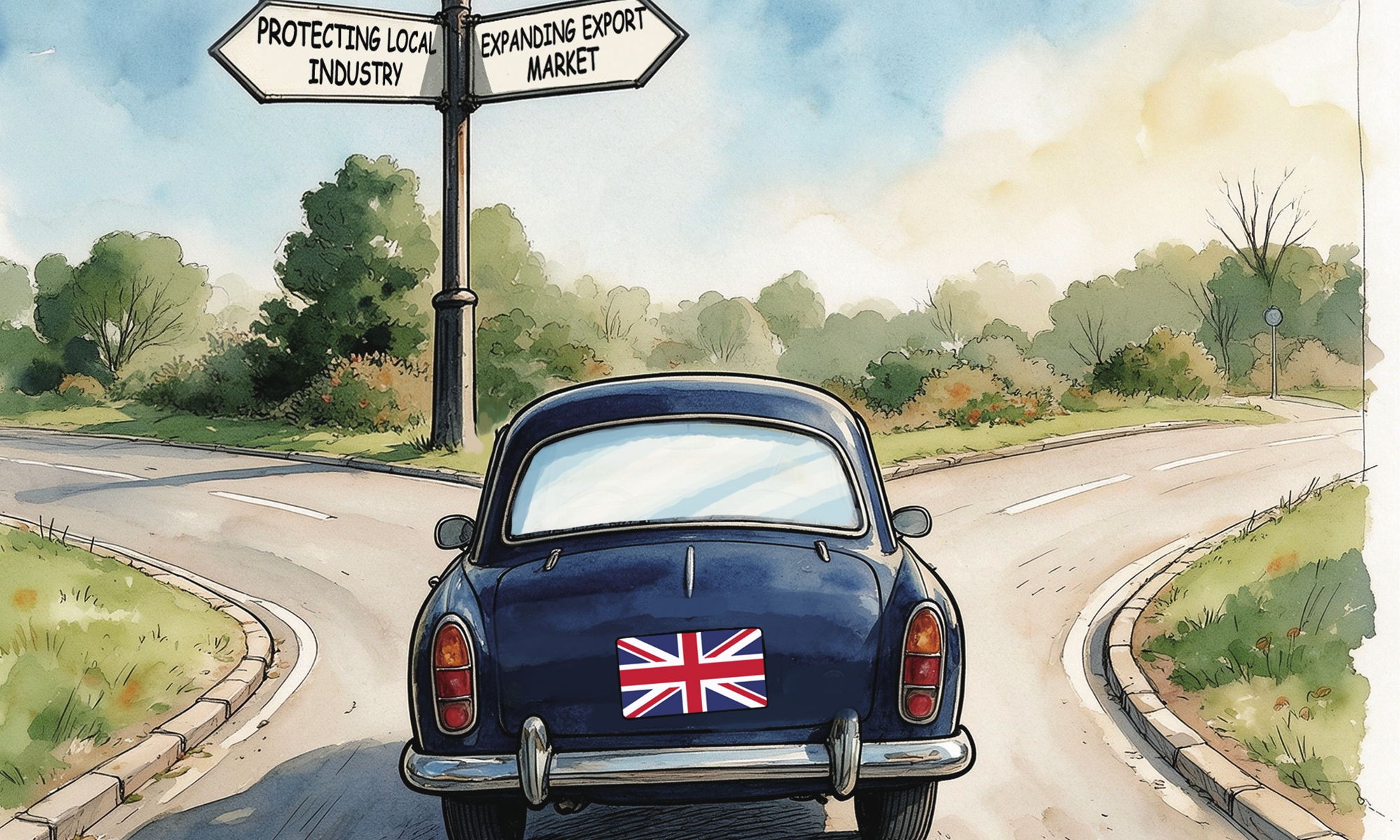
UK Illustration: Liu Rui/Global Times
The UK's Trade Remedies Authority (TRA) has published its initial recommendation to impose a new "anti-dumping measure" on imports of rutile titanium dioxide from China. Described as a way to "protect UK industry," the economic picture may be more complicated.
Rutile titanium dioxide may be unfamiliar to many, yet it is widely used as a whitening agent to provide brightness, opacity and durability to coatings, plastics, paper and many other industrial and consumer products. The TRA said that the UK's titanium dioxide production industry supplies hundreds of downstream businesses, underscoring the material's widespread role across the economy.
If the TRA's initial recommendation ultimately results in higher duties on imports of rutile titanium dioxide from China, downstream industries could face higher raw material costs. These costs could then be passed through the supply chain, putting further pressure on manufacturers that use the material in their products. From this perspective, an "anti-dumping measure" on Chinese imports could add costs across the wider UK manufacturing base. Rather than protecting UK industry, such a measure could end up hurting it.
Rutile titanium dioxide may account for only a small share of Britain's overall trade, but the case offers a glimpse into the more complicated trade environment that the UK faces. On the one hand, some of that pressure is coming from outside. The Financial Times reported that after the EU imposed "anti-dumping duties" on titanium dioxide, Brussels announced last month that it would be monitoring UK exports of titanium dioxide to ensure that EU "anti-dumping measures…are not being circumvented." This is seen as putting pressure on the UK.
On the other hand, the UK itself has a strong interest in expanding access to overseas markets. Trade gives British businesses access to foreign customers, while allowing them to expand, invest and improve their productivity. For an economy that relies heavily on international trade, overseas markets are therefore an important source of sales and economic growth.
These two forces appear to be pulling UK trade policy in different directions. Against this backdrop, how much could EU's industrial and trade policies affect the UK? The answer ultimately rests with the UK's own economic needs. For British businesses, access to competitively priced imports and overseas markets remains important to growth and competitiveness. From an economic perspective, lower trade barriers can help UK businesses secure affordable inputs and reach more customers abroad - a logic that applies not only to titanium dioxide but across the wider economy.
Following Brexit and its departure from the EU's trading system, the UK has spent the past several years trying to strike trade deals with countries around the world. This has helped broaden the UK's trading network, giving its businesses more opportunities to benefit from lower trade barriers and gain access to overseas markets.
China is an important market for the UK and its largest trading partner in Asia. With the world's largest middle-income population and a vast consumer market, China has considerable potential for increased UK imports. This could open new opportunities for British exporters of goods and services to reach Chinese consumers and businesses.
Titanium dioxide is a telling example. Trade barriers can drive costs along the supply chain, hitting downstream industries and the wider economy. As global trade grows more uncertain, the UK has good reason to reassess its trade and industrial policies in light of its own economic needs. A more open and flexible trading environment can support the UK economy by keeping input costs competitive and broadening access to overseas markets.
The author is a reporter with the Global Times. bizopinion@globaltimes.com.cn
RELATED ARTICLES