Chinese commerce minister speaks to new UK business secretary, raises concern over British Steel case
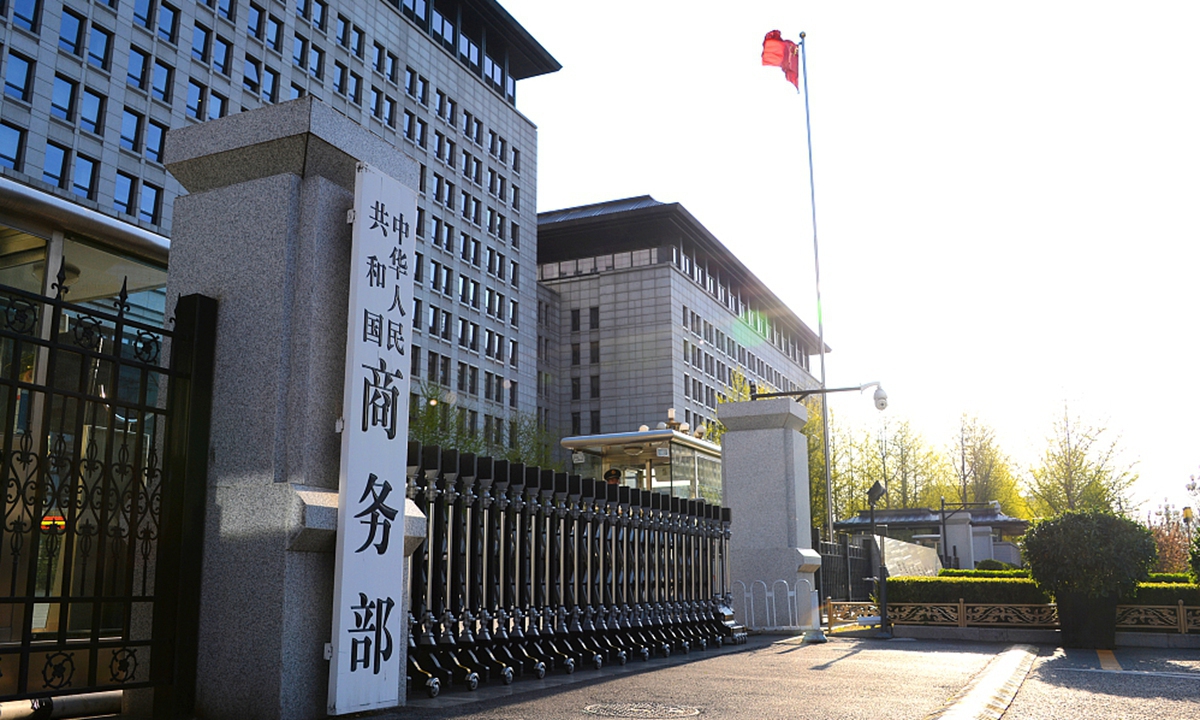
The Ministry of Commerce Photo: VCG
China is highly concerned about the nationalization of British Steel and urges the UK to abide by relevant international rules, fulfill its obligations under the China-UK investment protection agreement, prudently resolve the issue and provide a sound business environment for Chinese-invested enterprises in the UK, China's Minister of Commerce Wang Wentao said on Tuesday.
Wang made the remarks during a video call with the newly appointed UK business secretary Jonathan Reynolds, exchanging views on China-UK economic and trade relations, according to a release on the Ministry of Commerce website.
Wang congratulated Reynolds on his new appointment and expressed China's willingness to fully leverage the China-UK Joint Economic and Trade Commission mechanism to promote the healthy development of China-UK economic and trade relations.
China is willing to work with the UK to expand cooperation, strengthen cooperation in areas such as services trade, green transformation, and renewable energy, promote a balanced and progressive bilateral trade, and uphold the multilateral trading system with the World Trade Organization (WTO) at its core, Wang said.
Reynolds said that a sound China-UK economic and trade relationship will benefit businesses and people on both sides. The UK agrees with China's concept of promoting balanced and progressive bilateral trade and looks forward to deepening practical cooperation with China in areas such as services trade, climate change, and artificial intelligence, as well as strengthening coordination and cooperation within the WTO, according to the press release.
The UK understands and values China's concerns regarding the British Steel issue. In accordance with relevant laws, the UK will engage a third-party assessment agency to conduct an independent assessment. The UK will strictly abide by the assessment results and provide reasonable compensation. The UK does not wish to let this matter affect overall UK-China economic and trade relations, according to Reynolds.
The UK government announced on July 16 that it had nationalized British Steel in accordance with the Steel Industry (Nationalisation) Act, taking over the enterprise previously controlled by China's Jingye Group, and will establish a compensation mechanism through secondary legislation, with an independent assessment to determine whether compensation is needed.
Jingye Group on July 19 demanded that the UK government fully compensate the company for all losses arising from its investment in British Steel, stressing that it had initiated consultations under the relevant bilateral investment treaty, and that it reserves all legal rights and would never compromise.
On March 9, 2020, Jingye acquired British Steel, which was then on the verge of bankruptcy, rescuing the century-old steelmaker. Over the past five years, Jingye has injected substantial capital to upgrade obsolete equipment, guaranteed the payment of employee wages, fulfilled all tax obligations in full compliance with the law, and created tens of thousands of jobs, according to the company.
Pan Jian, chief analyst at Beijing Hezhong Dingcheng Co, told the Global Times that when Jingye Group acquired British Steel in 2020, the British government was involved throughout the entire process, and no one raised so-called "national security" concerns.
When Jingye prepared an orderly shut down of loss-making facilities in March last year, the British government stepped in. On April 12, 2025, the British Parliament rushed through the Steel Industry (Special Measures) Act within six and one-half hours, authorizing the government to forcibly take over British Steel. In Pan's view, the move was not based on security concerns, but rather British politicians, driven by electoral interests, using "national security" as a pretext to trample on market principles and the spirit of the contract.
When making investment decisions, investors value a stable local environment. Many countries, including the UK, promise stable treatment when utilizing and attracting foreign investment; such stability is grounded in mutual benefit and win-win cooperation between the parties. Jingye fulfilled its commitments, creating local jobs and maintaining British Steel's production and normal operations, Huo Jianguo, a vice chairperson of the China Society for World Trade Organization Studies in Beijing, told the Global Times on Wednesday.
The incident has become a reflection of the UK's business environment and international credibility. How the UK handles the British Steel issue will not only directly affect investors' perceptions of the UK's business environment and the credibility of its government, but may also influence China-UK economic and trade relations, Huo said.
RELATED ARTICLES