IN-DEPTH / IN-DEPTH
China’s ‘token going global’ is helping African livestreamers reach American shoppers while narrowing digital divide
Intelligent services delivered from 8000 km away
By Published: Oct 08, 2026 11:03 PM


Photo: VCG
In the evening in Addis Ababa, Ethiopia's capital, the building housing an e-commerce livestreaming hub was brightly lit. In front of the camera, an Ethiopian host spoke briskly: "If you have been watching this little guy for 10 minutes and you still cannot stop thinking about him - that is your answer."On the other side of the screen, consumers in New York heard a line that sounded like a native expression, delivered with just the right ease and conversational rhythm.
Few would have imagined that the sentence was generated by a large language model running in a machine room in Xiamen, East China's Fujian Province, more than 8,000 kilometers away.
This is one vivid scene in China's recent practice of "token going global." In the world of large models, tokens are the smallest computational units used to process information, and they are increasingly becoming the new "containers" of digital trade. The electricity never left China's power grid, and the computing power never left its data centers, yet the value of intelligent services was delivered across borders.
In August, Xiamen's first "token going global" project began officially serving an Ethiopian cross-border e-commerce livestreaming company. Within just one week of going live, token usage surpassed 10 billion. From Xiamen to Addis Ababa and then to the smartphone screens of US consumers, a new digital trade channel is taking shape.
"The first time we used it, the team's feeling was: this is fantastic," recalled Etsubdink Akede, deputy general manager of an Ethiopian e-commerce company and the client behind China's "token going global" service. Her voice still carried the excitement of that moment. "Finally, we didn't have to start from a blank sheet of paper."
From Xiamen to Addis Ababa
Akede's company runs cross-border e-commerce livestreaming in Addis Ababa, targeting the US market. Ethiopia's labor costs are relatively low, the capital's education level is fairly solid and English is one of the country's official languages. Together, these factors are helping the city emerge as a hub for cross-border e-commerce livestreaming.
But the pain points are just as real: the language and cultural gap. While Ethiopian hosts speak English, many of their incomes are only a fraction of those of US consumers, making it difficult for them to truly grasp US preferences, context and idiomatic expression, said Lu Yang, president of the Fujian Artificial Intelligence Association and head of the "AI Magic" project at Xiamen-based company Unisound, which provides Akede's company with "token" services.
"If you have to hire Americans to write scripts for every livestream, the cost will be high and the efficiency low," Lu said.
Lu recalled that, months ago, some Chinese cross-border e-commerce companies recommended Ethiopian clients to his team because "they knew very clearly where the pain points [of Ethiopian e-commerce companies] were." Lu's team then built an AI agent using a self-developed large language model that imitates American expressions and lifestyle habits, generating an entire livestream script in seconds.
"Just give the large model any product, and it will generate a full set of livestream content in the American style. The host only needs to get familiar with it, train according to the script and can go live soon," Lu told the Global Times.
The results were immediate. Akede recalled that the first time her company used this Chinese large language model, it was to prepare scripts for a batch of plush toys. After they entered the product information into the system, "it almost immediately produced a complete script - how to hook viewers at the opening, how long to talk about each product, when to drop the promotions - and it even generated the multilingual versions all at once," she said.
Previously, preparing a livestream script took two to three days, said Akede. Now, the time needed for the first draft has been cut to a few hours, with overall turnaround reduced by 70-80 percent.
The time saved is used to study trending products from competitors, negotiate new items with suppliers and get more rest, Akede said. "AI allows the colleagues on the night shift to get more rest, and that in itself is a very valuable improvement," she told the Global Times. "When the team is well rested, what they deliver the next day is different."
From China to Ethiopia, latency across the entire large-model pipeline is around 300 milliseconds, or 0.3 seconds - "hardly affecting daily work," Lu said. More importantly, the process is fully compliant: the self-developed large model is deployed in a compliant data center, overseas data is processed without being retained in China, and services are delivered via dedicated overseas lines. "Customers' privacy is well protected," he said.
A blooming industry
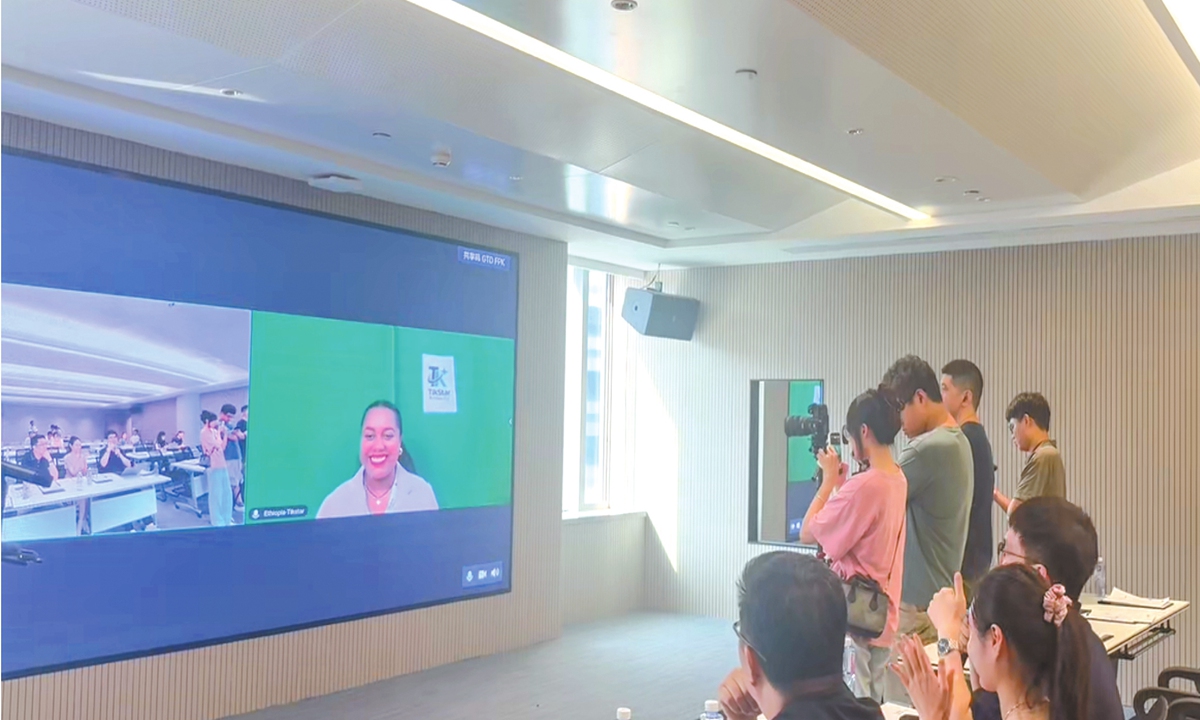
Staff members in Xiamen, East China's Fujian Province, speak with an Ethiopian client about the "token going global" project via video call. Photo: Courtesy of Unisound
What exactly is meant by "token going global"?"Put simply, 'token going global' means exporting China's AI capabilities overseas to help unlock cultural exchange and the exchange of smart-economy services," said industry insider Chen Duo, a guest professor at School of Overseas Education of Xiamen-based Jimei University, and founder of AI creator community "AINext."
Chen summarized the current landscape of China's "token going global" as two main models: one is the export of computing power to foreign countries such as Ethiopia; the other is what he called "incoming-data processing," in which overseas clients place orders while China handles data and content production before distributing the output back abroad. AI short dramas are a classic example of the second kind, he introduced.
Chen observed that this year, "token going global" has gradually evolved from fragmented efforts into a more structured system under official support. In Xiamen, he mentioned, the local government has identified eight major scenarios for token going global, including e-commerce, AI short dramas, gaming, healthcare and education, along with supporting policies. "When local governments are willing to pilot new approaches first, the boost to the market will be very significant," he told the Global Times.
For those on the front lines, policy support is felt most directly. Lu said Xiamen has introduced cost subsidies and support for overseas market expansion. "For companies setting up sites overseas, especially in BRICS countries, the government will also provide corresponding support."
Xiamen is not alone. In Shantou, South China's Guangdong Province, the city reportedly completed a full-chain closed-loop validation of "token going global" at the end of April. Daily token usage surged from 100 million to 100 billion, and the number of approved enterprises engaged in "incoming-data processing" rose to 132, and overseas-oriented computing capacity achieved a 1000-fold scale expansion, local media outlet Shantou Daily reported on September 28. On September 24, Shantou unveiled a series of policies to support "token going global," offering subsidy of up to 1 million yuan ($149,000) per company.
Open, inclusive, mutually beneficial
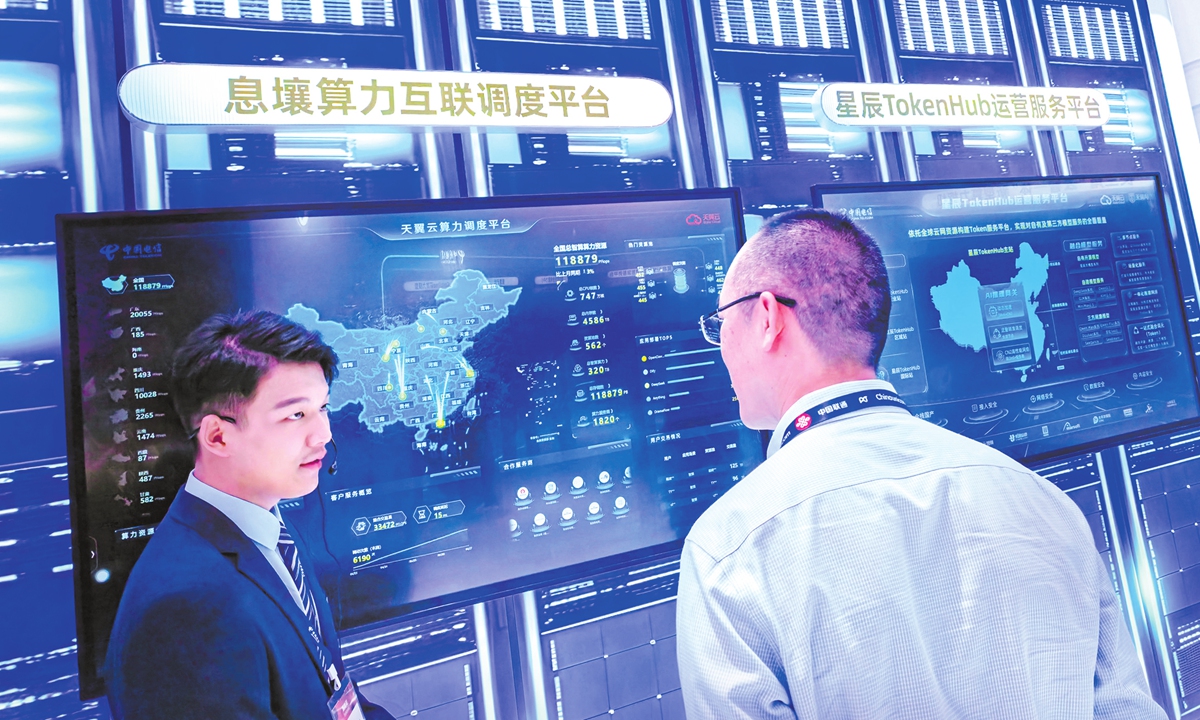
A visitor consults at the exhibition booth introducing tokens at PT Expo China 2026 in Beijing on September 23, 2026. Photo: IC
China's AI is becoming increasingly accessible, and that promise of inclusiveness is being felt by more and more users overseas. At the start of 2024, China's average daily token usage stood at 100 billion; by the end of 2025, it had surged to 100 trillion, and in March 2026, it had climbed past 140 trillion - an increase of more than a thousandfold in just two years, the People's Daily reported on March 24.At this year's World Artificial Intelligence Conference in July, China stressed the need to help Global South countries with capacity building to bridge the AI and digital divides, promote sustainable development, and prevent creating new historical injustice in AI.
"China's AI is not locked away in a treasure chest," Lu said. Chinese AI, he added, is both high-quality and relatively affordable, making it highly competitive in the international market. "Our Chinese AI may have 70 to 80 percent of the capabilities of the most advanced AI in the US, but it may cost only a third as much," he said. "And unlike the US' AI, ours comes with far fewer restrictions. It is more open."
This sense of accessibility and usefulness takes concrete form in Akede's day-to-day work. She pointed to one especially memorable word that came from a livestreaming script written by the Chinese large model: "huggable."
"When it was describing the material, the AI used 'huggable' instead of the 'soft' or 'cute' we normally default to," she told the Global Times. "'Soft' and 'cute' describe how it looks; 'huggable' describes what you would do with it. Just one word shifted the audience from simply looking at the product to wanting to own it." The word was later used in the livestream itself, and, she said, "the comments were noticeably warmer."
As a frontline user of Chinese tokens, Akede strongly agrees that China's AI is open, inclusive, and mutually beneficial. She laid out two main reasons.
First, it is genuinely useful. "We're a small and medium-sized company. We had used other international large models before; they performed well, but they were simply too expensive for us, and getting customized service was very difficult. The Chinese solution has made advanced AI affordable - and truly usable - for us for the first time," Akede explained to the Global Times.
Second, the barrier to entry is low. "We access it through an API (application programming interface) and pay as we go, so what we use is completely transparent. There is no need to build a data center first or sign a big contract. A small team can start right away," she said.
The night closed in. In Akede's team, the hosts were preparing product selections for the next livestream. On the computer screen was a first draft of a script generated moments earlier by the model. One colleague kept reading, then paused and said to the screen, "Add another section: focus on the product's size and feel. American audiences care about that." Seconds later, the revised paragraph appeared in the document. Several people leaned in to read it, then nodded in approval.
"This collaboration doesn't feel like we bought a tool," Akede told the Global Times. "It feels like we found a partner who genuinely wants to get things done together."
In a livestream room in Addis Ababa, the lights come on again. The host adjusts the headset and smiles into the camera. More than 8,000 kilometers away, indicator lights in a data center in Xiamen blink quietly. Between these moments, the width of the digital divide narrows - just a little, and then a little more.
RELATED ARTICLES