China rejects claims of yuan devaluation for trade advantage
PBC stresses market forces, urges joint action on global imbalances
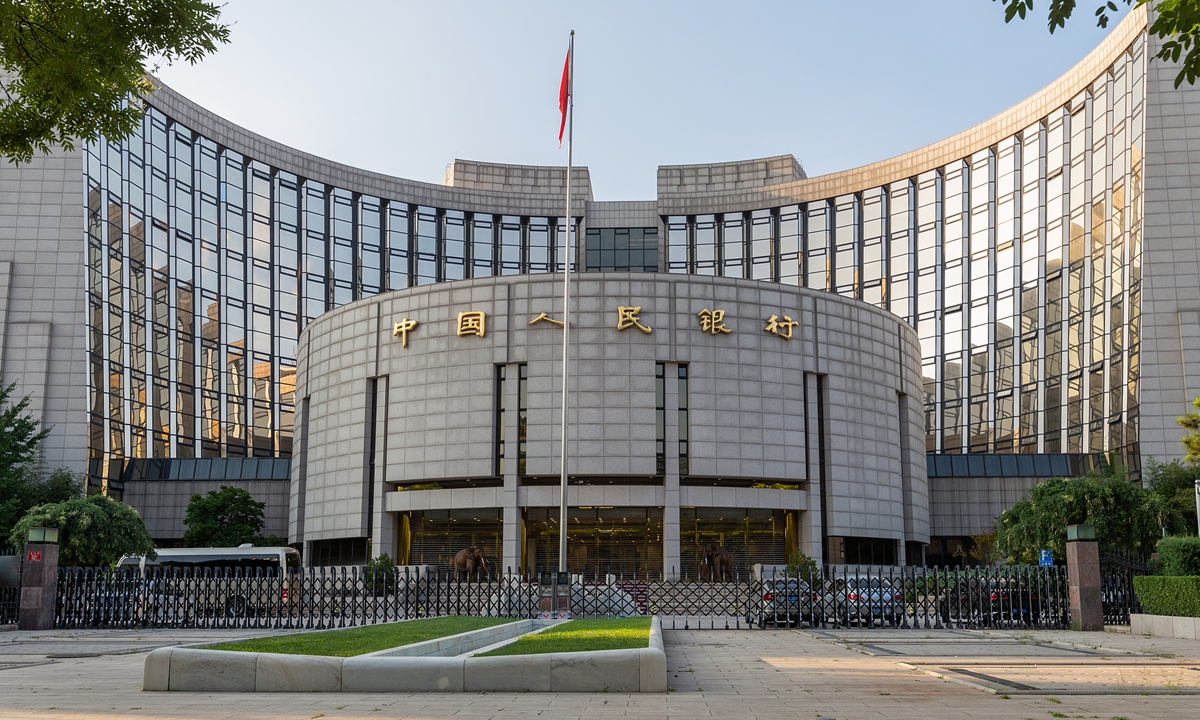
The People's Bank of China Photo: VCG
China has no need or intent to gain competitive advantages through currency devaluation, nor has it ever resorted to competitive devaluation, the People's Bank of China (PBC), China's central bank, said on Thursday on its official website, stressing that addressing global imbalances requires collective action rather than blaming other countries' exchange rates for domestic economic problems.In a statement outlining its view on the yuan exchange rate, the PBC said China adopts a managed floating exchange rate regime based on market supply and demand with reference to a basket of currencies. Market forces play a decisive role in determining the yuan exchange rate, it said.
The statement comes as some Western media outlets continue to claim that the currency is undervalued. Chinese experts said the statement rebuts claims that China deliberately keeps the yuan weak to boost exports, stressing that the country's trade growth is driven by its growing industrial competitiveness rather than currency depreciation. They also highlighted the need to guard against irrational expectations of further yuan appreciation and distinguish exchange rate risk management from currency manipulation.
Market-driven exchange rate
The yuan has strengthened against the US dollar from 8.27 per dollar in July 2005 to around 6.7 recently, appreciating by 23 percent cumulatively, according to the PBC. It has gained about 9 percent against the dollar since 2025.
The currency has experienced several cycles of appreciation and depreciation since 2010, with more pronounced two-way floating and greater flexibility, the central bank said.
Hu Qimu, a professor at the Maritime Silk Road Institute of Huaqiao University, told the Global Times on Thursday that the yuan exchange rate is not state-manipulated but fundamentally determined by market supply and demand. He noted that the central bank does not preset a level, and whether the rate rises or falls is for the market to decide. The "managed" float only means adjustment during special periods of irrational volatility; the yuan cannot be expected to appreciate one-sidedly all the time.
Hu added that China's trade is rooted in industrial competitiveness, not exchange-rate depreciation. Exchange rates rise and fall. One-sided appreciation cannot last forever, still less should other countries' own structural problems simply be attributed to China's exchange rate.
The PBC said it neither targets a specific level for the RMB exchange rate, nor seeks to determine its longer-term trajectory. It has phased out regular intervention in the foreign exchange market since 2017.
The central bank said its focus is on preventing short-term fluctuations from undermining financial stability, particularly sharp depreciation. It may use macroprudential tools to guide expectations or intervene in extreme cases to correct herd behavior and irrational market expectations.
Hu said the PBC's statement makes clear that exchange rate management is aimed at preventing irrational market fluctuations rather than deliberately weakening the yuan to boost exports. China's export competitiveness instead rests on technological innovation, complete industrial and supply chains, and resilience to external shocks, as reflected in the growing global competitiveness of products such as new-energy vehicles, lithium batteries and solar products.
Global imbalances demand joint action
Global economic imbalances require coordinated structural reforms rather than unilateral pressure on China, as attempts to blame the yuan exchange rate for trade deficits risk obscuring deeper economic challenges, Chinese experts said.
The PBC said global imbalances stem from shifts in the international division of labor, inherent flaws in the international monetary system and the savings-investment gap in each economy. Addressing them requires joint efforts by both surplus and deficit countries, rather than placing responsibility on either side.
Each country should do its own homework by advancing structural reforms, the central bank said. Deficit countries should consolidate fiscal positions, raise domestic savings rates, and strengthen industrial competitiveness, while surplus countries should boost consumption and investment, it said.
It warned that blaming the yuan exchange rate for the embedded problems in the international monetary system and structural difficulties will not help find a solution. "Such an act is nothing but an avoidance of responsibility for adjustment, and it is a de facto political maneuver in the context of protectionism and unilateralism," it said.
Dong Shaopeng, a senior research fellow at the Chongyang Institute for Financial Studies at Renmin University of China, told the Global Times on Thursday that the US has sought to pressure China into reducing exports and production capacity in sectors including steel, new-energy vehicles, and solar products to narrow its bilateral trade deficit.
Washington has also used allegations of yuan undervaluation to demand currency appreciation, Dong said. However, China's manufacturing competitiveness stems from its comprehensive industrial system and supply-chain advantages rather than currency depreciation, he noted.
Hu similarly stressed that China's export competitiveness has evolved beyond low production costs, increasingly relying on technological innovation, integrated supply chains and resilience to external shocks.
He cited new-energy vehicles, lithium batteries and solar products as examples of China's growing industrial strengths. Exchange rates affect export costs, but cannot alone determine international competitiveness, particularly as rising labor and resource costs make reliance on low prices unsustainable, Hu noted.
The experts' assessments highlight the limitations of using currency pressure or trade restrictions to address structural imbalances, which require broader domestic reforms and international coordination.
The PBC also cited historical evidence showing that China's global export share rose by 2.4 percentage points between 2005 and 2008 despite a 21 percent yuan appreciation against the dollar, underscoring the absence of a straightforward relationship between exchange rates and trade performance.
The International Monetary Fund said in its July 2026 External Sector Report that global current account imbalances widened in 2025, with China and the US among the main drivers, and emphasized the importance of coordinated policy adjustments.
The PBC said China would continue expanding domestic demand, advancing high-standard opening-up and contributing to a more open, inclusive and balanced global economy during the 15th Five-Year Plan period (2026-30).
RELATED ARTICLES