Chinese expert elected inaugural chair of new IEC subcommittee on advanced manufacturing
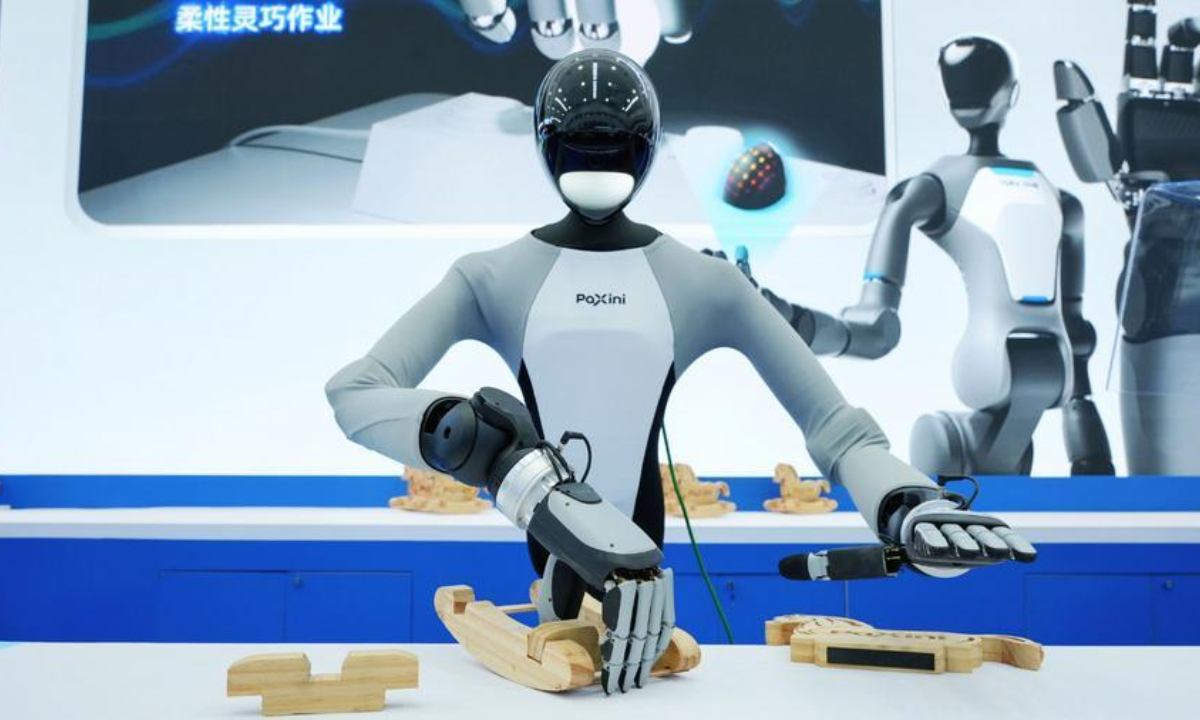
A robot exhibit from PaXini AI conducts a toy assembling challenge at the 2026 World Robot Conference in Beijing, capital of China, Aug. 19, 2026. (Xinhua)
A Chinese expert has been elected the inaugural chair of the International Electrotechnical Commission (IEC) Subcommittee on Smart Manufacturing and Enterprise Applications, marking another significant achievement in China's assumption of key positions within the technical bodies of international standards organizations and reflecting international recognition of China's contributions to international standardization in the field of advanced manufacturing, according to the State Administration for Market Regulation (SAMR) on Friday.
Vigorously developing the advanced manufacturing industry is a crucial step in implementing the strategy of building China into a manufacturing powerhouse, and is also key to keeping Chinese manufacturing aligned with global trends and achieving transformation and upgrading. The subcommittee, known as IEC/SC65F, was established to optimize the international standardization framework for advanced manufacturing and coordinate global technical, industrial and standardization resources, it said.
Its work covers key areas including reference architectures and conceptual frameworks, industrial data spaces, digital factories, enterprise control system integration, system performance assessment and human-machine interfaces. The subcommittee aims to develop international standards based on global consensus, helping establish common technical frameworks for advanced manufacturing and guiding the industry's digital and intelligent transformation.
"The move marks China's entry into global standard-setting in electrotechnical manufacturing. It also reflects a broader trend: rapid advances in smart manufacturing, batteries and autonomous driving have gone hand in hand with growing participation in international organizations - as industries grow stronger, taking leadership roles naturally follows," Cao Heping, a professor at Peking University, told the Global Times on Friday.
The positive implications are twofold. First, participating in standard-setting means having a say. As the saying goes, "first-class enterprises set standards" - those involved in drafting international standards gain a favorable position in global competition. Second, the standard-setting process offers a window into the development direction, frontier developments and evolving trends of the world's leading industries, which is highly beneficial to China's advanced manufacturing sector, Cao said.
In recent years, China's advanced manufacturing sector has continued to expand and strengthen, with significant gains in innovation capacity, competitiveness and overall strength, and solid progress has been made toward building the country into a manufacturing powerhouse.
According to market data, one out of every three cars sold worldwide is made in China. Through forward-looking planning, technological leapfrogging and accelerated development, China's new energy vehicle sales have grown more than 930-fold since 2013, with the penetration rate rising more than 590-fold - marking the strong emergence of a trillion-yuan strategic emerging industry.
Meanwhile, China's manufacturing value added has ranked No.1 in the world for 16 consecutive years, accounting for close to 30 percent of the global total. It has taken a global lead in areas of strength such as photovoltaics, communications, high-speed rail and shipbuilding, while robotics, artificial intelligence and innovative pharmaceuticals are developing rapidly. New quality productive forces are gathering momentum, and advanced manufacturing is surging with vitality.
Going forward, China will strengthen international cooperation on advanced manufacturing standards, promote the development of high-quality international standards and work to bring standardization and industrial innovation closer together. These efforts are aimed at supporting the digital and intelligent transformation of manufacturing and contributing to the industry's development worldwide, the SAMR noted.
RELATED ARTICLES