China rolls out 19 measures for new quality productive forces
Guidelines to boost innovation, curb involution-style competition
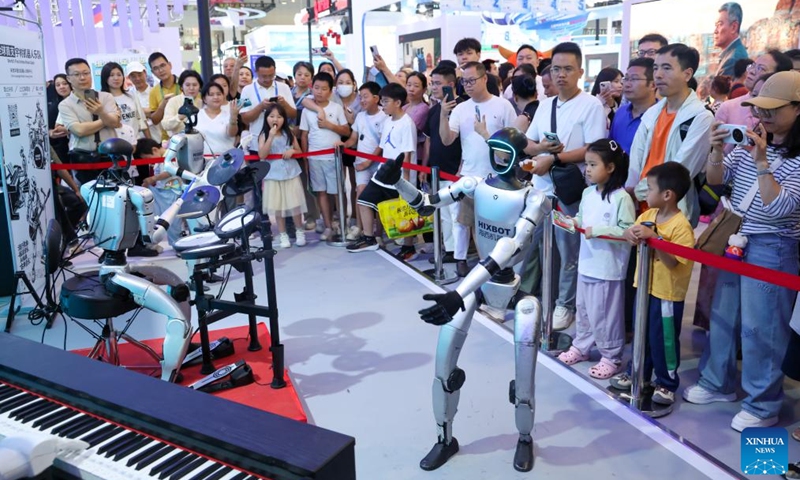
Robots stage a performance at the 22nd China (Shenzhen) International Cultural Industries Fair in Shenzhen, south China's Guangdong Province, May 24, 2026. Photo: Xinhua
The Central Committee of the Communist Party of China (CPC) and the State Council have issued guidelines to accelerate the development of new quality productive forces, setting out 19 key measures to strengthen technological innovation, deepen its integration with industry and improve institutional support for high-quality development. The document was made public on Friday.
The guidelines cover five main areas, including technological and industrial innovation, innovation in development approaches, institutional reform and talent management. They identify developing new quality productive forces as an inherent requirement and a key priority for promoting high-quality development, with a substantial increase in total factor productivity as the core indicator.
The document provides detailed arrangements for the systematic undertaking of developing new quality productive forces, Tian Yun, a Beijing-based economist, told the Global Times on Friday, while highlighting stronger support for enterprises' role in technological innovation as an important institutional innovation underpinning this effort.
The guidelines call for establishing a corporate research and development reserve system, increasing the additional tax deduction rate for R&D expenses of technology-oriented small and medium-sized enterprises, and supporting capable private enterprises in leading major national technological research tasks.
Enterprise R&D projects that meet national strategic needs can be elevated to national projects through prescribed procedures. Tian said coordination between the government and the market could help identify innovative projects across regions and industry segments, supporting the development of emerging industries.
To accelerate commercialization, the document proposes deploying research and commercialization tasks together when technological projects are initiated and assessing actual application results upon completion. It also encourages universities and research institutions to license technological achievements to micro, small and medium-sized enterprises on a use-first, pay-later basis.
The new guidelines combine traditional industrial upgrading with emerging and future industry development, placing particular emphasis on fully implementing the "AI Plus" initiative. They call for sector-specific AI pilot application bases and high-value application scenarios to accelerate adoption across industries.
"Developing new quality productive forces is not about simply abandoning traditional industries, but rather empowering the existing real economy with intelligent technologies, so that old industries can regain new vitality," Xi Junyang, a professor at the Shanghai University of Finance and Economics, told the Global Times on Friday.
AI can be widely applied across industries, making it an important avenue for developing new quality productive forces, Xi Junyang said, adding that it can advance technology while accelerating the large-scale application of technologies in traditional industries.
China's high-tech manufacturing sector has maintained strong growth. Its value-added output among large enterprises rose 16.7 percent year-on-year in August, compared with 5.2 percent growth in overall industrial output. Industrial robot production increased 34.6 percent, according to the National Bureau of Statistics.
The guidelines also call for advancing the energy revolution, developing advanced nuclear fission energy in an orderly manner, building a power system with a high proportion of renewable energy, and improving renewable energy integration and regulation policies.
Xi Junyang said the energy revolution provides a reliable and secure foundation for developing new quality productive forces. It is an important arena for technological and industrial transformation, a path toward carbon peaking and carbon neutrality, and a source of security support for new growth drivers, he added.
Alongside innovation support, the document sets requirements for orderly development. It calls for cross-regional industrial cooperation to avoid "involution-style" competition and mechanisms to increase investment and share risks in future industries. It also seeks stronger patient capital support for early-stage, small and hard-technology businesses.
Localities must tailor their approaches to actual conditions, the guidelines state, warning against speculative expansion, industrial hollowing-out and blindly pursuing new industries. They prohibit the improper use of policies in the name of developing new quality productive forces and require serious accountability in cases where investment stampedes or blind investment cause major losses.
The document also encourages foreign venture capital institutions to develop in China and calls for global innovation cooperation networks. Tian said the package could inject fresh momentum into Chinese modernization while generating positive spillover effects, enabling international partners to share opportunities arising from China's technological advances and development.
RELATED ARTICLES