Multiple localities of China announce plans to develop high-end, precision, advanced industries during 15th Five-Year Plan
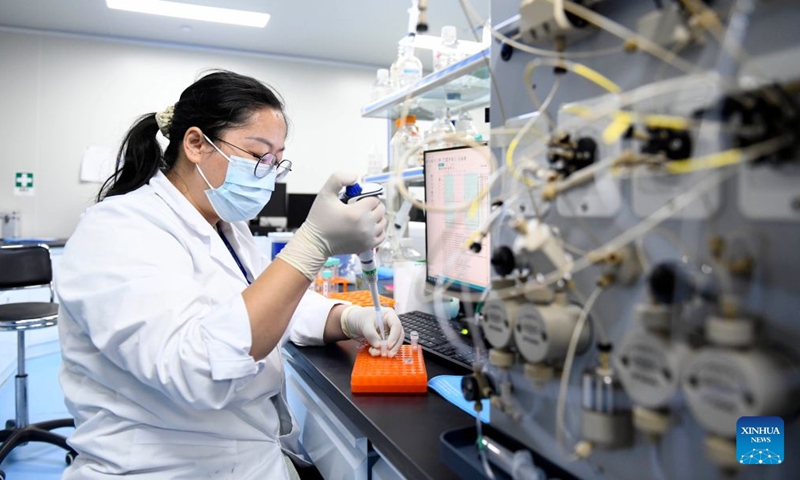
A staff member conducts 3D stem cell culture experiments at Shandong Qilu Cell Therapy Engineering Technology Co., Ltd. in Jinan High-tech Industrial Development Zone in Jinan, east China's Shandong Province, July 11, 2026.
A number of Chinese localities including Beijing and Shanghai have recently announced plans for developing high-end, precision and advanced industries as well as building a modern industrial system during the nation's 15th Five-Year Plan (2026-30) period.Observers said that the moves show that China's top-level industrial blueprint is being translated into local action based on each locality's factor endowments and comparative advantages, and these efforts, taken together, will inject fresh impetus into China's technological self-sufficiency and global competitiveness.
The Beijing municipal government on Wednesday announced a plan, identifying and prioritizing the development of sectors including commercial aerospace, artificial intelligence (AI), humanoid robots, quantum technology, brain-computer interface, and 6G telecommunication technologies.
Under the plan, the city will pursue full-stack self-reliance and citywide applications in AI to seize the commanding heights of global competition, build itself into a global benchmark city for robot applications featuring human-machine collaboration, and seek breakthroughs in reusable launch vehicles and high-thrust engine technologies.
According to the plan, the capital aims to make major breakthroughs by 2030 in developing new quality productive forces. The capacity of high-end, precision and advanced industries to serve and underpin major national strategies will be further strengthened, and their capabilities in industrial scientific and technological innovation, self-reliance and self-control, and driving regional development will be significantly enhanced.
By 2030, the value-added of high-end, precision and advanced industries as a share of the city's GDP should reach 40 percent, up from 34.6 percent in 2025.
In August, the government of East China's Fujian Province announced a plan for the development of emerging industries and industries of the future during the 15th Five-Year Plan (2026-30) period.
The plan sets the goal of fostering a trillion-yuan new-energy industrial cluster, lifting the new materials cluster above 900 billion yuan ($134,12 billion) and the integrated circuit and optoelectronics cluster above 300 billion yuan, as well as building 100-billion-yuan-level clusters in AI, biomedicine, energy conservation and environmental protection, and the low-altitude economy.
In July, the Shanghai government released a similar plan for accelerating new-type industrialization and building a modern industrial system over the next five years.
The plan stressed the build-up of a "2+3+6+6" modern industrial system with advanced manufacturing as its backbone. It called for the comprehensive advancement of the twin transitions of digital-intelligent and green development, while strengthening the three leading industries of integrated circuits, AI and biomedicine.
The plan identified six emerging pillar industries -- next-generation electronic information, intelligent connected new-energy vehicles, high-end equipment, advanced materials, new energy and green low-carbon industries, and fashion consumer goods, along with six industries of the future.
"There is some overlap in emerging and future industries across local plans, but each locality has rolled out its plan based on local conditions and its own strengths. Beijing, for example, has an edge in science and technology, while Fujian — home to CATL — has an industrial advantage in building a new-energy cluster," Li Chang'an, a professor at the Academy of China Open Economy Studies at the University of International Business and Economics, told the Global Times on Wednesday.
Li said that the development of those industries in the next five years will play a critical role in "driving high-quality economic development and fostering more investment." It will also elevate the global competitiveness of relevant industries, he added.
RELATED ARTICLES