Hainan Province aims to develop high-tech industrial clusters in coming five years
Localities' tailored plans help boost efficiency: expert
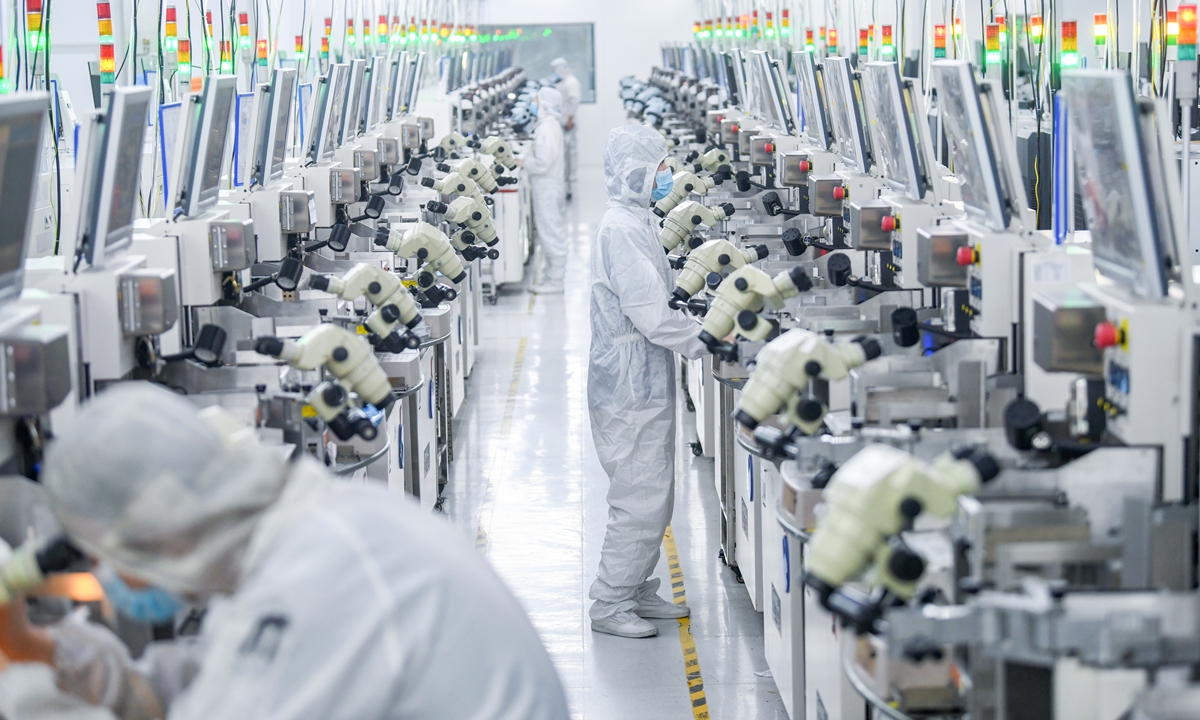
Workers fulfill orders and testing products in a production workshop of a company in Haikou, South China's Hainan Province on May 23, 2026. The company utilized production equipment imported under Hainan Free Trade Port's zero-tariff policy to independently manufacture and successfully export 773,000 transistors, with a total value of 1.849 million yuan. Photo: VCG
By 2030, the added value of South China's Hainan Province's high-tech industries is expected to account for about 20 percent of its GDP, with their total business revenue surpassing 1 trillion yuan ($147.41 billion), according to the province's high-tech industrial development plan for the 15th Five-Year Plan (2026-30) period, which was released on Tuesday.
The province's plan comes as various regions across the country vow to leverage their respective industrial foundations and comparative advantages to cultivate and develop the high-tech sector. Developing high-tech industries in accordance with local conditions helps avoid homogeneous competition and repetitive construction, gives better play to the comparative advantages of various regions, and improves the allocation efficiency of resources nationwide, an expert noted.
In terms of specific high-tech industries, according to Hainan's plan, by 2030 the added value of its core digital industries is expected to account for about 9 percent of its GDP, with substantial growth in output value in commercial aerospace and deep-sea marine technology.
The plan supports the construction of international intelligent computing centers, while developing offshore data centers, and exploring new models for token-related services. Meanwhile, the province will build cross-border data infrastructure facilities such as international submarine optical cables and international telecommunications service gateways, and accelerate the development of a coordinated electronic information manufacturing industrial ecosystem featuring "chip design as the driver, breakthroughs in advanced packaging and testing, and extension into maintenance and manufacturing."
The plan also vowed to advance the construction of a commercial space launch site, by developing the rocket chain, satellite chain, data chain, and "aerospace+" industrial system. By 2030, the revenue of the commercial aerospace industry is targeted to reach 50 billion yuan, according to the plan.
"The plan offers clear direction for Hainan's industrial development in the coming five years by fully utilizing the institutional strength and preferential policies pertaining to the Hainan Free Trade Port. It aims to establish a coordinated sea-land-air development framework, promoting the marine economy, commercial aerospace, cross-border data operations, and other related industries," Hu Qimu, a professor at the Maritime Silk Road Institute of Huaqiao University, told the Global Times on Tuesday.
Hu noted that leveraging its locational advantages and policy support, Hainan is shifting from its traditional reliance on tourism and agriculture to a model oriented toward technological superiority, research and development (R&D) strengths, and trade advantages.
In addition to Hainan, other Chinese localities have also rolled out local five-year plans to boost their high-tech development.
For instance, South China's Guangdong Province will strengthen emerging industries such as new energy, new materials, intelligent connected vehicles, intelligent robotics, pharmaceuticals and medical devices, aerospace, integrated circuits, the low-altitude economy, and biomanufacturing. It will also support Shenzhen in becoming the "capital of high-tech enterprises," according its 15th five-year plan.
East China's Anhui Province has vowed to develop automotive-grade chips, artificial intelligence computing power chips, and other advanced chips, strengthen capabilities in memory manufacturing, logic foundry, and packaging and testing, and accelerate the development of key equipment and materials such as metrology and testing equipment, high-end photomasks, and large silicon wafers.
Southwest China's Sichuan Province plans to implement the "East Data, West Computing" initiative, promoting the nationwide integrated computing power network through the advancement of the national hub node between Sichuan's capital city Chengdu and neighboring Chongqing Municipality. Sichuan will also guide regions rich in clean energy to explore and promote the integrated development of computing power and electricity.
Hu noted that in the next five years, various localities will rely on their industrial foundations and comparative advantages to strive for building a number of technology industries.
"Eastern provinces, leveraging their geographical advantages and industrial foundations, will focus their industrial strategies on creating globally influential industrial innovation hubs and highlands, while central provinces, based on their east-west connecting location and industrial foundations, will seek breakthroughs in fields such as equipment manufacturing and electronic information," Hu said.
In addition, the industrial development strategies of western provinces are closely integrated with their abundant energy and ecological resources. Aiming at national strategic needs, they strive to transform resource advantages into industrial advantages, Hu added.
According to the outline of the 15th Five-Year Plan (2026-30) for national economic and social development, the country will build distinctive and complementary emerging industry clusters tailored to local conditions, focusing on creating a number of emerging pillar industries with high growth potential, high technological content, and broad market penetration.
"Developing high-tech industries in accordance with local conditions plays a significant role in advancing the overall scientific and technological progress of the country. It not only avoids resource waste caused by redundant construction and expansion across regions, but also makes R&D in each region more industry-focused and market-driven, facilitating the transformation of research results, industrialization, and the development of industrial clusters," Hu said.
RELATED ARTICLES