From tent hotels to solar canopies: how China’s outdoor manufacturing sector climbs the value chain
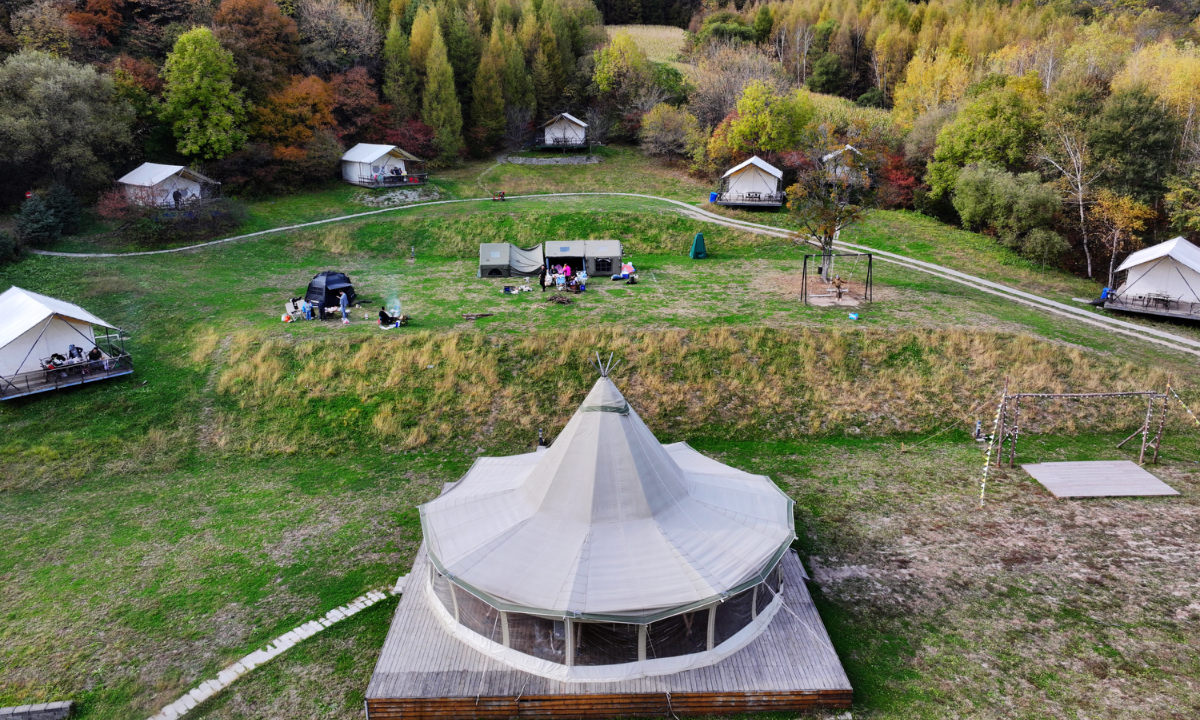
Tourists pitch tents and camp in a wooded area in Harbin, Northeast China’s Heilongjiang Province, on October 3, 2026. Photo: VCG
As the National Day holidays fuel a wave of hiking, cycling and camping across China, the country's outdoor industry is greeting a rapid upgrade in the products it makes.
A tent can now come equipped with sofas, carpeting, a king-size bed, air conditioning, underfloor heating, a bathroom and even a kitchen. The upgrade reflects a broader transformation in China's outdoor manufacturing sector.
Once known mainly for low-cost fabric shelters and basic camping gear, Chinese outdoor manufacturers are now producing hotel-style tent houses, inflatable shelters, modular assembly units, and solar-powered canopies.
An industry representative with years of experience in outdoor activities told the Global Times that consumer preferences in China have changed markedly in recent years. While casual camping remains popular, consumer demand has increasingly shifted toward backpacking, lightweight hiking and camping gear.
And, to cater to overseas market demands, Chinese outdoor manufacturers are seizing emerging opportunities by moving beyond basic camping products and into higher-value, more specialized outing offerings.
A tent house manufactured by a company in Changzhou, East China's Jiangsu Province, illustrates the trend. Unlike a conventional camping tent, the structure is designed as a fully equipped lodging space, complete with sofas, carpeting, a king-size bed, air conditioning, underfloor heating, a bathroom and a kitchen.
According to the company, production and on-site installation can be completed in about three months. The product is built for multiple uses, including living, leisure and short-term accommodation, with a balcony outside and separate interior spaces for a living room, study, bedroom and bathroom. The company said orders are increasing rapidly, with the estimated annual growth rate set to reach 30 percent.
The trend comes as global demand for "glamping" and outdoor leisure continues to rise. In this fast-growing segment, Chinese companies are finding new opportunities by combining speed, customization and a mature industrial ecosystem. Backed by faster delivery, customized design and a maturing industrial ecosystem, these products have become one of the most visible new growth points in China's outdoor goods exports.
Growing consumer demand
Lü Xuyao, Brand & Visual Director at Zhejiang Naturehike Outdoor Products Co., Ltd, told the Global Times that the company has been actively expanding overseas, with the share of sales from overseas markets rising from 20 percent to roughly 40 percent now.
"Over the years, our lightweight hiking products, including trekking poles, tents, backpacks, and sleeping pads, have been well received in overseas markets," said Lü.
Overseas orders have continued to grow steadily, especially from North America, Europe, Japan, Australia, and Southeast Asia, and the company's current production schedules are already booked several weeks in advance, with an annual growth of around 30 percent.
For example, one of its trekking pole models has seen strong repeat orders from customers in Japan and Europe, leading to a notable increase in monthly shipments.
Founded in 2010 in East China's Zhejiang Province, Naturehike is among the companies that have ridden the rise of outdoor recreation. Its experience mirrors a larger shift in the market: Chinese companies that once focused on overseas sales are increasingly balancing their exports with domestic market push.
In Dujiangyan, Southwest China's Sichuan Province, another company has found success with a different approach by making modular tent houses.
Components such as windows and room modules are packed separately and shipped overseas for on-site assembly. The company's outdoor products have been exported to 16 countries and regions.
According to CCTV Finance, the global tent market size was estimated at between $4.4 billion and $5.62 billion in 2025 and is projected to reach $8.8 billion by 2035. China's export performance has remained strong. According to local customs data, Ningbo exported 796 million yuan worth of tents in the first eight months of 2026, up 6.3 percent year-on-year.
In Wuyi county, East China's Zhejiang Province, a company producing foldable outdoor canopies has integrated solar-powered lighting and wind-resistant reinforcement into its design.
One solar panel can illuminate an area of more than 10 square meters, reducing the need for additional camping lamps.
The company's order book has reached 500,000 units, with production scheduled into January 2027. Daily output has risen from about 3,000 units to around 4,000. Its export revenue climbed from 5 million yuan in 2015 to 160 million yuan in the first half of this year.
In Shaoxing, another company has tapped into the glamping trend by offering one-stop product sets that bundle mattresses, beach mats, carpets and other accessories. Orders are already booked through next June. Industry observers say these developments point to more than a temporary consumer craze. They reflect the broader transformation of Chinese manufacturing.
Relying on innovation
"Chinese manufacturing is increasingly characterized by efficiency and indispensability," Li Changan, a professor at the Academy of China Open Economy Studies at the University of International Business and Economics, told the Global Times. "It is moving beyond low-end, low-price competition and advancing into medium- and high-end trade."
Li said outdoor and sports equipment has become an important part of Chinese manufacturing, driven by global demand for recreation, outdoor life and sports. Chinese fi rms are responding by expanding product categories, improving quality and ramping up innovation, Li noted.
Currently, the global outdoor industry is marked by "concentration at the top" with a small number of major brands dominating the market while smaller firms compete in narrower niches, the Securities Times reported.
In China, industrial clusters in coastal Jiangsu, Zhejiang and Fujian provinces have created a highly efficient production ecosystem. Top-tier makers are expanding their advantages through integrated supply chains, a stronger green certification system, and better research and development capability, the newspaper said.
For example, Ningbo-based Naturehike holds more than 200 patents across various categories. Since 2022, the company has invested 15 million yuan annually in R&D, with a focus on product design and the development of new materials.
To address the uncertainty caused by global trade policies, companies are diversifying their capacity layout, expanding overseas production bases, and cultivating local supplier networks and outsourcing partners. With the market moving beyond one-size-fits-all products, companies are being pushed to better understand the real needs of consumers in different environments.
To meet increasingly diversified and personalised demand, Chinese companies are accelerating innovation, expanding product offerings, and improving quality, which, according to Li, is a manifestation of the prowess of China's manufacturing sector.
RELATED ARTICLES