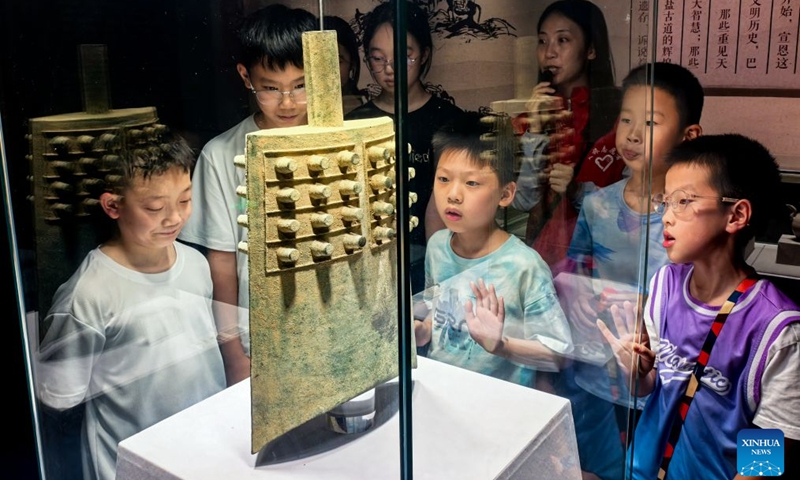
Students visit the Xuan'en County Museum in Xuan'en, central China's Hubei Province, Aug. 15, 2026. Museums in Hubei Province have seen a surging number of children and teenagers on study tours during the summer vacation. With guided tours, hands-on experiences, and intangible cultural heritage classes, these museums are offering more than just exhibitions to enrich the summer life of children and students. (Photo: Xinhua)
A number of Chinese cities including Shenzhen in South China's Guangdong Province and Chengdu in Southwest China's Sichuan Province have announced autumn breaks for secondary and primary school students, which experts said is needed to bridge the holiday gap between the National Day and the New Year's Day, and to inspire travel and inject new momentum into tourism spending.
Shenzhen unveiled its citywide autumn and spring break schedules for primary and secondary schools on Friday. The autumn break falls on November 17-20, and the spring break on April 1-2, 2027, according to China Media Group.
Ningbo in East China's Zhejiang Province has set its autumn break for November 25-27. The three-day holiday, combined with the following weekend, creates a five-day-long break.
Cities in Sichuan Province also announced their arrangements, with Chengdu setting a three-day autumn break that schools may schedule on the last three days of the second week of November.
Zigong city has set its autumn break from November 16 to November 18, which, if joined with the weekend, forms a five-day-long holiday. Panzhihua's autumn break will run from November 18 to 20, again linking up with the weekend for an extended break.
And, Southwest China's Guizhou Province and cities across Central China's Hunan Province have also announced similar arrangements, with most breaks concentrated in mid-November.
"The autumn break fills the holiday vacuum between the National Day and the New Year's Day, creating fresh momentum for extended travel," Bian Yongzu, executive deputy editor-in-chief of Modernization of Management magazine, told the Global Times on Sunday.
Bian noted that with students making up a sizable group and families traveling alongside them, the number of holidaymakers quickly adds up — bringing new energy to the tourism market.
"Spring is the season for sowing and autumn for harvesting, and these two breaks offer children rich hands-on opportunities. This has given rise to a niche tourism market featuring farm experiences, crop harvest and agricultural education. Closely tied to daily life and learning, such offerings have broad prospects for growth," Bian said.
Meanwhile, for families unable to travel far, three-to-five-day getaways within city clusters will become the norm, with theme parks, rural homestays and distinctive campsites all poised for rapid growth, Bian noted.
Yang Yiyong, a senior consultant at the Academy of Macroeconomic Research, told China Business Journal that, in one to two years, the spring and autumn breaks could add 0.4 to 0.6 percentage points to total retail sales of consumer goods, with that figure potentially rising to 1 to 1.66 percent over three to five years.
Early signs suggest the policy is off to a smooth start. Zhejiang, which became the first province to roll out spring and autumn breaks across all its cities in 2025, expanded after-school care program during the break, keeping school facilities open for students whose parents could not take time off.
Sichuan followed a similar path, with cities coordinating museum visits and sports events specifically for the holiday period.
During the 2025 autumn break, passenger trips on Zhejiang's railways increased 22.1 percent year-on-year, while ticket bookings within Sichuan surged 3.4-fold — a clear sign of strong tourism spending.
While childcare services and study camps can ease some parents' anxiety over supervision, closing the "time gap" between parents' leave and children's school breaks remains the key to making spring and autumn breaks truly work, China Media Group said.
The 2026 Government Work Report said that spring and autumn breaks will be introduced for primary and secondary school students in localities where conditions permit, and the system of extended paid leave will be set up.
Since this year, Yunnan, Zhejiang, Hainan, Tianjin and other regions have rolled out measures to push for the implementation of paid leaves. For example, Nanjing in Jiangsu has made it clear that employees' paid leave requests during their children's spring and autumn breaks should be "approved on a priority basis."
"When parents' leave can be aligned with children's spring and autumn breaks, family travel is made easier," Bian said, noting that tourism consumption will no longer be a pulsed pattern — concentrated in a few peak periods followed by prolonged lulls — and instead becomes a rhythmic demand, dispersed across multiple periods throughout the year.
RELATED ARTICLES